In 1982, the Blade Runner score gave cinema a synthetic color no one had heard before. Behind those neon-and-rain pads sits a single instrument that keeps coming back: Vangelis’s Yamaha CS-80, a 1977 analog beast he plays like a living instrument rather than a machine.
A 1977 analog beast
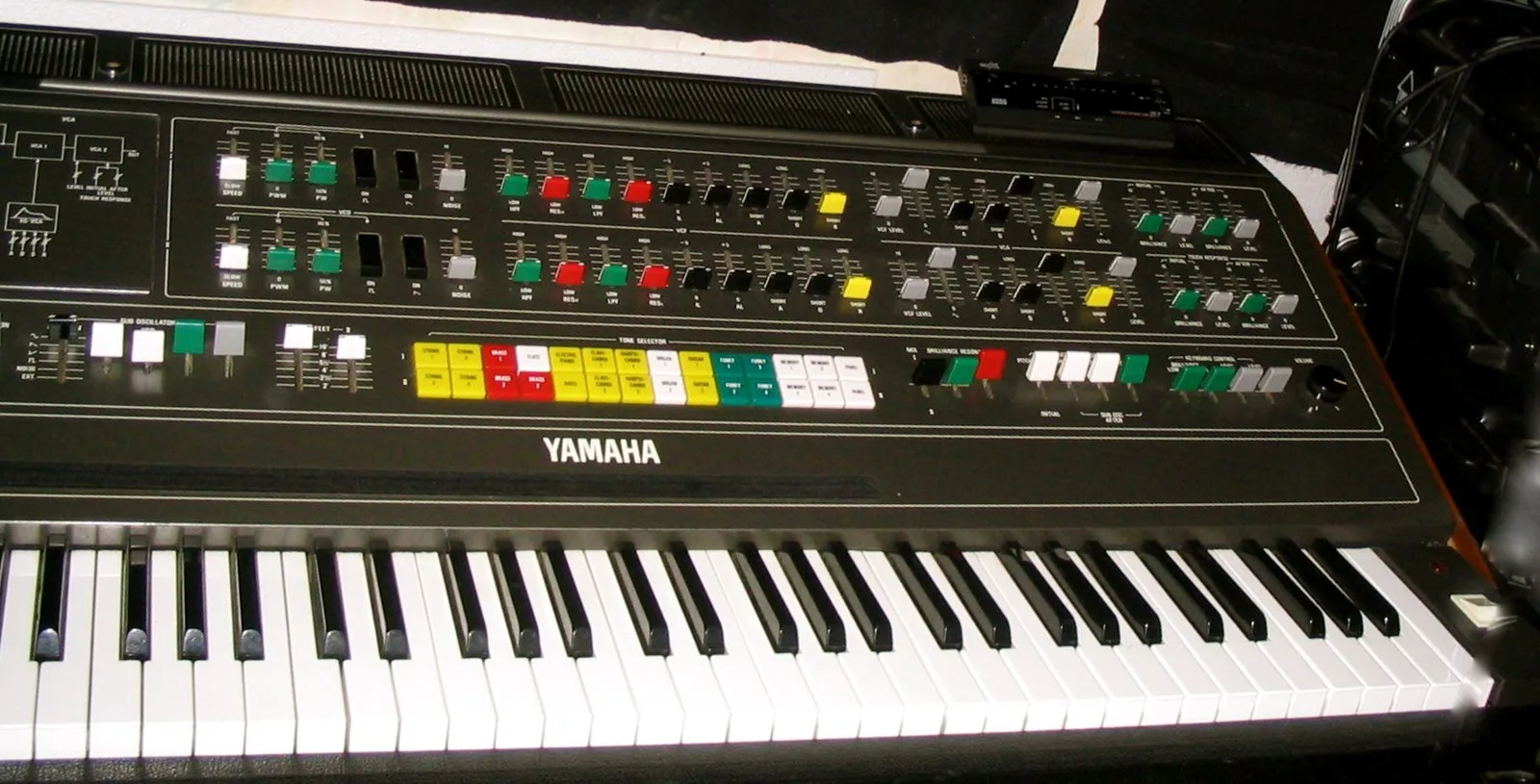
The CS-80 arrives in 1977, at a time when analog polyphony is still a rare luxury. Yamaha answers with eight fully analog voices, each built from two independent sound layers, the famous channels I and II, which you can detune and stack to thicken the timbre. The 61-key keyboard is weighted, close to a piano feel, and the whole thing weighs nearly 100 kilos once it sits on its stand. At launch it costs around $6,900, enough to reserve the machine for studios and the few artists able to haul it around.
The front panel mixes two worlds. Up top, a row of hardwired presets gives instant access to ready-made tones: strings, brass, basses. Below, a bank of sliders opens up fine programming, with a resonant filter, brilliance, sustain, a ring modulator and a sub-oscillator. User memory is limited to a few settings tucked under a flap, tiny trimmers you adjust by hand. The CS-80 is not a machine for recalling sounds, it is a machine for building them and playing them on the spot.
Under the hood, the architecture explains the weight and the price. Each voice gathers two complete synthesis lines, every one with its own oscillator, high-pass filter, low-pass filter and envelope. Multiply that by eight voices and two channels and you get a machine of sixteen hand-wired analog chains, famously fussy to service, with a thermal drift that means letting the instrument warm up before a session. That complexity is not wasted: it gives the CS-80 a thickness and a slight pitch instability that feed its signature, far from the clinical cleanliness of the digital synths that follow.
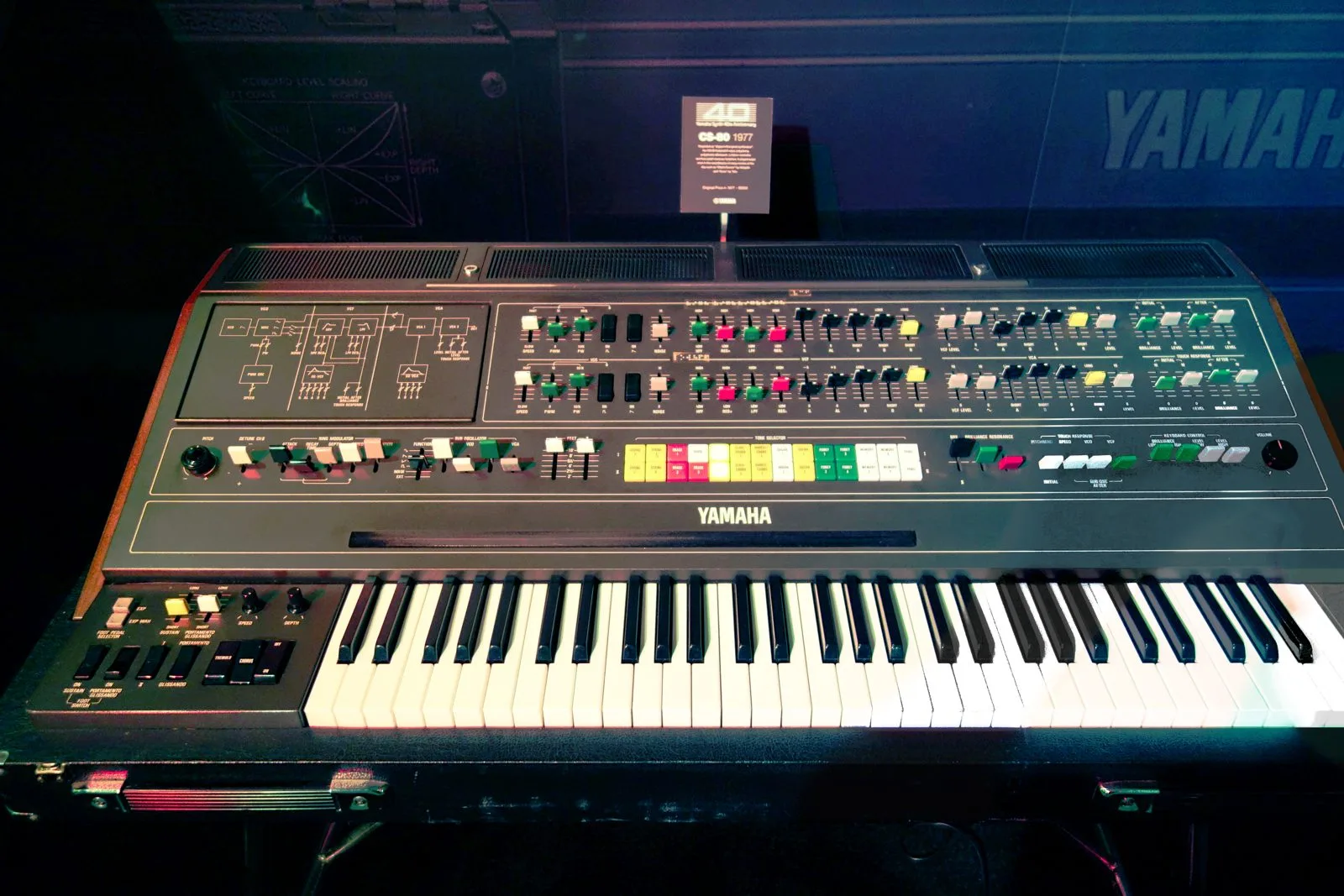
Expression above all
The CS-80’s singularity lives in two playing details. First, polyphonic aftertouch: every key responds to pressure, note by note, not globally like most synths. Press harder on one finger and that sound swells in intensity or opens up in timbre, while the others stay put. Second, the ribbon, a touch strip for continuous glissandos and those big pitch dives that became a signature. Between the two, the player holds an instrument that moves under the fingers.
Vangelis works this material like no one else. In his Nemo studio in London, he plays in real time, surrounded by linked keyboards, composing by performing rather than by programming sequences. The CS-80 sits at the center because it translates the gesture: a press, a bend of the ribbon, and the pad breathes. The approach owes a lot to classic analog synthesis, whose basics we laid out in our guide to subtractive synthesis.
Blade Runner, a city that breathes
When Ridley Scott hands the Blade Runner music to Vangelis in 1982, the CS-80 becomes the heart of the film. The Main Titles, the Blade Runner Blues, the theme under the rain in the closing scene: everywhere, its pads draw the hazy Los Angeles of 2019. The synth does not play showy melodies, it holds slow chords that swell and fall, and that inhabited slowness is what locks onto the image. The sound fits the film so well that it remains, even today, the reference for the melancholy machine-city.
The power of it lies in the match between machine and image. The CS-80’s glassy synthetic strings evoke the rainy city without ever sounding like a real orchestra, and the thick brass underline the turning points without grandstanding. Vangelis often lets a single sustained note run for long seconds, then shapes it with finger pressure, so the music seems to react to the picture rather than follow it. That breathing, impossible to get from a plain held sample, is what composers still try to recreate when they want this exact mood.
A tasty detail for collectors: Vangelis’s actual soundtrack was only released officially in 1994, twelve years after the theatrical run. In the meantime only a third-party re-orchestrated version circulated, and fans swapped bootlegs of the original music. Scarcity fed the myth as much as the music itself.
Beyond the film
The CS-80 is not limited to Blade Runner. A year earlier, Vangelis’s music for Chariots of Fire had won him the Oscar, and his favorite instrument runs through much of his work, from the album China in 1979 to 1492: Conquest of Paradise. Others grab it too: Toto, Keith Emerson, Stevie Wonder and Paul McCartney all pass through this keyboard, each for its very particular color. Little by little the machine turns cult, surviving units grow scarce, and used prices climb, pushed along by a reputation for tricky maintenance.
A synth’s long afterlife
Demand never faded, to the point that the CS-80 lives again in several forms. Arturia has offered a software emulation for years, while Black Corporation launched the Deckard’s Dream, a hardware clone whose name quotes Blade Runner’s hero directly. Designer Love Hultén drew a high-end version from it, which we covered as the Deckard’s Dream X2, and Behringer is working on a pocket tribute of its own, the CS Mini, for a few dozen euros. When Denis Villeneuve shot Blade Runner 2049 in 2017, Hans Zimmer and Benjamin Wallfisch reached for that same color to extend the first film’s sound world. Nearly fifty years after it was born, the big Yamaha still sets the idea we have of the future in music.