Some boxes an engineer reaches for without thinking. The Teletronix LA-2A is one of them. Its compression is not something you notice, it is something you feel: levels settle, the vocal moves forward, and nothing seems to have changed. That character comes down to one unusual part, an optical cell designed in the late 1950s, and to a story that starts far from the studio.
An engineer, a light and cell-based detection
Behind the LA-2A stands one man: Jim Lawrence, founder of Teletronix in Pasadena. His idea came from optical detection work done for the defence industry at Caltech’s Jet Propulsion Laboratory in the 1950s. Carried over to audio, the method produced a first unit, the LA-1, released in 1958. The LA-2 followed, adding a larger meter and, above all, the famous optical capsule. The LA-2A arrived in 1962: same principle, new front panel, lower noise floor. The earliest units, known as “grayface”, span 1962 to 1965.
The T4 cell, an optical heart
Everything happens inside a sealed housing, the T4 cell. Within it, an electroluminescent panel and photoresistors face each other. The tapped audio signal feeds the panel: the louder the level, the brighter it glows. The photoresistors read that light and set the gain reduction accordingly. Nothing mechanical, nothing fast or electronic, just light rising and falling.
One direct result: the T4 cell responds both to the level and to the frequency content of the signal. The compression ratio is not fixed, it shifts with the source. A bass-heavy voice and a bright one will not be treated the same way. That program dependence, impossible to dial in on a front panel, is what gives the LA-2A its distinctive touch.
A fixed attack, a two-stage release
The LA-2A offers neither an attack nor a release control, because the cell sets them. The attack is fixed, around ten milliseconds. The release comes in two stages: roughly sixty milliseconds to recover half of the reduction, then a long settling of about half a second to five seconds for the rest, depending on what the cell has seen. That two-slope curve explains the LA-2A’s smoothness and its near absence of audible pumping. To hear how far this sits from a fast transistor limiter, the FET-based 1176 and its lightning attack make the ideal counterpoint.
Two knobs, one transformer
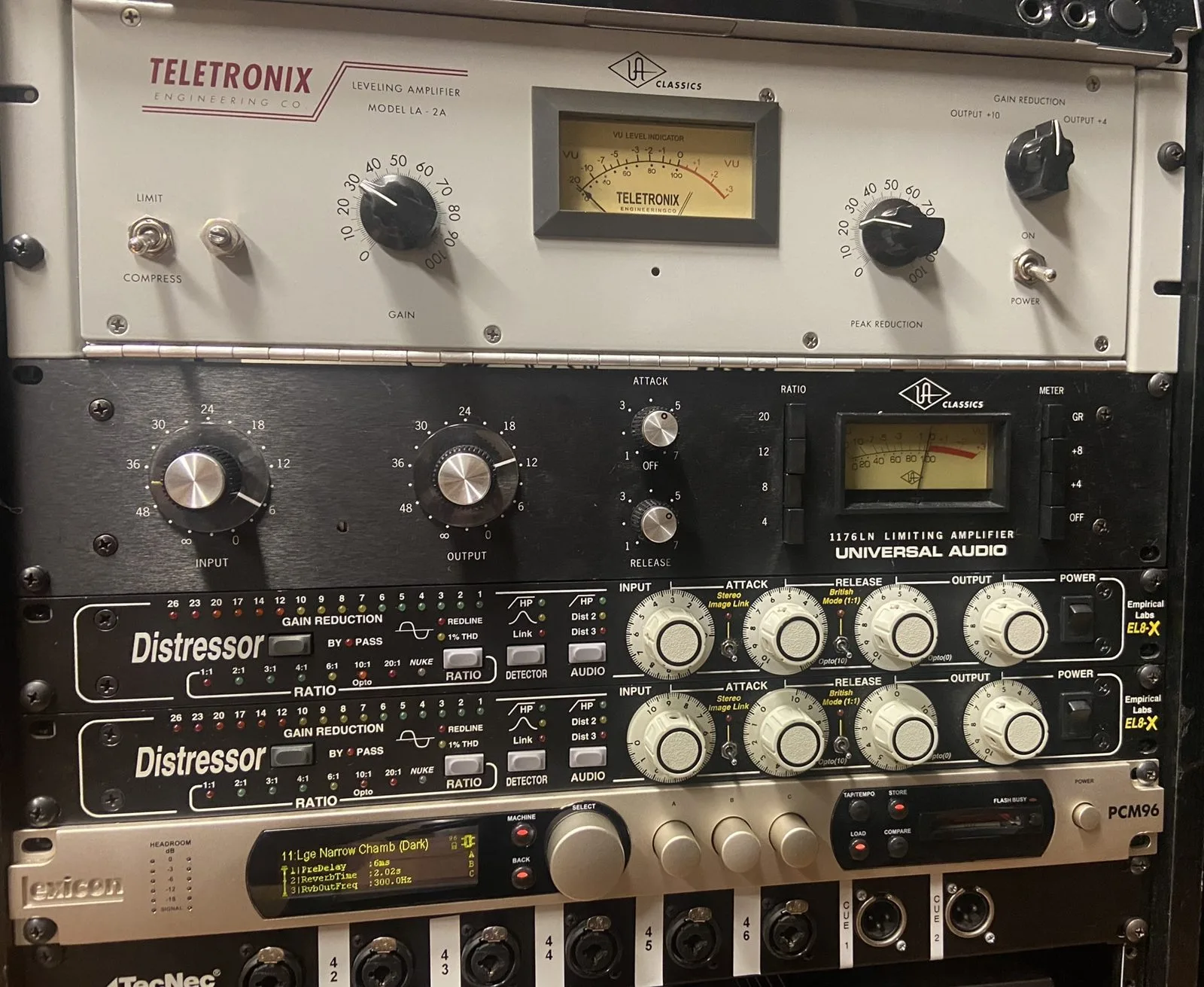
The front panel comes down to two controls. “Peak Reduction” sets the amount of compression, “Gain” makes up the output level. A “Compress / Limit” switch on the rear changes the behaviour between soft compression and firmer limiting. That is all. The tube gain stage offers up to forty decibels of gain and feeds a balanced output transformer, which adds its own colour. That simplicity forces you to listen with your ears rather than your eyes, in the spirit of the optical compressor set against the other families. The gain-setting reflexes that apply here line up with those in our guide to setting a compressor.
From Teletronix to Universal Audio
The brand changed hands over the years and production moved under the Urei name, which spread the LA-2A far and wide. The tube version ended in the late 1960s, replaced by transistor successors such as the LA-3A and then the LA-4, smaller and cheaper. The legend did not fade. Universal Audio, the company founded by Bill Putnam and revived by his sons, brought out a faithful hardware reissue whose hardest task was recreating the original T4 cell, then a software version. Sixty years on, the LA-2A remains a reference on vocals, bass and anything that needs a steady hand. It still earns a prime spot in a well-planned vocal chain.
My take
The LA-2A lasts because it refuses control. No curve to draw, no ratio to pick: you turn a knob and you listen. That constraint, which would send a rushed engineer running, is exactly what makes it musical, because it lets the cell decide at the pace of the program. On a lead vocal it stays hard to fault. Its only real downsides are its price and its slowness: to catch sharp transients, you need something else. But to seat a performance, few machines do so much with so little.