Before 1992, covering a stadium meant stacking loudspeakers in clusters and living with their interference. Sources blended badly, coverage was uneven and the sound fell apart quickly with distance. That year, physicist Christian Heil presented a theory to the Audio Engineering Society that would change everything, Wavefront Sculpture Technology. It gave rise to the V-DOSC and, through it, to the modern line array that now powers almost every major tour.
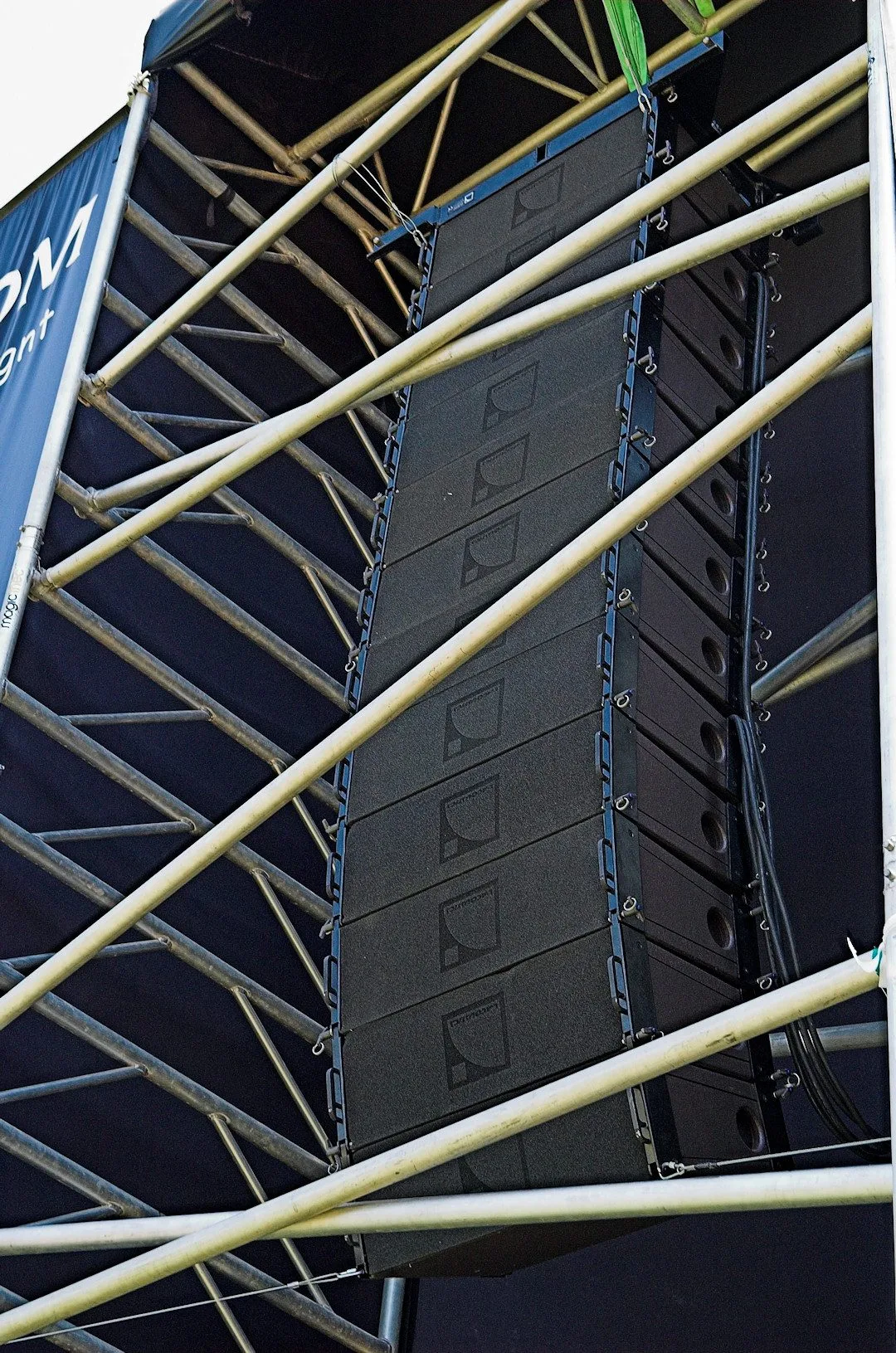
The problem with loudspeaker clusters
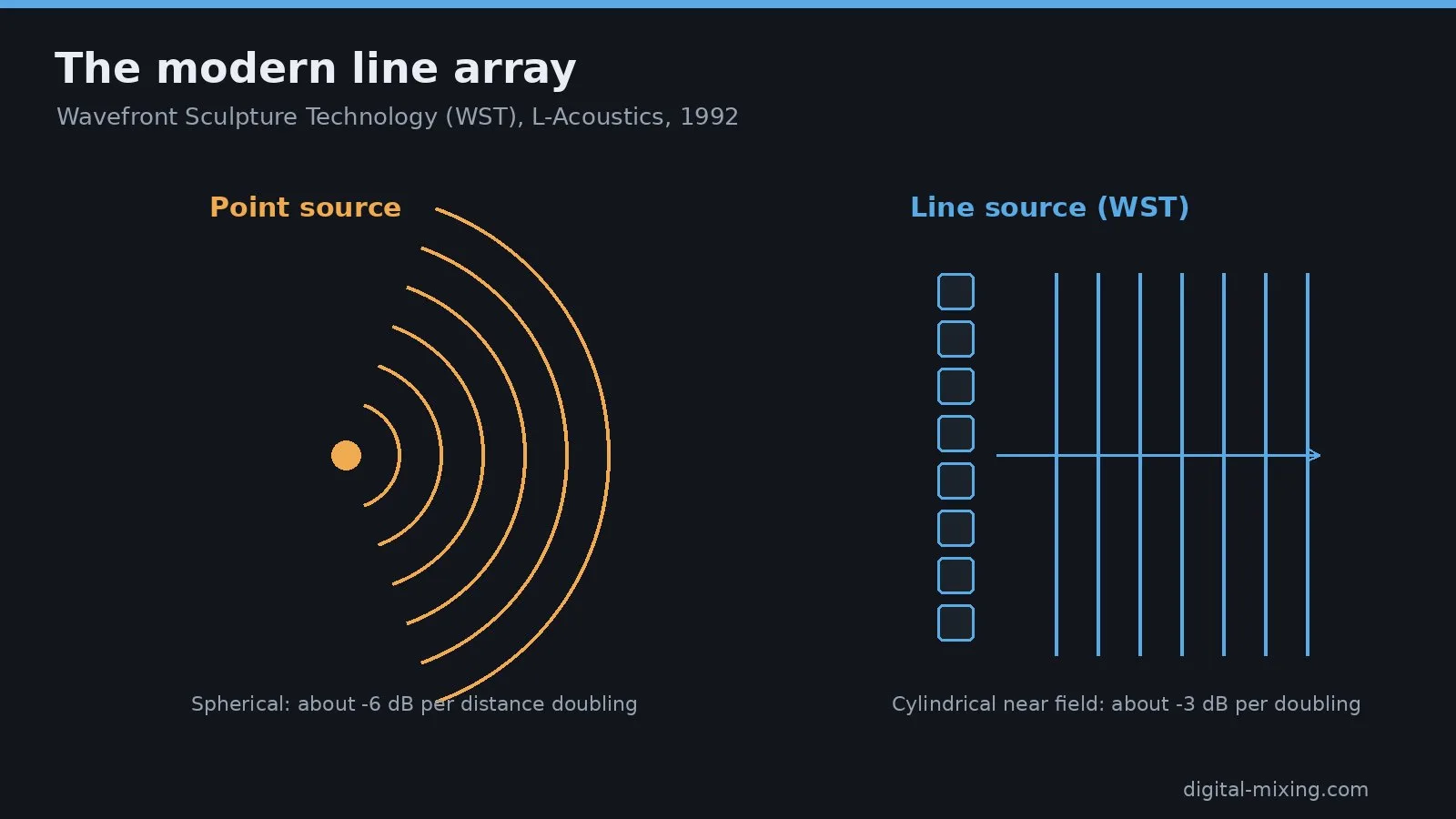
A classic loudspeaker radiates like a point source. Its energy spreads in all directions and its level drops by about 6 dB every time the distance doubles. To cover a large room, engineers multiplied the boxes, aimed in different directions. The trouble is that two sources playing the same signal interfere, with reinforcement and cancellation depending on frequency and listener position. You heard it in the front row and at the back alike, with low end that carried and highs that faded. Our comparison of point source vs line array lays out that core contrast.
WST and the five criteria
Christian Heil, a particle physicist who turned to acoustics, founded in 1984 the company that would become L-Acoustics. With physicist Marcel Urban, he formalized Wavefront Sculpture Technology and presented it at the 92nd AES Convention in Vienna, in a paper titled Sound Field Radiated by Arrayed Multiple Sound Sources. WST sets out five criteria that define the conditions under which a column of sources can behave as a single, coherent line source rather than a stack of point sources fighting each other.
The idea fits in one sentence. If you respect certain rules of size, spacing and curvature between elements, the emitted waves recombine into a near-continuous wavefront. An ideal line source then radiates cylindrically in the near field, with a level drop cut to about 3 dB per distance doubling, half that of a point source. The sound carries farther and stays even across the depth of the audience.
The DOSC waveguide, the missing piece
The theory required a component able to turn a high-frequency driver’s output into a flat, coherent wavefront over the full height of the enclosure. That is the job of the DOSC waveguide, patented by L-Acoustics and described as the first device able to produce a flat, constant-phase output at the top of the spectrum. Without it, the highs would again behave like point sources, wrecking the coherence. With it, the V-DOSC became in 1992 the first system to apply WST at scale, often described as the first modern line array.
A legacy that still holds
The principle spread far beyond L-Acoustics. Every pro loudspeaker brand now designs line arrays, with their own waveguides and prediction software, like ArrayCalc auralization that lets you hear a design before you hang it. The crafts followed, from flying arrays safely to system tuning, by way of mastering directivity. The quest for long, even coverage is nothing new, as the famous Grateful Dead Wall of Sound of the 1970s reminds us, but it was WST that finally gave it a workable theory.
What the five criteria mean
The WST criteria are about the geometry of the column. They set, in essence, conditions on the size of the sources relative to wavelength, on how the wavefront is filled between two boxes, and on the angle between neighbouring elements. Met properly, they ensure the column behaves in the near field like a continuous line source, without gaps or stray lobes at the top of the spectrum. That is why a line array curves gradually toward the bottom of the hang, to match the geometry of the audience while keeping the highs coherent.
This logic gave rise to the curved array, often called a J-array, where the top boxes, nearly vertical, throw far to the back of the room, while the bottom ones, angled more steeply, cover the front rows. The whole industry adopted the principle, then scaled it from the big stadium V-DOSC down to the compact systems of clubs and fixed installs. Today’s prediction software simply applies these rules to the precise geometry of a given room, angle by angle, before a single box is hung.
My take
We often forget that an engineering breakthrough can hinge on a single well-designed part. WST without the DOSC waveguide would have stayed a neat equation. The value of this story is the reminder that the line array is not marketing fashion but a physical answer to a real coverage problem. The L-Acoustics sound is still called aggressive by some ears and setups, and that is a fair debate. But the 1992 shift redefined how large audiences are covered, and thirty years on, nobody has gone back.