A loudspeaker does not radiate sound equally in every direction. Understanding its directivity — the angle over which it truly covers the audience — changes everything: evenness, intelligibility and gain before feedback. Here is how to read a dispersion spec and use it in the field.
Directivity, dispersion, coverage angle: what are we talking about?
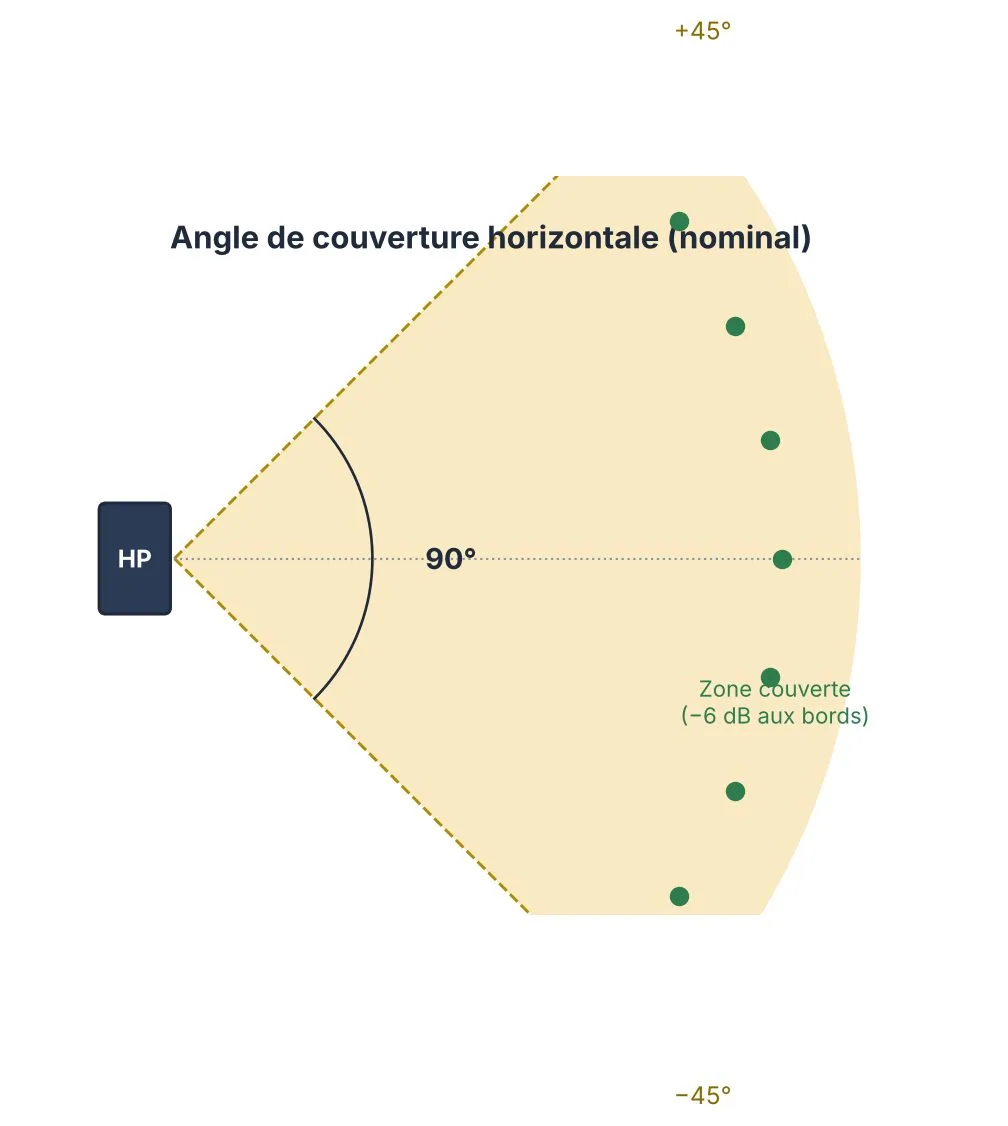
Directivity describes how a loudspeaker concentrates or spreads its energy in space. It is summed up by a coverage angle, given horizontally and vertically — say 90° x 40°. By convention that angle marks the points where the level has dropped 6 dB from the on-axis value: beyond it, sound is still there but fades fast. Reading that angle tells you in advance which part of the room a box will actually serve.
The stakes are very practical. Aiming energy at the audience rather than at walls and ceiling means more clarity, fewer stray reflections and precious decibels of margin before feedback. A poorly chosen dispersion, by contrast, sprays the surfaces, blurs intelligibility and brings feedback closer.
Why directivity depends on frequency
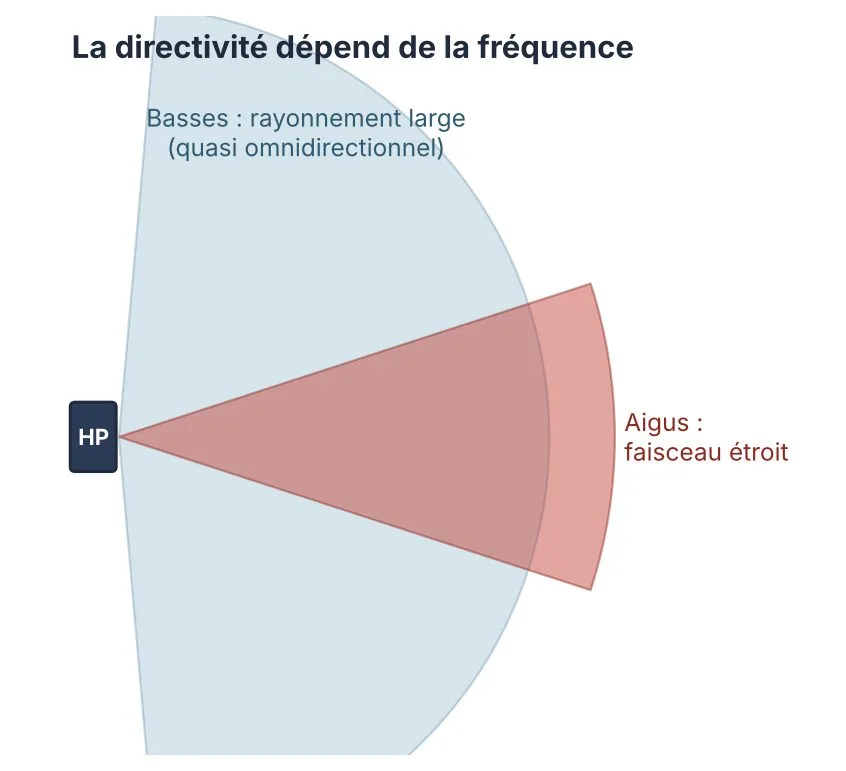
The same driver is not directional in the same way across the spectrum. In the bass, wavelengths are large compared with the source: sound wraps around the cabinet and radiates in almost every direction. In the treble, wavelengths shrink and energy focuses into a narrow beam. That is why you hear the low end of a concert well beyond the target zone, while the highs drop off as soon as you step off-axis.
How manufacturers control it
The whole craft of a PA loudspeaker is to keep that directivity as even as possible across the spectrum. Constant-directivity horns and waveguides exist precisely to hold a stable angle in the top end. Driver size and the way boxes are assembled do the rest:
- a point-source system sets its coverage through horn geometry;
- a line array controls mostly the vertical through the summation of its elements, which gives it throw — hence the importance of splaying the boxes correctly;
- in the bass, where a single cabinet is nearly omnidirectional, you rebuild directivity with arrays, using cardioid subwoofers.
Choosing the right dispersion for the room
In practice, the horizontal angle is chosen from the width of the audience to cover, the vertical angle from its depth. A wide, shallow room calls for generous horizontal dispersion; a narrow, deep venue wants a tighter beam that throws far without waking the side walls. When several boxes share a zone, you overlap their -6 dB edges: the two contributions then add up to a consistent level at the seam.
A few traps come up again and again:
- going too wide “to be safe”: you mostly gain reflections and feedback;
- forgetting the vertical: you cover the front row and lose the back, or the reverse;
- neglecting overlap between boxes, which leaves holes or hot spots;
- pointing boxes at hard surfaces instead of at people.
Measure and verify
The manufacturer’s charts are the starting point, but nothing replaces checking on site. A measurement-mic sweep confirms the audience is in the beam and that levels join cleanly from one zone to the next. Directivity then becomes the foundation of all your system tuning: there is no point EQ-ing a zone the box never properly lights up.
My take
Directivity is the free setting too many systems leave on the table. Picking the right coverage angle before you even touch the EQ buys intelligibility and headroom without pushing anything. The good news: makers now document their dispersion charts precisely, and a quick measurement-mic sweep tells you at once whether the audience is in the beam. Aim at people, not walls — and the rest of the tuning gets far simpler.