In live sound we spend forever aiming the highs and mids — array angles, coverage, alignment — then drop the subs on the deck and hope for the best. But bass does not just travel toward the audience: it also fires back at the stage, where it drowns the monitors, blurs the mics and wears the musicians down. The cardioid subwoofer answers exactly that problem. The principle is decades old and utterly routine on the road, yet plenty of rigs still run omnidirectional subs that spray the deck for nothing.
Why bass goes everywhere
At low frequencies the wavelength is large — several metres. A single subwoofer is therefore, in practice, an omnidirectional source: it radiates as much behind as in front. At the downstage edge, half that energy heads straight for the musicians and the mics. The result: monitors that “pump” in the low end, a snare captured with a halo of sub, a needlessly high stage level, and often a back wall that echoes the whole thing back at you.
The cardioid array aims at one thing: sharply reducing the sub’s rearward radiation while losing little or nothing toward the front. The name comes from the heart-shaped polar pattern it produces, pointed at the audience. You get there by making the waves cancel behind the source, through a play of polarity and delay between several boxes.
The principle: add in front, cancel behind
Two sources emitting the same signal add up where they arrive in phase and cancel where they arrive out of phase. The whole cardioid technique is about staging that meeting: in phase toward the audience, out of phase toward the stage. You achieve it by offsetting the boxes in space and in time, and sometimes by inverting the polarity of one of them. Depending on how you combine those two levers — position and delay — you land on three classic layouts.
The reversed-box cardioid
The most compact. In a stack of three boxes, you turn one to face the rear, invert its polarity and apply a small delay. Its output cancels the energy that was leaking behind the stack, while the front stays reinforced. This is the famous “three forward, one reversed,” ideal when floor space is tight. The trade-off: the reversed box adds no forward power, so you “pay” a little SPL to buy the directivity.
End-fire
You line the boxes up one behind another, facing the audience, spaced roughly one to one-and-a-bit metres apart, and progressively delay the front boxes so everything arrives in phase to the front and out of phase to the rear. It is an acoustic relay race: each box’s rear wave is “caught” and cancelled by the next. End-fire delivers superb rear rejection and holds the front level well, but it demands floor depth — two to four boxes in a row — which is not always possible in front of a stage.
Gradient (broadside)
A two-row variant, one in front of the other, with polarity inversion and delay on the rear row. The gradient gives clean rejection in a specific band and suits wide configurations. As always, effectiveness depends on frequency: these layouts work best across a given slice of the low end, not uniformly everywhere.
The settings that matter
Three parameters make all the difference, and a mistake on any one of them ruins the result:
- Polarity: the rear box (reversed cardioid, gradient) must be out of phase. Forget it and you reinforce the rear instead of cancelling it.
- Delay: it is calculated from the spacing between boxes and the speed of sound (about 343 m/s). A few well-placed milliseconds tip the balance between addition and cancellation.
- Spacing: tied to the target wavelength. Too tight or too wide and the cancellation window drifts out of the useful band.
The good news: most manufacturers ship cardioid and end-fire presets in their processors, with polarity and delays already set for a given spacing. The real work left is verifying by measurement, with a mic and a dual-FFT, exactly in the spirit of system tuning: you check the actual rear rejection and, above all, align the subs with the main PA so lows and mids meet cleanly at the crossover.
What it changes in the field
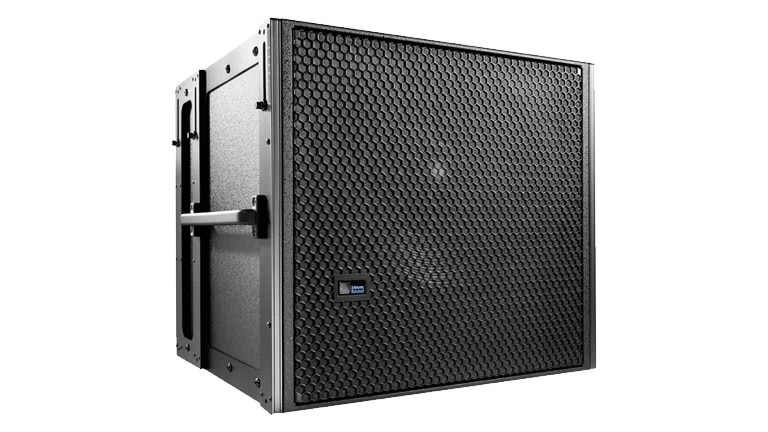
A clean cardioid array transforms a stage. Low-end level on deck drops sharply — often fifteen to twenty decibels less to the rear in the useful band — which relieves monitors and in-ears, restores definition to the stage mics and calms the musicians. Out front, the mix gains clarity because the sub no longer “returns” from upstage. And for neighbours and level compliance alike, aiming the energy rather than scattering it always pays. A capable box like the Yorkville EL24S will give even more, arranged as a cardioid, than sitting alone on the floor.
The pitfalls to avoid
The first is forgetting these layouts are frequency-dependent: they do not make the stage “bass-free,” they attenuate a band. The second is neglecting alignment with the rest of the system: a perfect cardioid that is out of sync with the main PA — a compact line array, say — will leave a dip or a bump at the crossover. The third, more mundane, is lack of space: without floor depth, end-fire is off the table and you fall back on the reversed cardioid. Finally, beware of reflective surfaces right behind the stack: a nearby wall can bounce back part of what you just cancelled.
My take
Cardioid is one of the rare setups where you win on every front: less bass on stage, a cleaner mix out front, happier musicians. The principle is elementary physics, not magic, and manufacturer presets have put it within reach of any serious rental company. What remains is the one thing you cannot delegate: measure and align on site. If you still line your subs up omnidirectionally out of habit, try a reversed cardioid at the next show — the first time the stage clears of bass, you never go back.