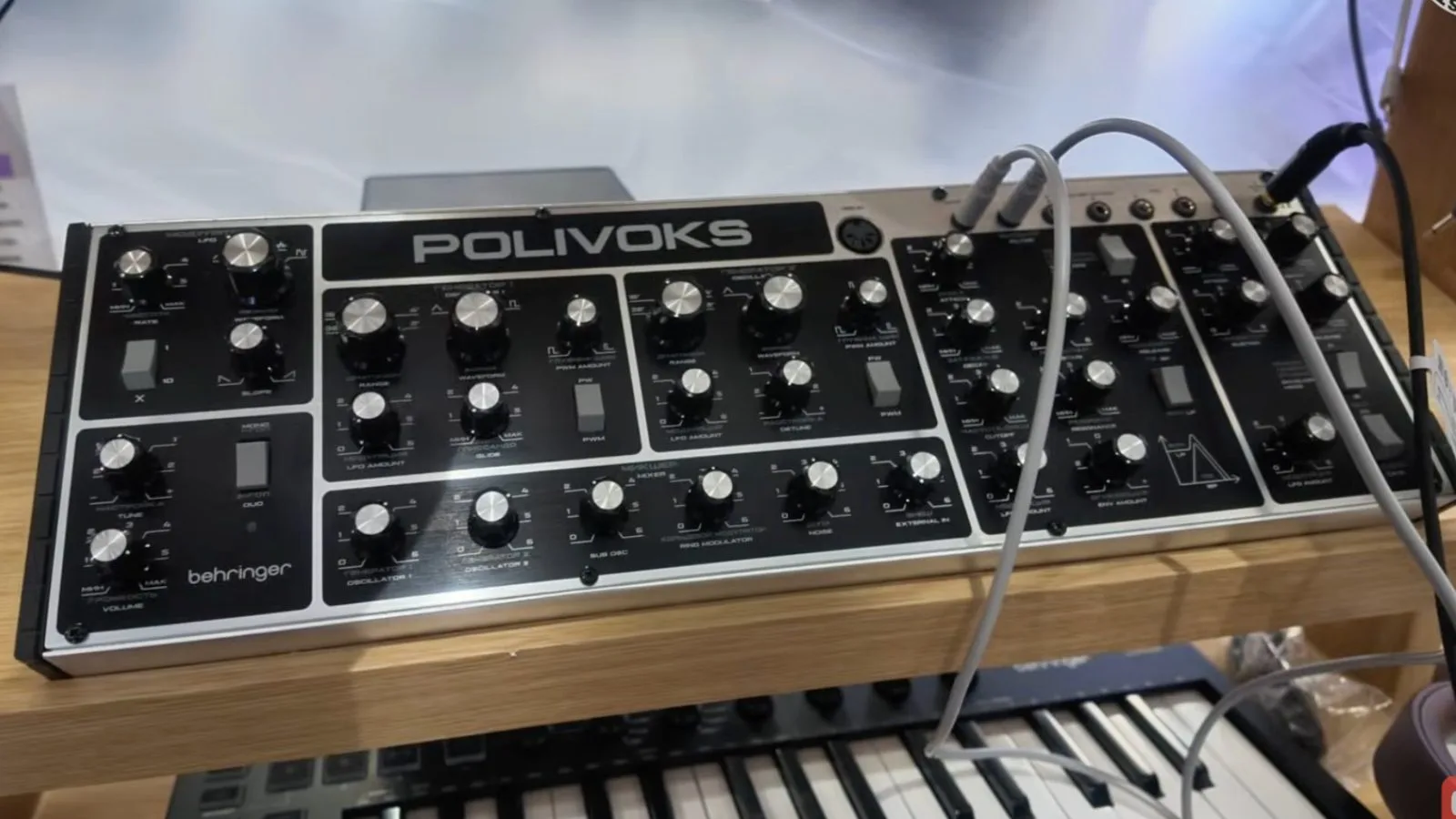
It’s one of the most eagerly awaited entries in the Behringer catalogue: the Polivoks. Ahead of the Music China show, the brand showed what very much looks like a finished version of this clone of the legendary Soviet synthesizer. After development spread over several years, carried out in collaboration with Vladimir Kuzmin, the designer of the original, the project seems ready at last to leave the prototype stage.
A Soviet myth finally cloned
The original Polivoks, built by the Formanta firm from the early 1980s, is a legend of Eastern synthesis. Rugged and a touch brutal, it owes its reputation to a sonic character that never chased smoothness. Vladimir Kuzmin designed it with the means and components of the time, which gave it an unmistakable signature. Behringer announced at the start of the decade its intention to offer a faithful reissue, hand in hand with Kuzmin — a mark of respect for the heritage, the designer having sadly since passed away. Seeing the machine completed closes a long chapter.
What the Behringer Polivoks offers
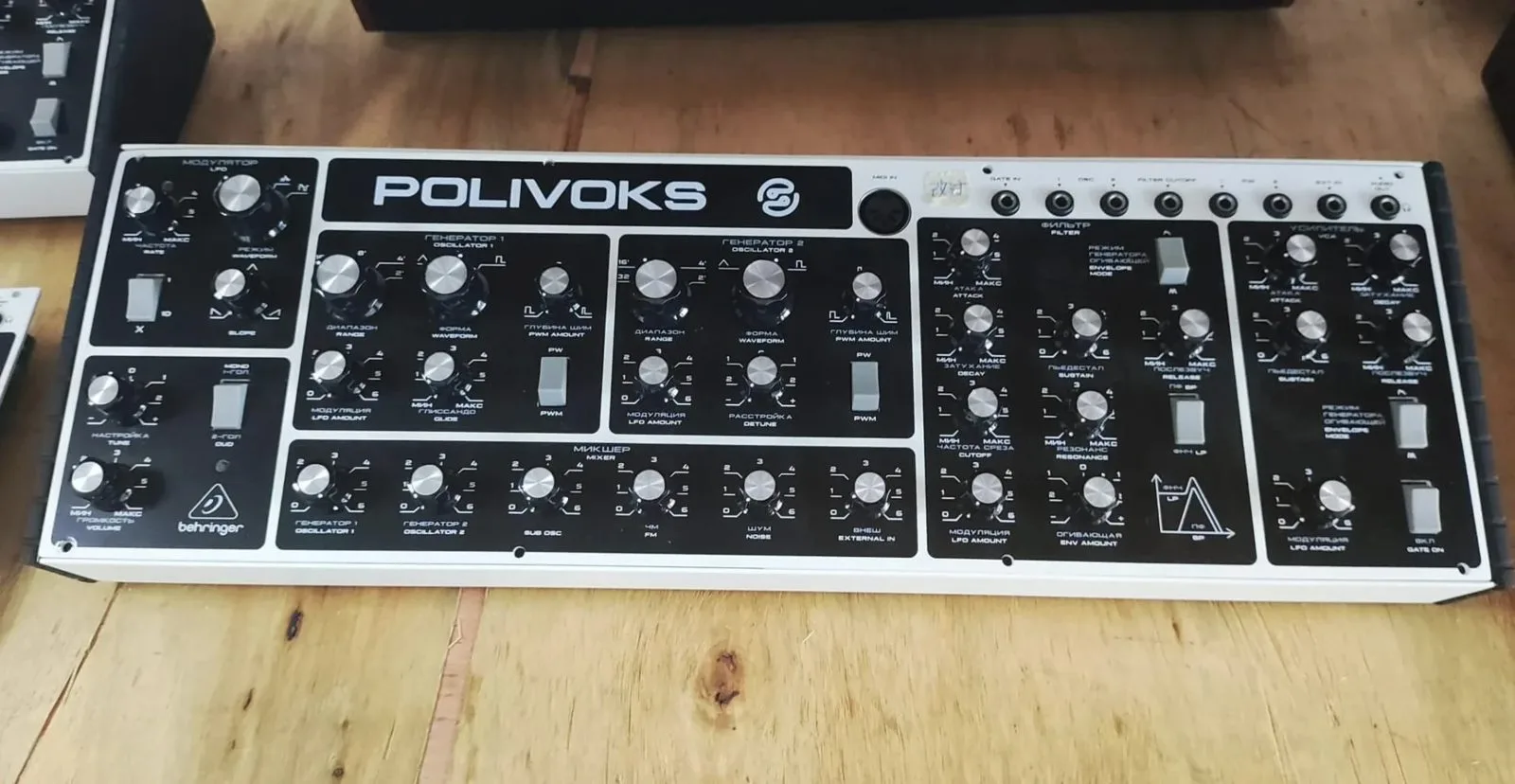
Under the hood, Behringer takes the architecture of an analogue mono synth built on subtractive synthesis, with a generous spec. There are two multi-waveform oscillators, each with a detune control and modulable pulse width (PWM), joined by a sub-oscillator and frequency modulation. A noise generator and an external input with level control round out the sound sources — enough to process an outside signal through the machine.
On the modulation side, two ADSR envelopes are on board: one dedicated to the filter, the other to modulation, each offering two operating modes, a hold function and the option of modulation from the low-frequency oscillator. The LFO itself is multi-waveform, with rate, waveform and slope controls. Finally, a switch moves from monophonic to duophonic play, true to the spirit of the original.
The filter, the crux of it all
You can’t talk about the Polivoks without its filter. It’s what built the instrument’s reputation: a multimode filter offering low-pass and band-pass modes, capable of a biting resonance and a characteristic distortion when pushed. Where many filters chase roundness, this one embraces an aggression that made it a favourite for lovers of gritty textures, acid basses and cutting leads. Behringer’s fidelity on this exact point will be the real test: it’s on the reproduction of that grain that the reissue will be judged. For anyone wanting to grasp what’s at stake here, our explainer on synth filters lays the groundwork.
Format, connectivity and integration
The Polivoks adopts the Eurorack format in a slanted enclosure, the familiar “boat” Behringer has already used for several of its semi-modulars such as the Neutron or the Model 15. You can sit it on a desk just as easily as slot it into a modular case, since it can join a Eurorack system. The announced connectivity pairs a front-panel MIDI In with CV/Gate ins and outs, opening the door to control from a sequencer, a keyboard or the rest of a modular rig.
This fits the brand’s now well-honed strategy of churning out reissues of classics at knockdown prices. Recent weeks have seen the Polyeight, an eight-voice clone of the Korg Polysix, and the JN-80 inspired by the Juno-60. The Polivoks enriches that collection by tackling a monument from the East, less often copied than its Japanese counterparts.
Price, availability and what to expect
For now, Behringer has given neither a price nor an availability date: the machine has been shown, not yet put on sale. The brand’s track record calls for patience, the gap between reveal and release having often been long on its most ambitious projects. Still, seeing the Polivoks in a finished form, after years of waiting, is a strong signal. From here we’ll be watching the price — the crux of this segment — and above all the first listens, the only thing able to say whether that legendary grain is present and correct.
My take
The Polivoks is exactly the kind of clone that makes sense: a rare instrument, pricey on the used market, with a character so distinctive that no software emulation has truly replaced it. If Behringer nails that snarling filter for a handful of euros, this is a small bombshell for anyone who loves sounds that bite. Caution still applies until we’ve heard it and until the price lands, but the intent — running the project with the original’s designer — commands respect. Fingers crossed the production version doesn’t smooth away what made the machine special: its polite refusal to behave.