Play a three-note chord on a MIDI keyboard, then try to bend just one of those notes into vibrato without touching the other two. You can’t: traditional MIDI applies the pitch wheel, aftertouch and controllers to all the notes on a channel at once. MPE was created precisely to lift that limit and give every note its own expressive independence.
The problem MPE solves
The MIDI of 1983 is brilliantly simple, but it thinks in channels, not notes. Pitch bend, pressure (channel aftertouch) and most continuous controllers act globally on the MIDI channel. The upshot: a polyphonic instrument receives several notes, but it can’t make them live separately. That constraint stays invisible as long as you play piano-style, but it’s frustrating the moment you chase the expressiveness of an acoustic instrument, where each string or breath evolves on its own.
What is MPE?
MPE stands for MIDI Polyphonic Expression. It’s a convention for using MIDI — since formalised in the specification — that gives each note its own control path. The trick is simple and elegant: instead of stacking every note on a single channel, MPE spreads each note across a separate MIDI channel. Every note then has its own pitch bend, its own pressure and its own timbre controller, without disturbing its neighbours.
Technically MPE doesn’t create a new protocol: it reorganises existing MIDI so that a per-note gesture becomes possible. That’s what lets a suitable keyboard capture each finger’s movement and pass it to a compatible synth, which interprets it voice by voice.
The three dimensions of expression
MPE formalises three continuous gestures, usually described by their established names:
- Glide (horizontal): sliding a finger left or right varies the pitch of that note only, via per-note pitch bend. It’s vibrato or portamento on a single key inside a chord.
- Slide (vertical): moving a finger forward or back drives a timbre controller (CC 74 in MIDI), generally mapped to the filter or brightness. Each note can open or close on its own.
- Pressure: pressing harder or softer after the attack sends a pressure value unique to that note. Where classic aftertouch acts on the whole chord, MPE makes it individual.
Add per-note attack velocity and release velocity, and you get a level of nuance that brings the synth closer to the playing of an acoustic musician.
How it works under the hood
MPE defines a “zone” grouping several MIDI channels. One channel, the master, carries messages common to the whole zone; the others, the member channels, each host one active note. Play a five-note chord and the instrument distributes those five notes across five member channels, each carrying its own expression gestures. Maximum polyphony therefore depends on the number of allocated channels — up to fifteen simultaneous notes on a full zone.
This mechanism explains two things. First, you need a genuinely MPE-capable receiving instrument, or the per-note gestures collapse into global commands. Second, MPE is still MIDI: it records, edits and plays back in a compatible sequencer exactly like a classic performance, provided the software handles per-channel distribution.
MPE instruments and controllers
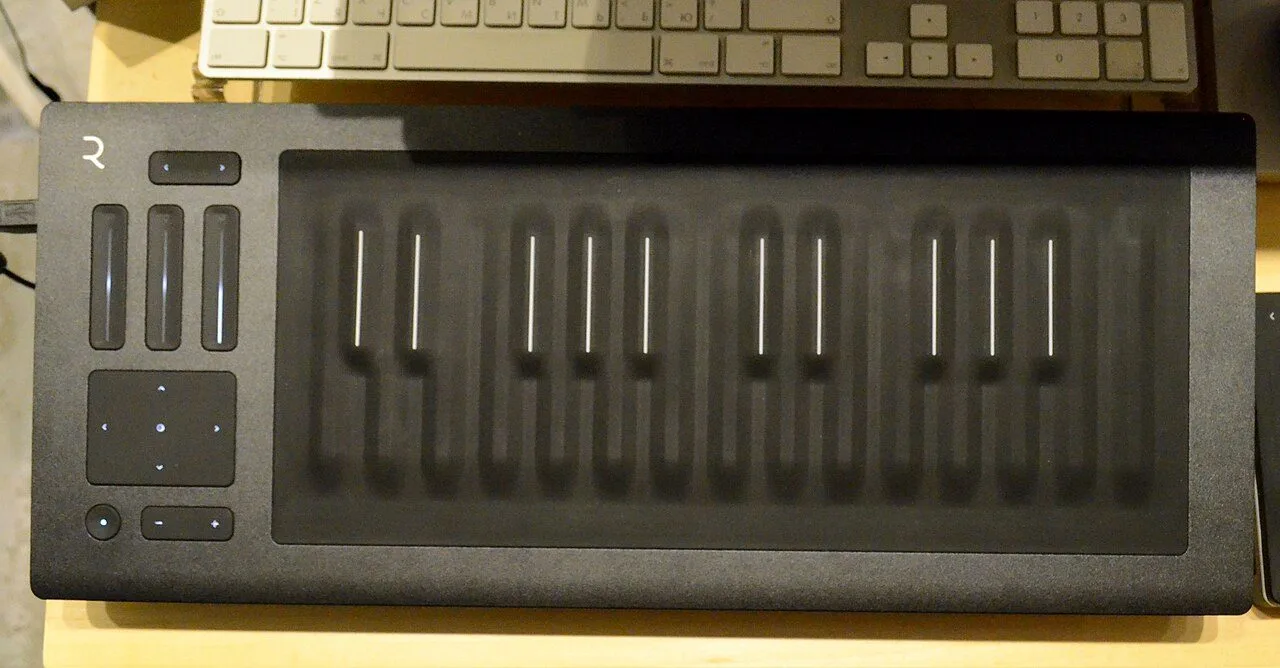
MPE was first popularised by a new breed of playing surface. Soft silicone-key keyboards let the finger slide on both axes; pad grids sense the position and pressure of each contact; some continuous-key keyboards even add a vertical travel under every note. On the sound side, many recent hardware synths and a large share of software synths now accept MPE, whether they run on subtractive synthesis or on more modern engines.
What these instruments share: they turn a physical gesture into musical modulation. It’s the ideal chance to route those expression sources to varied destinations — pitch, filter, amplitude — much as you’d assign an LFO, except the hand replaces the low-frequency oscillator.
Should you move to MPE?
MPE only matters if your music calls for per-note expression. A few markers before you dive in:
- Check the whole chain. Controller, instrument and sequencer must all claim MPE; a single non-compatible link drops everything back to global MIDI.
- Expect to relearn your touch. An MPE surface is far more sensitive than a weighted keyboard: involuntary micro-movements are audible, and it takes time to adapt.
- Think evolving timbres first. Pads, strings, brass and sustained sounds gain enormously from per-note expression; a percussive bassline, much less.
- MPE doesn’t replace polyphony: it complements it. A good MPE sound is still a good sound, enriched with gestures — not a sound that only survives on the trick.
My take
MPE is one of the few real advances in keyboard expressiveness since aftertouch, and it’s worth your time. It’s no gimmick: playing a chord and making a single note inside it sing genuinely changes your relationship with the instrument, and some timbres only come alive there. The trade-off is honest — you need a fully compatible chain and a little patience to tame hypersensitive surfaces. If you write textures that breathe, try it: chances are you won’t go back. If you mostly sequence square rhythms, classic MIDI will serve you just fine.