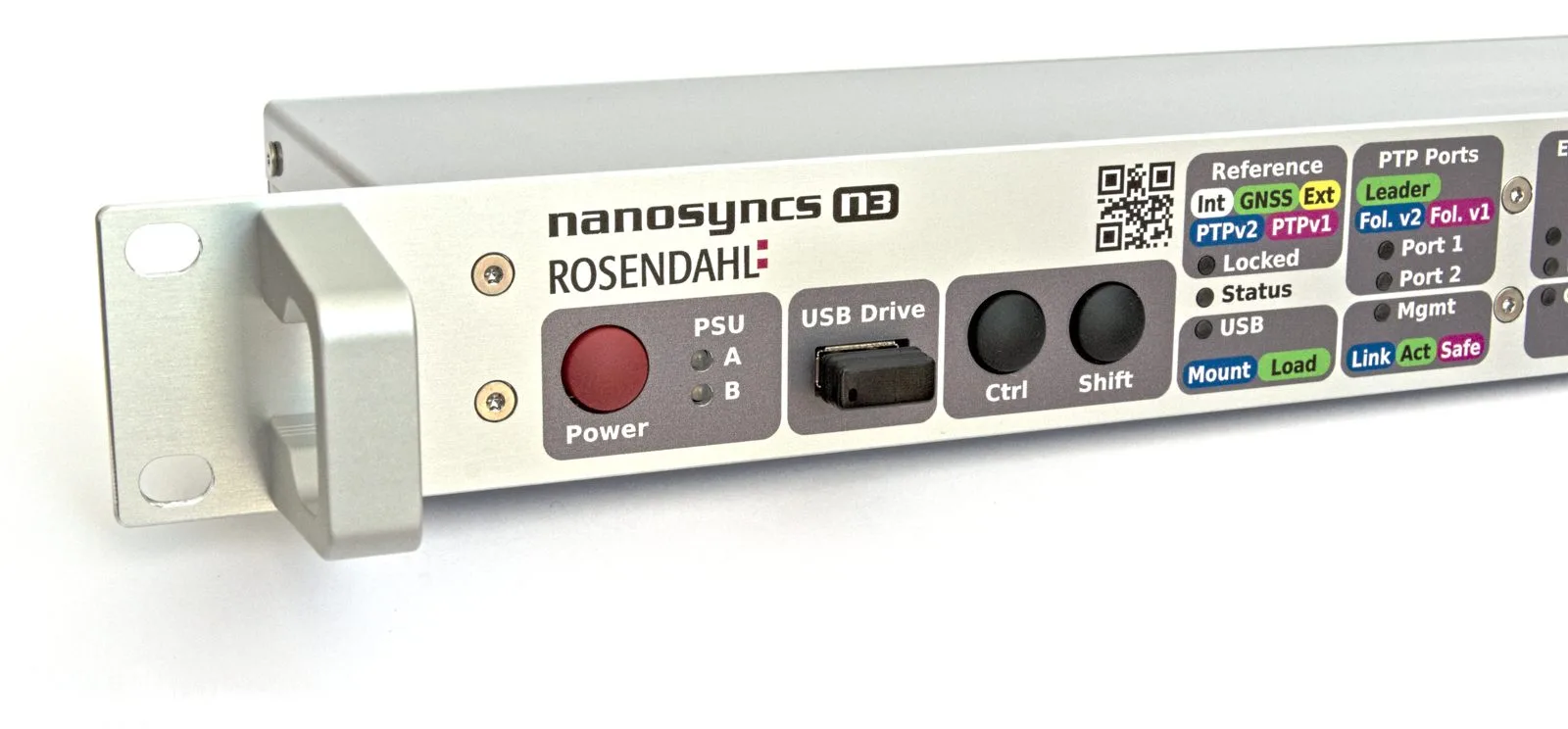
Rosendahl Studiotechnik is refreshing one of the quiet but essential boxes in any control room: the sync generator. The nanosyncs n3, now available, succeeds the nanosyncs HD and moves decisively into the audio-and-video-over-IP era. Where the old model mostly distributed word clock and video sync over BNC, the n3 adds a full networking core with a PTP implementation built in-house.
A master clock built for IP networks
The n3 is billed as a highly integrated reference generator that can act as a PTP Grandmaster, a Boundary/Relay Clock and an NTP server. It carries two Gigabit Ethernet ports and a network stack with precision timing MACs designed by Rosendahl. It handles IEEE 1588-2019 (PTP v2) and IEEE 802.1AS (gPTP), with ready-made presets for AES67, SMPTE ST 2110, Ravenna and AVB environments. One point worth flagging for Dante-equipped rooms: a separate PTP v1 (1588-2002) instance runs alongside the rest, enough to serve a Dante network without compromising the timing of the other flows.

The detail that matters in operation is how it handles followers. Rosendahl claims a high-performance Delay_Req responder that can absorb any number of requests per second, so there is no limit on the number of devices locking to the clock. On an ST 2110 plant that mixes dozens of audio and video nodes, that missing ceiling changes how you size clock distribution.
The BNC legacy isn’t dropped
Rosendahl hasn’t sacrificed the old world for the new. The n3 keeps serious traditional sync capability: eight video sync outputs across three pulse generators (4+2+2 BNC), eight word clock outputs and two timecode generators, all phase-locked to the chosen reference. On the video side there are bi-level 625i and 525i signals, tri-level 720p, 1080i and 1080p signals, with every frame rate from 48 to 60 Hz, 0.1% pull-down included. That is the promise of a bridge between a legacy black-and-burst plant and a modern PTP network, in a single box.
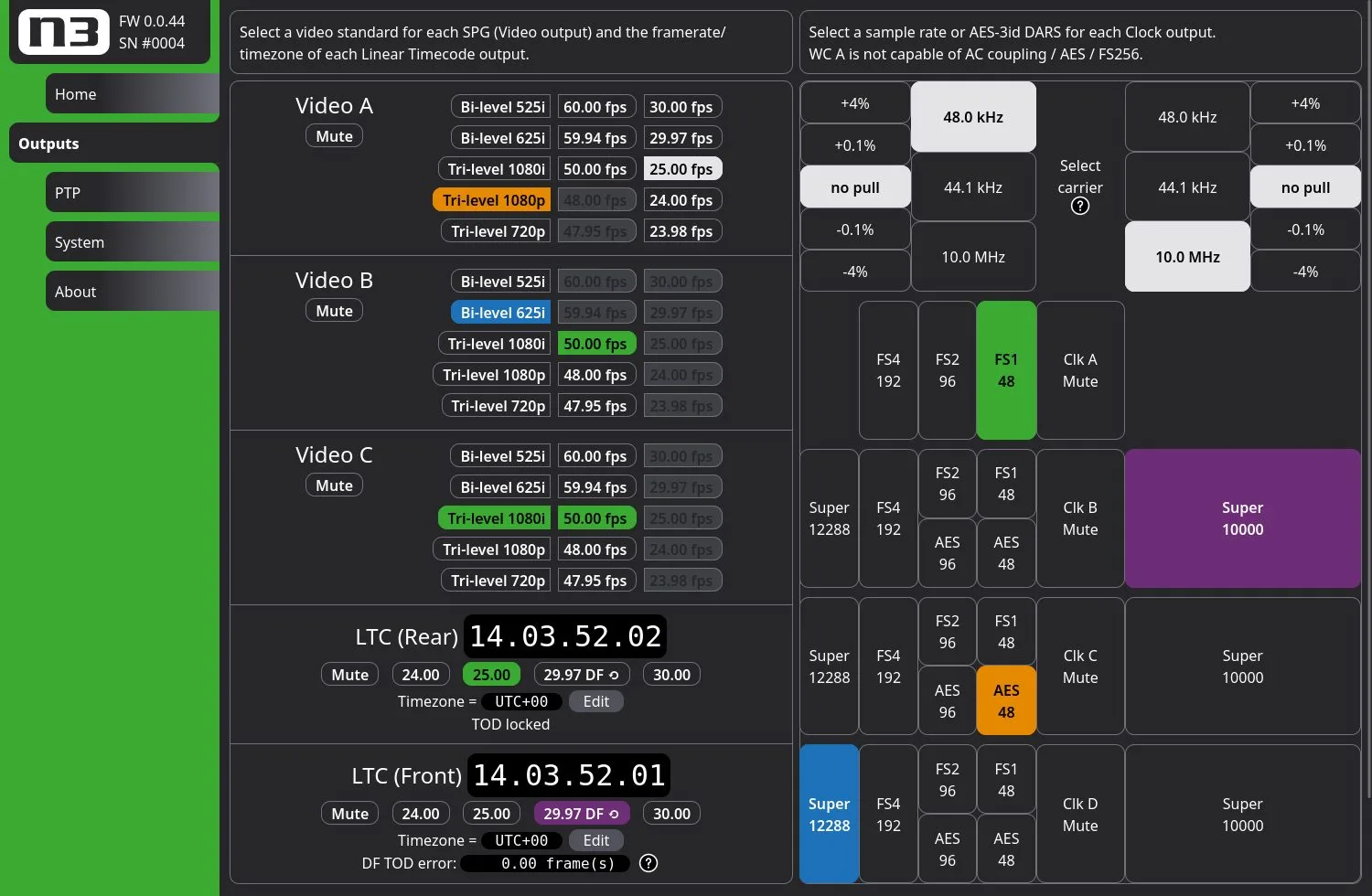
Robustness and operation
The architecture is aimed at the machine room that doesn’t forgive failure. The n3 runs on redundant USB power supplies and offers an out-of-band Management Port, isolating control and monitoring traffic from media and sync flows—a networking best practice too often ignored. GNSS satellite synchronisation is built in, so you can lock to an absolute reference without a third-party receiver. Rosendahl also claims, not without cheek, a design that is “100% developed by humans, 0% AI”—a way of stressing end-to-end control over the timing stack.
Control is through a web interface, letting you configure presets, clock modes and routing from a browser. For context, the n3 sits at around 2,000 € at first availability—a sensible figure for a PTP grandmaster that replaces a word clock, a black-and-burst generator and a time server all on its own.
For the fundamentals, revisit our rundown of PTP and clocking in AES67, ST 2110 and Dante networks and our explainer on word clock, jitter and master clocks. The official product page is on the manufacturer’s site.
Frequently asked questions
Does the n3 work on a Dante network?
Yes. On top of its PTP v2 (1588-2019) instance for AES67, ST 2110, Ravenna and gPTP, the n3 carries a dedicated PTP v1 (1588-2002) instance, which is the profile Dante networks expect. Both coexist on the unit, so a single master clock can serve a mixed plant.
How many devices can sync to it?
Rosendahl states no follower limit. The Delay_Req responder is sized to handle a large number of requests per second, avoiding the client ceiling you hit on some entry-level PTP clocks.
What happens to my word clock and black-and-burst outputs?
They stay. The n3 offers eight word clock outputs, eight video sync outputs (bi-level and tri-level) and two timecode generators, all phase-locked. It bridges a legacy plant and a PTP network without forcing you to migrate everything at once.
Do I need an external GPS receiver for an absolute reference?
No, GNSS satellite synchronisation is built in. You can lock the n3 to an absolute reference without adding a third-party box, which simplifies the install and removes a point of failure.
My take
Sync is the one job you only notice when it goes wrong—a dropped stream, a click on air, a frame that jumps. The n3 has the right instinct: fold PTP, word clock, black-and-burst, timecode and GNSS into one box instead of stacking three units that each age on their own. The unlimited followers and the out-of-band Management Port give away people who know what an ST 2110 plant actually feels like. The open question is the price of a niche product; but if you are building an IP plant, the master clock is not where you save money.