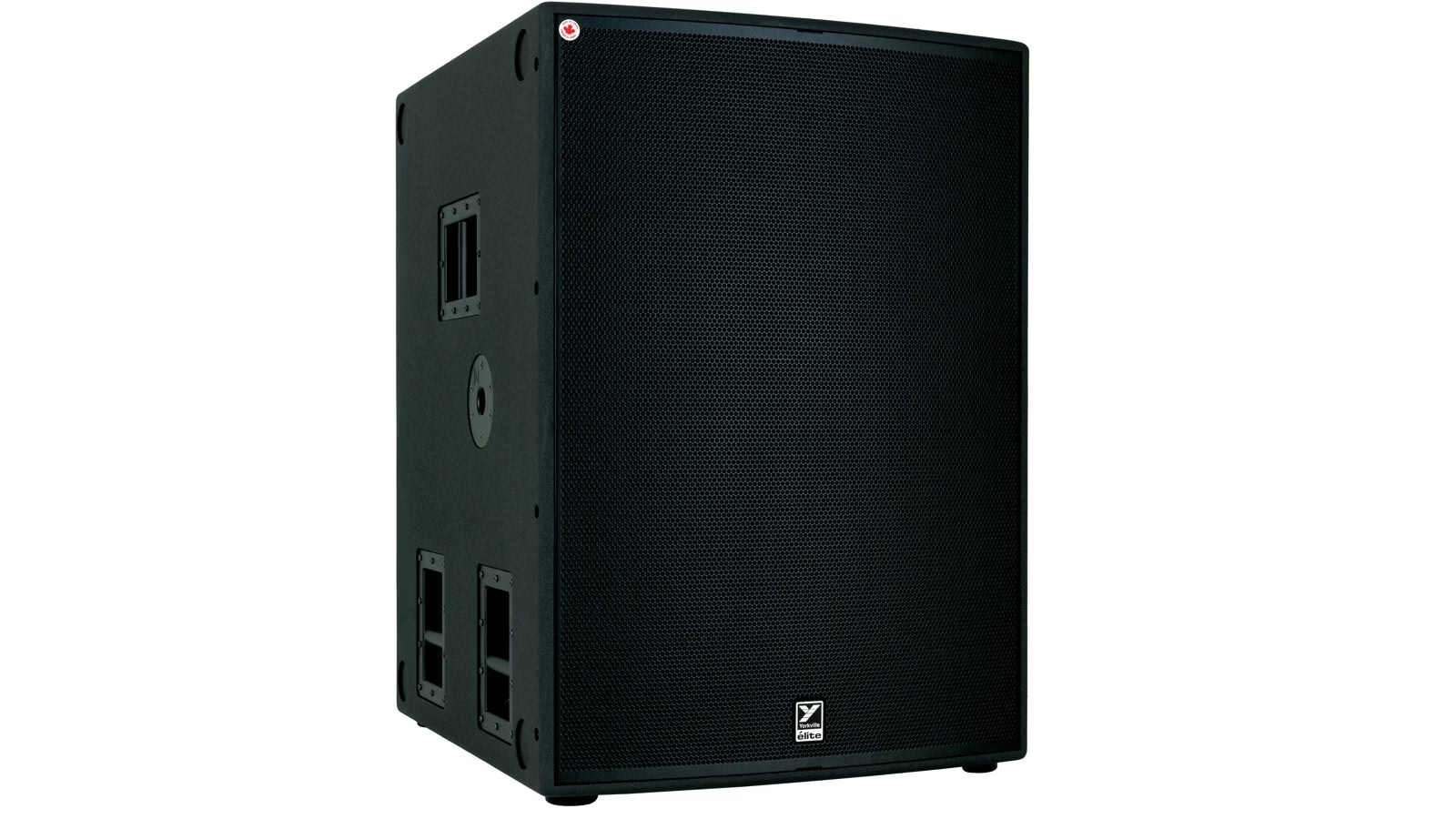
You have to hand it to them for nerve. While live sound has standardised around 18- and 21-inch low-frequency drivers, often stacked into cardioid arrays, Yorkville is zigging where everyone zags with the EL24S: a powered subwoofer built around a single 24-inch transducer, more than two feet across. The Canadian maker, low-key but well established in install and live, is billing it as the world’s first active 24-inch PA subwoofer. It is an intriguing move, and it raises a real engineering question.
Why 24 inches, and why now
In a subwoofer, what matters is not the wattage on the sticker but the volume of air the box can move. That comes down to cone area times excursion. Going from 21 to 24 inches buys roughly 30% more cone area over a 21-inch driver, and close to double that of an 18. Put another way, one EL24S shifts about as much air as a pair of conventional 18-inch subs, from a single cabinet with one amplifier and one mains connection to manage.
The trade-off is well known: a bigger diaphragm is heavier, and harder to keep under control in the upper bass. Yorkville answers with a neodymium motor and a 6.5-inch voice coil, meant to preserve some agility despite the moving mass. The quoted 30 to 100 Hz bandwidth confirms the intent: this box is built for sub-bass and the bottom octave, not for creeping up into the tops’ territory.
The numbers
| Spec | Yorkville EL24S |
|---|---|
| Driver | 24-inch (61 cm), neodymium magnet, 6.5-inch voice coil |
| Power | 5,000 W peak / 2,500 W program |
| Max SPL | 143 dB peak / 137 dB continuous |
| Bandwidth | 30 – 100 Hz |
| Enclosure | 15 mm birch plywood, textured finish, steel grille |
| Weight | about 240 lb (109 kg) |
| I/O | 2x XLR in, full-range and high-passed XLR out, powerCON TRUE1 in/out |
| Price / availability | around $4,199, shipping Q4 2026 |
Amplification, protection and cabling
On the electronics side, the onboard amp delivers 5,000 watts peak and includes limiting to protect the driver from overexcursion, a critical detail on a transducer this size where pushing too hard is punished instantly. The I/O is deliberately simple but stage-minded: two XLR inputs, both full-range and high-passed XLR outputs so you can feed the tops without an extra crossover box, and crucially powerCON TRUE1 connectors that daisy-chain on both power and signal. On a festival changeover, being able to loop power and audio from one sub to the next genuinely cuts your rigging time.
This is also where it slots into a modern digital rig: a box like this is best driven from a console or system processor on a dedicated send, with careful alignment. None of those fundamentals change for a 24-inch driver — which is exactly what live sound system alignment is about, where lining up delay, phase and gain between subs and tops makes or breaks the result.
Where it makes sense
A single 24 is not out to replace a sub array on a big show. Its natural home is the club, the electronic-music night, the high-end corporate gig or the demanding small room where you want physical low end without deploying a stack. The logic is maximum sub in minimum floor footprint: one radiating point, one cable, a serious weight but a single box to move. That said, 240 lb of driver is no joke, and handling and storage become a real consideration.
A view from the console
I have spent enough time behind a front-of-house desk at festivals to know that low end never comes down to a single SPL figure. What makes a sub work in the field is how tight and defined it stays when you lean on it, and above all how you align it and lay it out on the ground. A 24-inch driver reaching 30 Hz looks spectacular on paper; in practice it will all hinge on cone control in the upper bass and on array behaviour when you run several of them. I stay loyal on principle to systems whose end-to-end coherence I trust, but the idea of one well-designed low-frequency point instead of a stack makes real logistical sense. I want to hear it on real program before calling it.
Yorkville is playing the spectacular-object card here and owning a niche. The engineering bet is real: controlling a 24-inch cone is anything but trivial, and that is precisely what will separate a marketing feat from a production tool. We want to hear it in the field. Full details are on the manufacturer’s site.
To place this box in a modern, distributed reinforcement chain, our pieces on audio over IP and the Lawo Edge One stagebox round out the infrastructure picture.