We talk endlessly about consoles, loudspeakers and system tuning, and almost never about the thing that holds it all together: the patch. Yet the patch is the invisible skeleton of a show. A clear, consistent, redundant patch means a soundcheck that starts on time and a gig that doesn’t fall over; a bodged patch means the phantom channel you chase for twenty minutes while the room fills up. Here’s how to connect stage to console cleanly, from the old copper multicore to audio-over-IP.
Before it’s hardware, the patch is a plan
To “patch” is to decide which physical source lands on which console input, and which output feeds which amp, monitor or recorder. Before any cable there’s a patch list: a document that numbers each source (kick, snare, bass DI, lead vocal…) and assigns it a line. That document is what circulates between the engineer, the backline and the rental company, and it’s what you follow when cabling. A well-thought patch groups sources by family and by stage position, in a logical order you’ll then find again on the console surface — which makes working in groups and VCAs feel natural.
The analogue snake: simple, heavy, indestructible
The analogue multicore — the snake — is still everyone’s mental reference. It’s a thick cable bundling dozens of balanced links between a stage box and the console position. Each source goes into the box on XLR, travels down the multicore, and reappears at front of house on a patch bay.
Its virtues are real: no latency, no configuration, no clock, and bulletproof robustness. So are its limits: the weight and bulk of a 40-line cable over 50 metres, the length that degrades the signal and raises noise pickup, and above all the rigidity — the channel count is fixed by the cable, and everything runs from one point to exactly one other.
The digital stagebox: conversion moves on stage
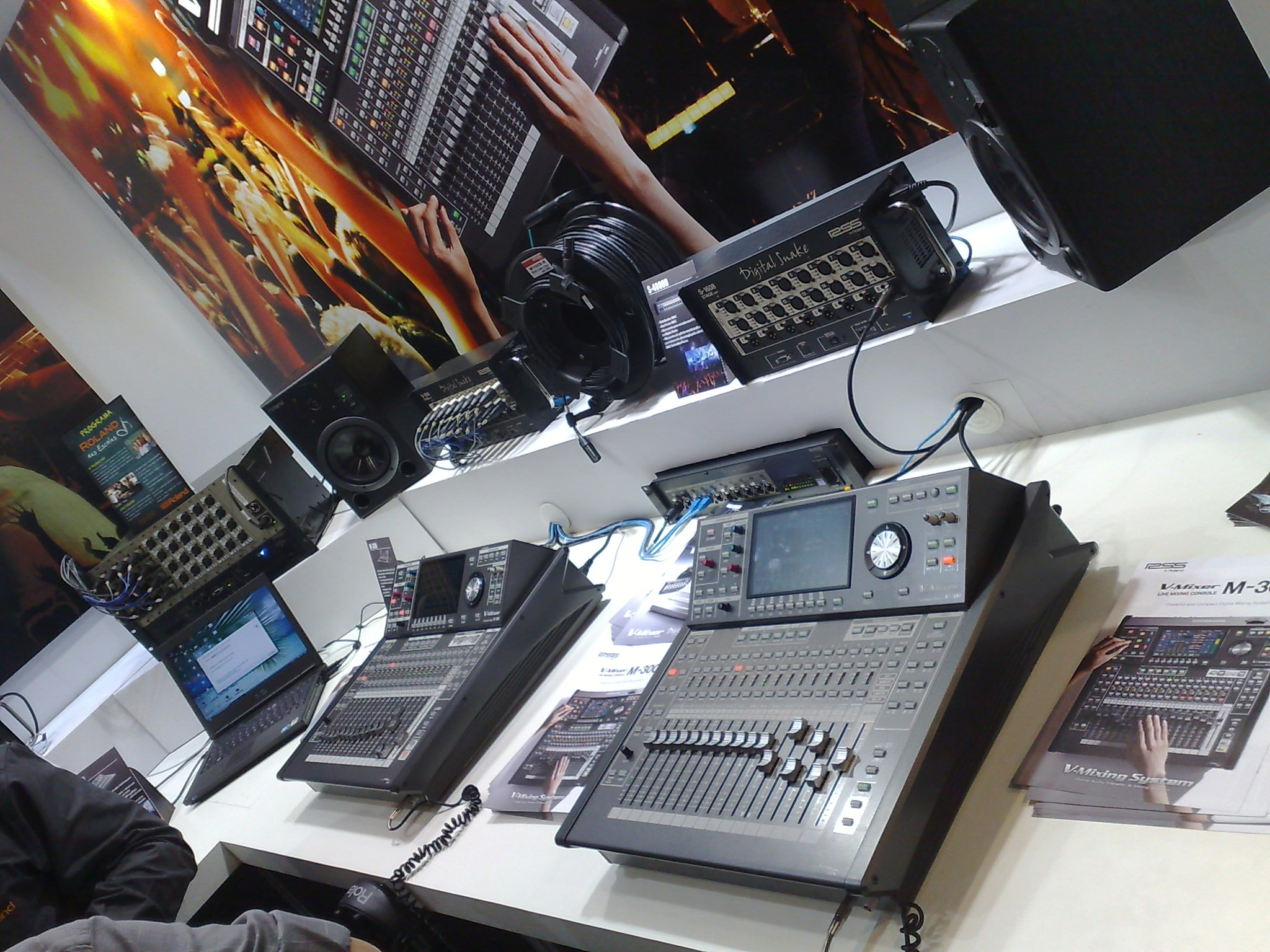
Going digital moved the converter. With a stagebox, each mic is preamplified and digitised right on stage, as close to the source as possible. From there only a digital stream travels — historically on a proprietary cable, today increasingly on a plain network cable — to the console.
The gains are huge: a single light cable replaces the heavy snake, quality no longer degrades over distance, and you carry far more channels. The sensitive point becomes remote preamp control: the console drives the gain of preamps sitting on stage, which assumes a reliable control link and clean handling when two consoles (FOH and monitors) both want to drive the same preamp — hence the importance of compensating digital gain, which lets each of them set a level without touching the shared analogue preamp.
The split: feeding several consoles
As soon as there’s a front-of-house console and a monitor console — never mind an OB truck or a broadcast feed — you need to split the sources. In the analogue world you use a passive (transformer) or active split that copies each mic to several destinations. In digital, the split becomes trivial: the same network stream is simply listened to by several consoles.
That’s one of the big favours networked audio does. On an analogue split, the single gain point and galvanic isolation between consoles are a genuine concern; on a network, each console receives the same samples and applies its own digital gain in its corner. It also simplifies tuning, since FOH and monitors start from exactly the same signals — see our guide to system alignment on that.
Audio-over-IP: the patch goes software
The last step is the move onto standard networks. With Dante, AES67 or SMPTE ST 2110, the stagebox and console are no longer tied by a proprietary protocol but by Ethernet, and the patch becomes a software matter: you “route” a source to a destination in a matrix, with no change to physical cabling. You can send one source to FOH, monitors, an in-ear system and a multitrack recorder in a single click. The full detail of these protocols deserves its own piece: we gave it to audio-over-IP.
That flexibility has a flip side: the physical patch gives way to a network configuration you must document, lock down and protect. A mis-routed source isn’t visible to the eye — it only shows up in a routing app.
Redundancy and naming: the two reflexes that save you
Two disciplines separate the amateur patch from the pro one. Redundancy first: on networks you physically double the links (a primary network, a secondary one taking a different path) so a cut cable never silences the stage. Naming next: every channel must carry a clear, consistent name end to end — on the patch list, on the stagebox, on the FOH console and on the monitor desk. A channel labelled “Lead Vocal” everywhere is set in three seconds; a “Ch 17” has to be hunted down.
My take
I’ve cabled enough 56-pair snakes in the rain not to feel nostalgic about all-analogue. Networking has made live work lighter, more reliable and more flexible, no argument. But it also moved the risk: a fault used to be visible and touchable; now it hides in a network configuration that a single unlucky click can break. My field conviction hasn’t shifted an inch: the best patch is the one that’s documented, redundant and named before the first musician walks in. The technology changes; the discipline never does. And if you’re new to digital, take the time to understand the system tuning and the loudspeaker deployment that come right after the patch in the chain.