Switch between two FM stations and you hear it instantly: each has its own “colour”, and above all the sound stays constant, dense, never clipping or dropping away. That result is anything but accidental. Between the studio console and the transmitter sits a broadcast processor, often called the on-air chain, that conditions the signal before it goes out over the air. It’s one of the least understood links in the radio chain, and one of the most decisive for a station’s sonic identity.
What is on-air processing?
On-air processing covers all the treatment applied to the programme just before transmission. It has four goals: to guarantee a constant level whatever the source (a hot-mastered track, a mic voice, a phone report); to give the station a recognisable sonic signature; to maximise presence and perceived coverage; and above all to protect the modulation, meaning never to exceed the technical limits set by the broadcast mode. The processor typically sits after the control room, at the end of the studio chain, just before the studio-to-transmitter link.
The stages of the chain
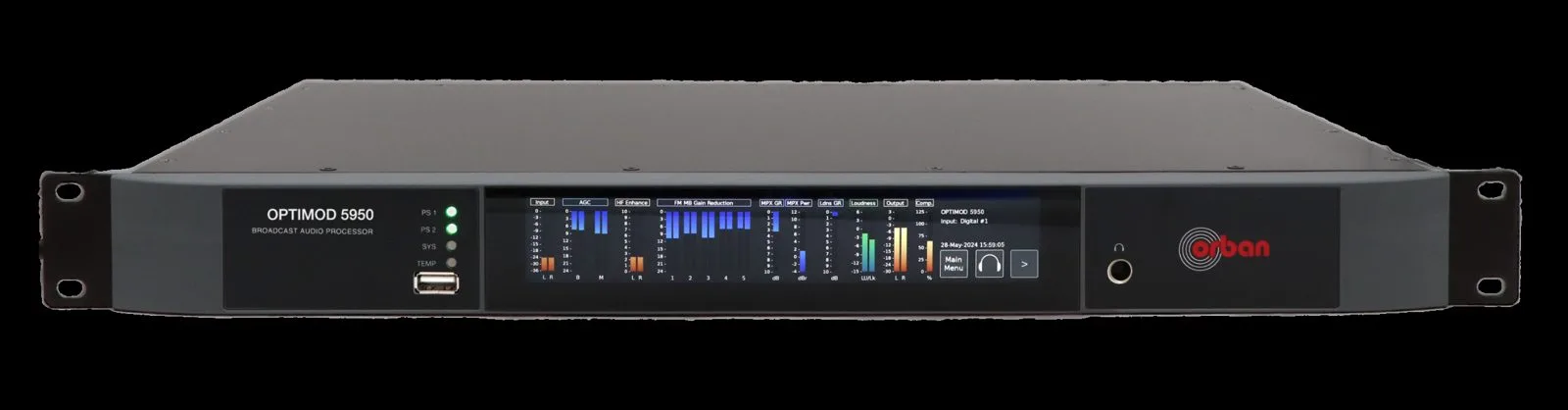
A broadcast processor chains several treatments in an order that matters. At the input you usually find an AGC (automatic gain control) that rides out level differences over several seconds and presents the following stages with an already-regulated signal. Then comes the heart of the system: multiband compression, which splits the spectrum into several independently treated bands. This is what balances lows, mids and highs, densifies the sound and sets much of the station’s signature — a very forward pop station and a discreet classical one do not set their bands the same way at all.
Downstream, a limiter then a final clipper lock the peaks. The difference between the two is subtle but essential: the limiter acts fast and cleanly on transients, the clipper hard-clips to win the last few decibels of perceived level, at the cost of controlled distortion. Set well, the whole thing stays musical; pushed too far, it tires the ear.
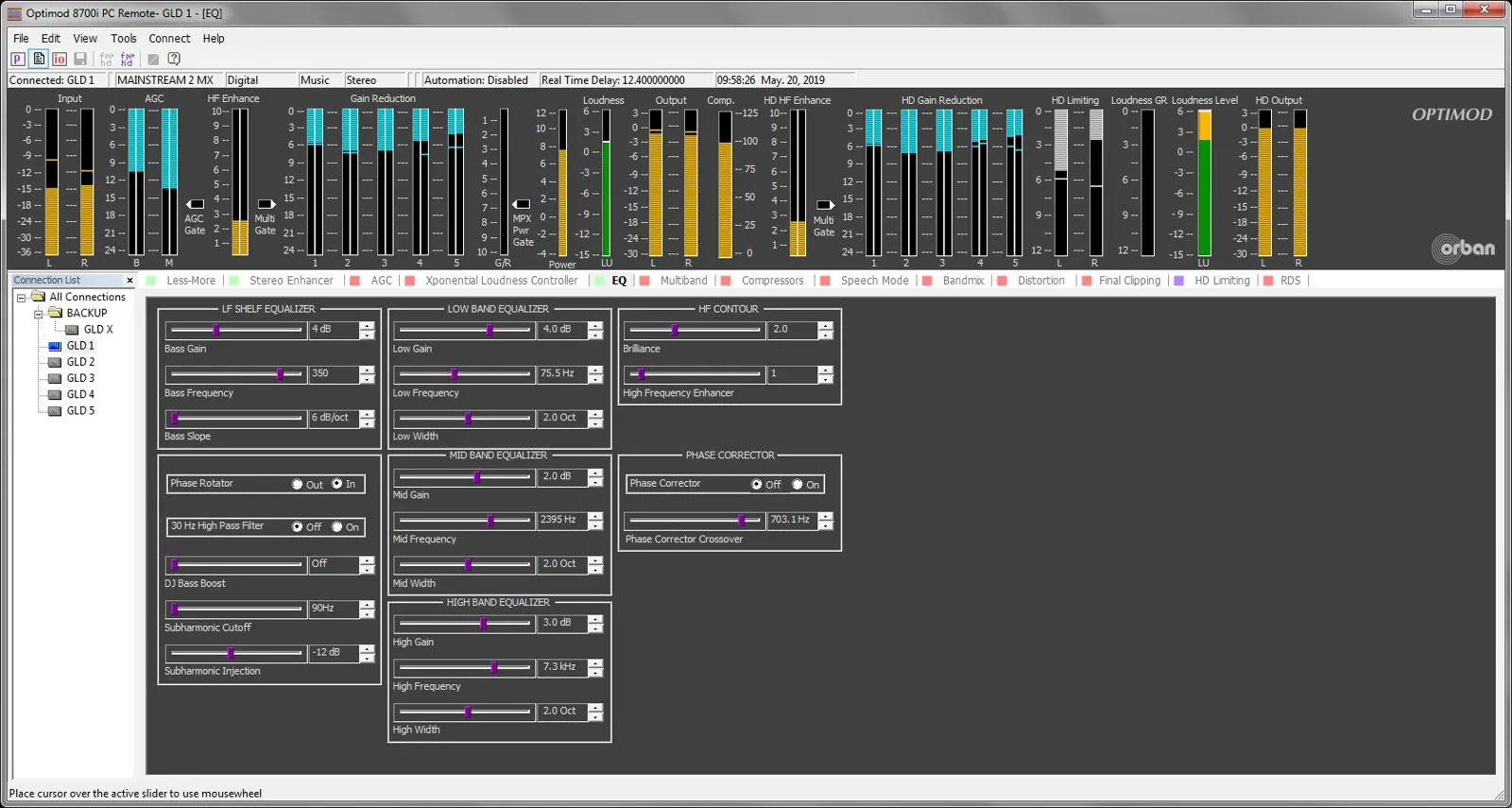
Protecting the modulation: pre-emphasis and MPX power
On FM, on-air processing has to deal with two constraints specific to the mode. First, pre-emphasis: the FM signal deliberately boosts the highs at transmission (50 µs in Europe) to cut them back at reception, which improves the signal-to-noise ratio but forces the processor to watch high-frequency energy closely to avoid overmodulation. Second, the processor builds the composite signal — the famous MPX multiplex — with its 19 kHz stereo pilot and, where used, the RDS data. In several countries, regulation also caps the multiplex power (the BS.412 standard): you can’t push the level indefinitely, the processor has to manage that budget.
One chain, several outputs
A modern processor no longer serves FM alone. The same unit often feeds, in parallel, an output for digital radio (DAB+ or HD Radio) and one for streaming. These modes don’t share the same rules: digital drops pre-emphasis and thinks in terms of maximum digital level, while online streaming is most often loudness-normalised by the platforms. Hence distinct processing settings per output, designed for each channel rather than a single compromise.
The loudness war and normalisation
For decades, FM stations waged a “loudness war”, each trying to sound louder than its neighbour to grab the listener scanning the band. The result: increasingly aggressive chains, at the expense of dynamics and listening comfort. The digital world reshuffled the deck. Because streaming platforms and, increasingly, listening environments align everyone to a LUFS loudness target, pushing level no longer helps much: past the target, the signal is simply turned back down. The smartest on-air processing now aims for useful density and consistency, not raw volume.
My take
On-air processing is where a radio station really happens, and yet it’s too often left to a factory preset nobody ever opens. That’s a shame, because it’s where the difference lies between a station you listen to for an hour without fatigue and one you switch off after ten minutes. The good news is that loudness normalisation has defused the volume race: you can finally set for listening quality without shooting yourself in the foot against the competition. One piece of advice: set by ear, over time, not on the meter.