There was a time when you plugged two wireless mics onto two random frequencies and everything just worked. That time is gone. Between shrinking UHF bands, the growing density of links on a single stage — handhelds, bodypacks, in-ear monitors, intercom — and audiences saturated with phones, frequency coordination has become a skill in its own right. A solid plan, prepared ahead of time, is your best insurance against dropouts in the middle of a live show.
Why a frequency plan?
Every RF transmitter occupies a carrier frequency, but it never lives alone: as soon as several systems transmit at once, they can interfere. Two problems stack up. First, coexistence with the environment: local TV channels, other rental companies on the same site, assorted networks. Second, and this is the sneaky one, the links interact with each other and create their own interference. Building a plan means choosing a set of frequencies that hold together and within their environment, then documenting it so you can replay it.
The spectrum: where are you allowed to transmit?
It all starts with the band. Most professional links live in UHF (470–694 MHz in Europe, with regional variants), an area shared with broadcast TV. Some portions are licensed, others are license-free, and the so-called duplex gap plus a few complementary bands offer a little breathing room. First rule: know the blocks allowed in your country and for your gear, and never transmit in a locally occupied TV channel. A receiver that tunes across a wide range gives you room to manoeuvre when a crowded city closes doors on you.
Scan before you coordinate
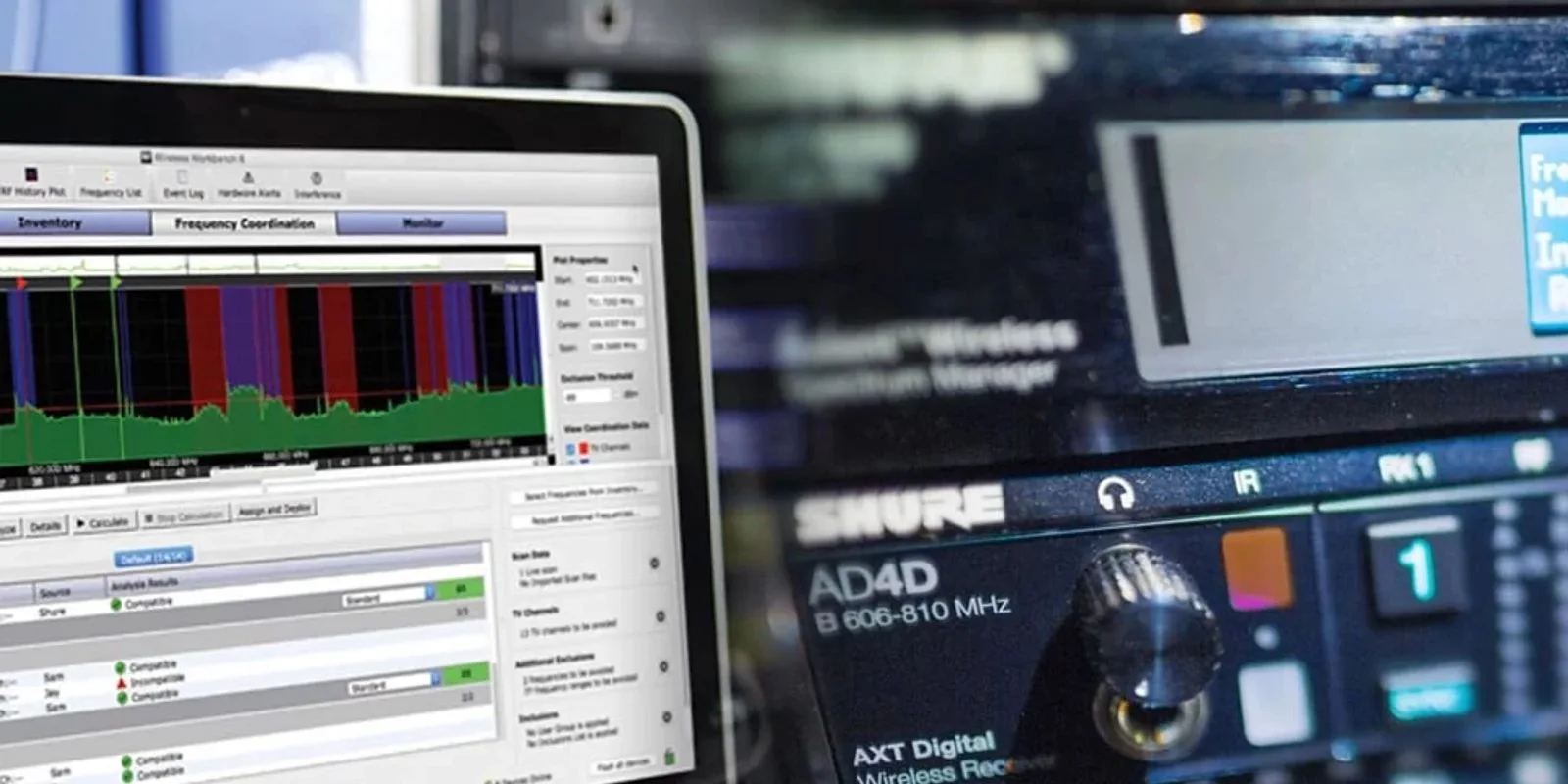
You never coordinate blind. Before anything else, you sweep the spectrum at the venue itself, with a receiver or an analyser, to read the ambient noise floor and spot the carriers already present. That scan becomes the map on which you’ll place your own frequencies, excluding everything that’s occupied. Ideally you redo it on site on the day: the RF landscape of an empty room at 9 a.m. has nothing to do with the same room packed at 8 p.m.
Intermodulation, the invisible enemy
This is the heart of the matter. When several transmitters run together, their signals mix in the receivers’ input stages and generate intermodulation products: new spurious frequencies, the sum and difference of the carriers and their harmonics. The so-called third-order products (of the 2f1 − f2 type) are the most troublesome, because they often fall right inside the usable band. A counter-intuitive consequence: spacing your frequencies evenly is a bad idea, because it lines the intermod products up on neighbouring channels. A good plan spreads the carriers deliberately unevenly, calculated so the spurs fall into the gaps.
Doing that maths by hand for twenty links is unrealistic. This is exactly the job of coordination software, which evaluates the intermodulation products of a frequency set and proposes compatible combinations.
Building compatible groups
Two approaches, often combined. The simplest is to use the pre-calculated groups and channels supplied by the maker of your links: these are frequency sets already checked against each other, which you just load. As soon as your inventory grows, mixes several brands or has to coexist with other companies, you move to coordination software that starts from your scan, folds in your constraints and generates a bespoke plan.
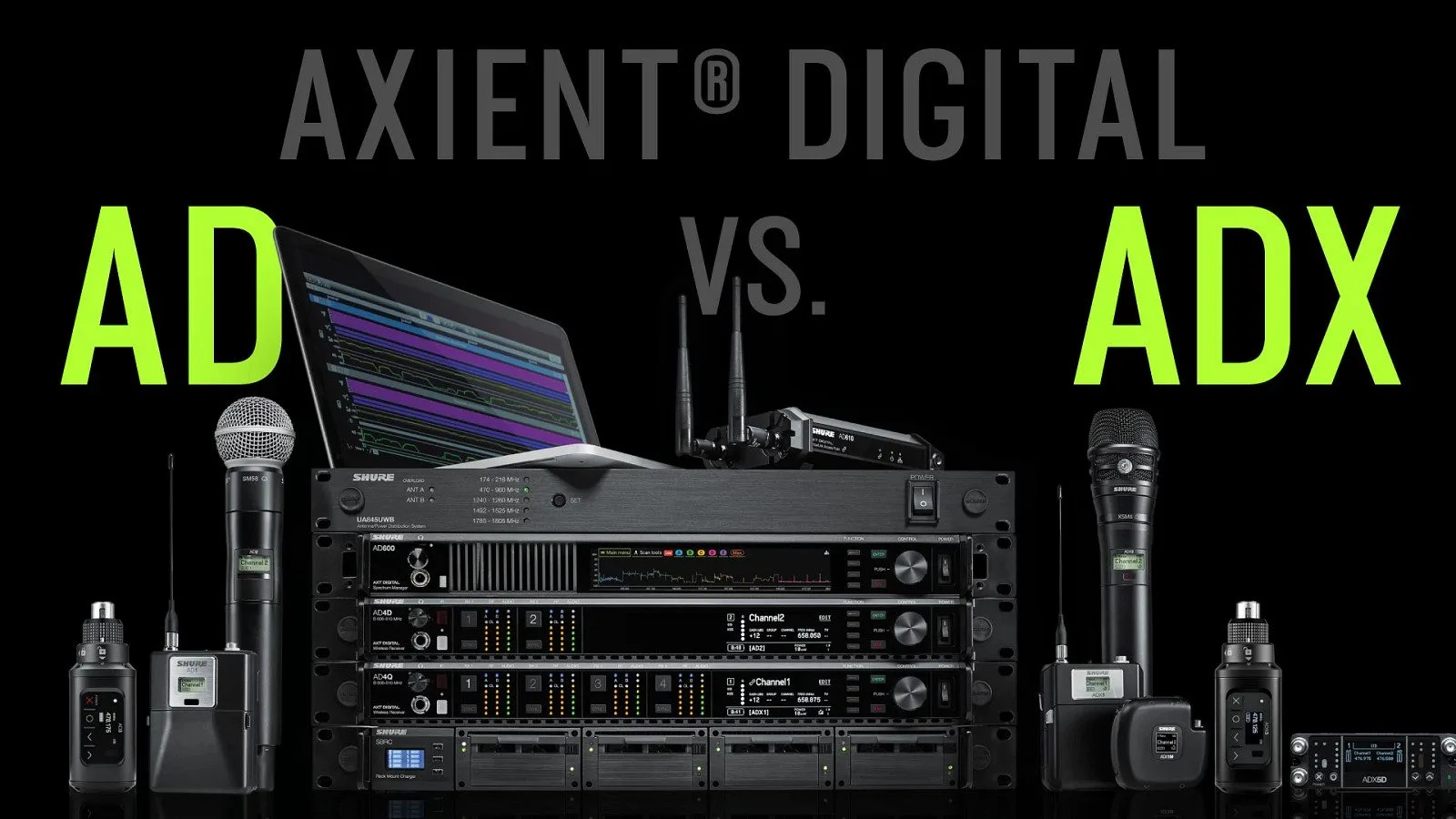
A few field habits: fold your in-ear systems into the same plan as the mics — they transmit too, and take part in the intermodulation; always reserve a few compatible backup frequencies to switch to if something jams; and think in zones if you cover several stages. Recent systems make life easier on big inventories, as shown by the Axient Digital 1.6 update and its channel linking.
From plan to deployment
A plan is only worth something if it survives the field. Once the frequencies are loaded into transmitters and receivers, take care of reception: a clean antenna distribution, well placed and properly managed for gain, avoids half the problems wrongly blamed on a “bad plan”. Then run a walk test — you cover the stage and the wings, transmitter in hand, to check coverage — and log everything: frequencies, groups, mic-by-mic assignments. That document is what you’ll replay at the next date, and what you’ll hand to the colleague relieving you. The major names in the field — Shure, Sennheiser, Wisycom, Lectrosonics — each supply their own coordination tools; the principle, though, never changes.
My take
RF coordination is the kind of work nobody mentions when it goes well, and the first suspect named when a mic drops out. The investment is well worth it: an hour of serious scanning and coordination up front saves a night of stress. The real change in recent years is that software and systems have made accessible what used to be niche expertise. One rule won’t budge, though: you scan on site, on the day, with a full room if possible. The spectrum isn’t guessed, it’s measured.