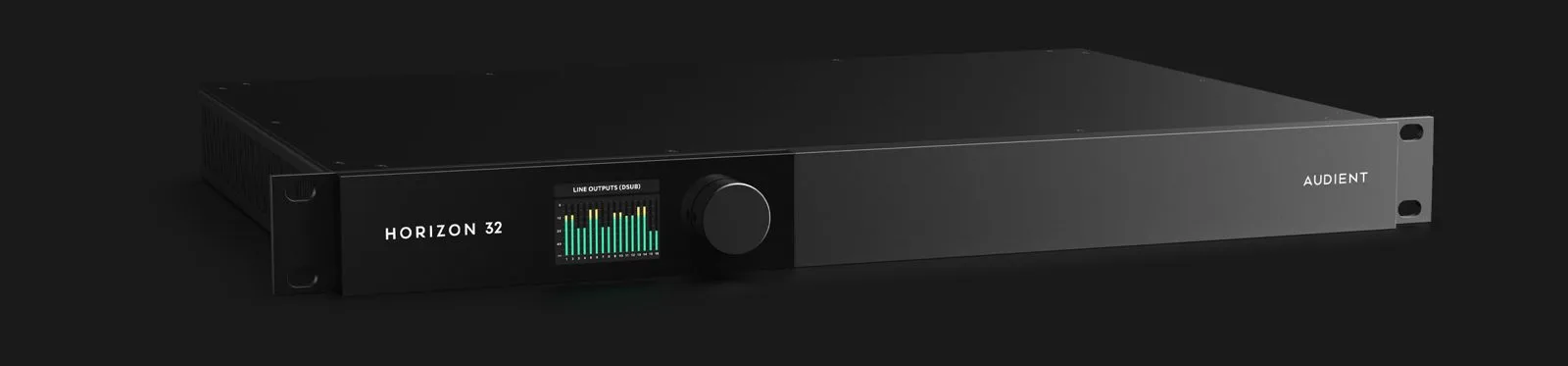
Audient is planting a new flagship at the top of its interface range. The Horizon 32 is a 1U Thunderbolt 3 interface with 50 inputs and 50 outputs, including 32 channels of line I/O across eight DB25 connectors. Announced in September 2026 and shipping since late September, it targets studios running big sessions, from multi-room tracking to hybrid rigs packed with outboard.
An interface built for high channel counts
The Horizon 32’s pitch is one set of numbers: 50 inputs, 50 outputs, 64 analog I/O channels over eight DB25s, all in a single 1U rack. It’s as much a patch-and-routing hub as a converter, built to sit at the centre of a studio that stacks analog processing racks and tracks many sources at once.
Conversion goes to 32-bit at up to 192 kHz, with a stated 133 dB dynamic range and sub-millisecond round-trip latency (0.99 ms at 192 kHz). For a studio mixing in analog while keeping a foot in the DAW, that near-zero latency changes how you monitor performers.
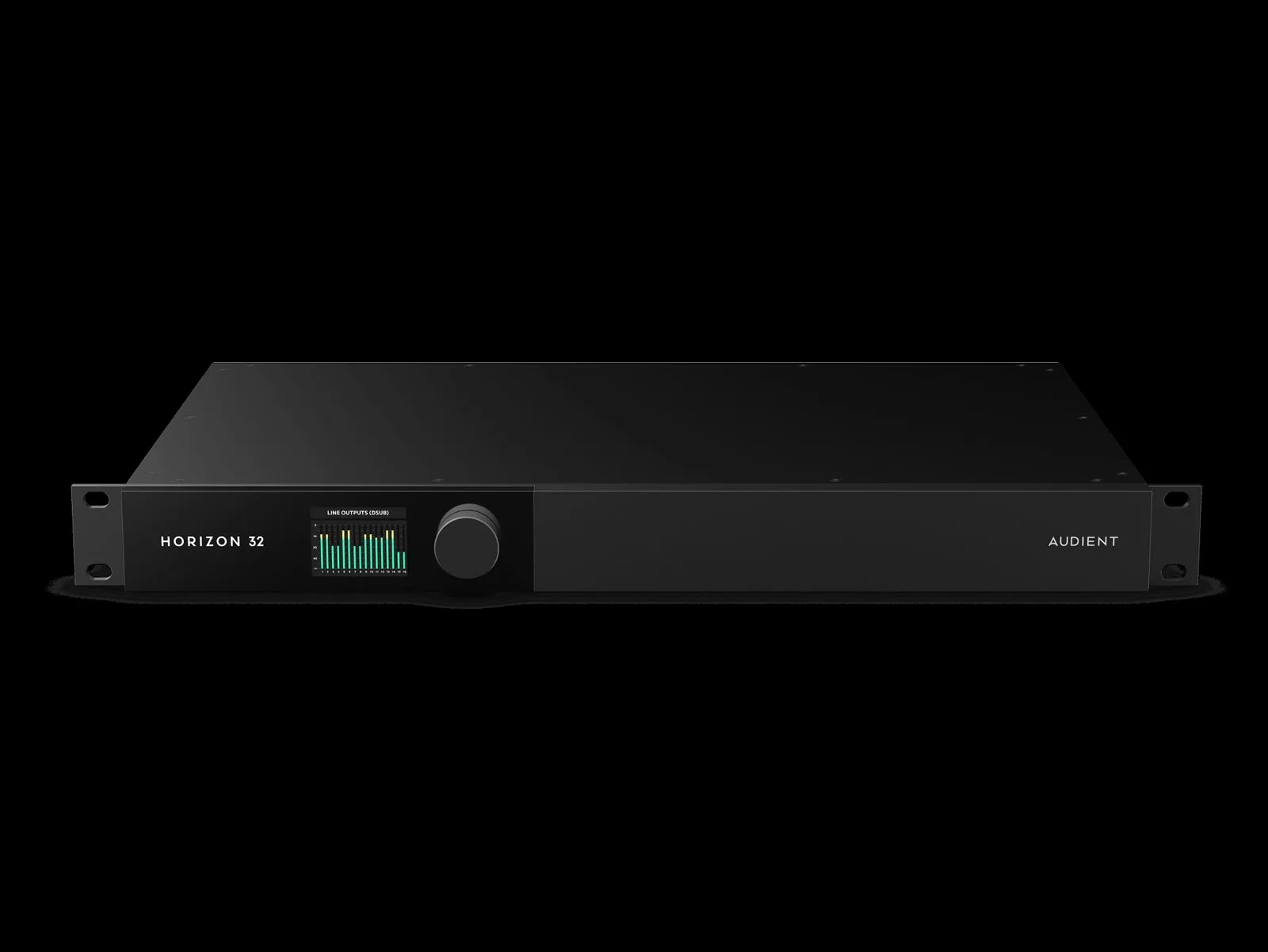
Digital recall and workflow
The real comfort comes from recall: input gains and system settings store and recall digitally, ending the preamp-notes notebook. Horizon Control software acts as a virtual patchbay and metering suite, routing signals and watching levels without leaving the screen. Add a dedicated stereo mix-bus input, monitor controls, dual ADAT I/O for expansion, and BNC word clock.
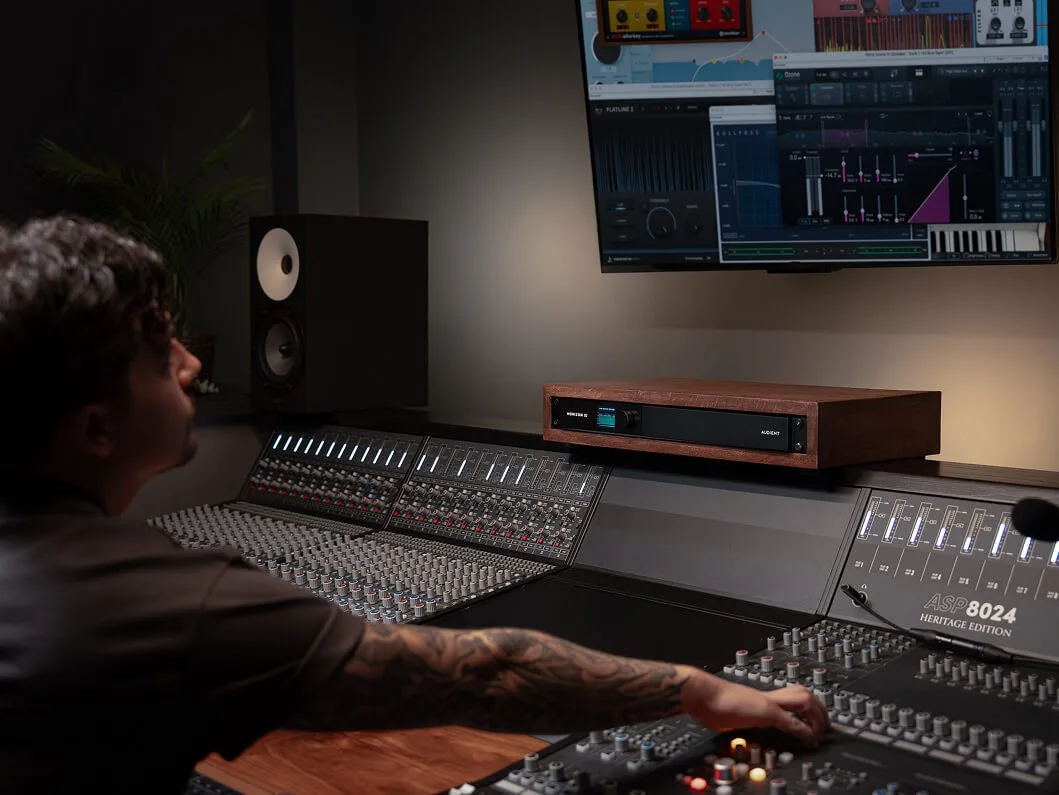
Modularity as the argument
The Horizon 32 doesn’t work alone: it daisy-chains up to four units on a single macOS driver, reaching a maximum of 200 inputs and 200 outputs. That’s Audient’s answer to multi-room installs and studios that want to grow their rig without starting over. It tops a Horizon line that also includes smaller models (Horizon 8P, Horizon 16), with the 32 as the flagship.
| Spec | Horizon 32 |
|---|---|
| Format | 1U, Thunderbolt 3 |
| I/O | 50 in / 50 out (64 line channels, 8 DB25) |
| Conversion | 32-bit, up to 192 kHz, 133 dB dynamic range |
| Latency | 0.99 ms round-trip at 192 kHz |
| Expansion | dual ADAT, BNC word clock, chain up to 4 units (200 x 200) |
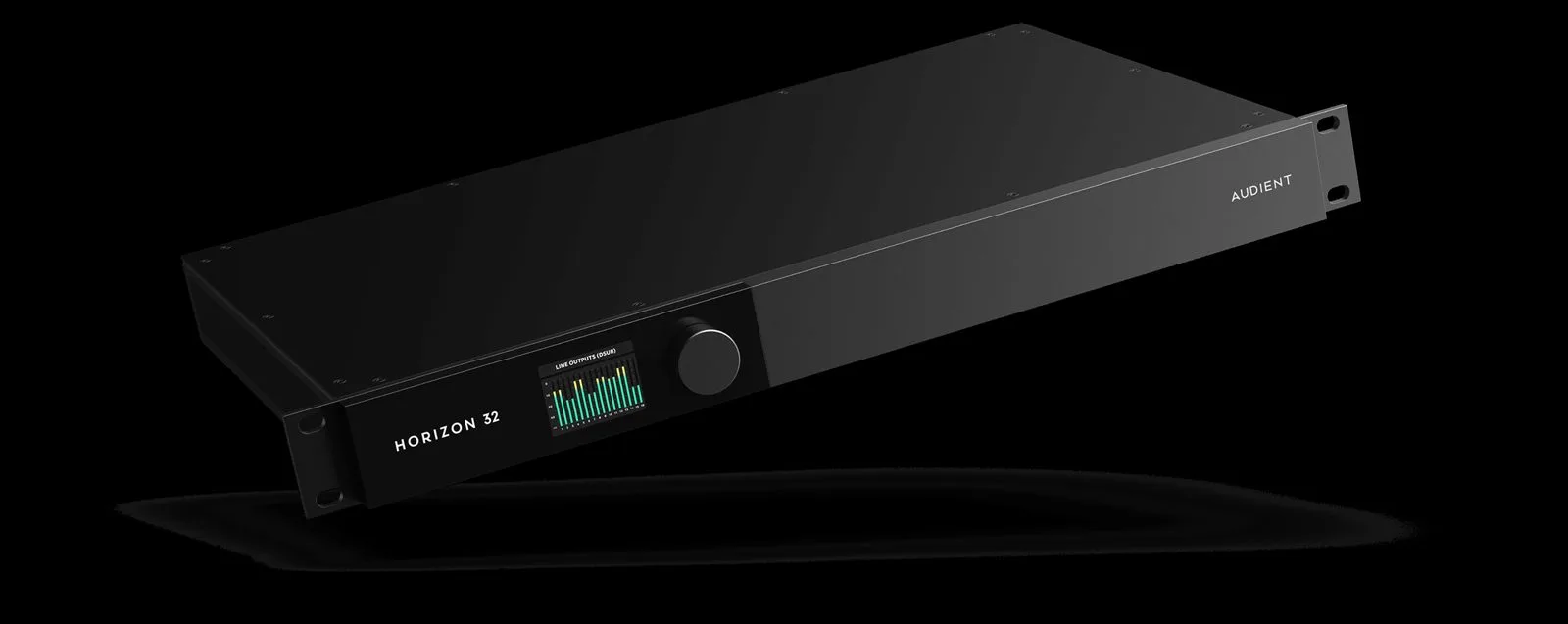
Priced around $3,499, the Horizon 32 isn’t playing the home-studio game: it’s an infrastructure interface for anyone who needs to move a lot of signal cleanly and recall sessions to the letter. Audient’s bet is clear — offer the I/O density of the biggest interfaces with the price-to-performance that built its name on preamps.
Frequently asked questions
Does the Horizon 32 run on Windows?
Audient presents it as a Thunderbolt 3 interface driven under macOS, with four-unit chaining on a single driver. Windows compatibility wasn’t highlighted at launch, so if your studio runs on PC, confirm this before investing.
How many units can you chain?
Up to four Horizon 32s on one macOS driver, for a total of 200 inputs and 200 outputs. That’s what makes it a scalable backbone for a multi-room install.
Are preamps built in, or do you supply your own?
The Horizon 32 is built mainly around DB25 line I/O, designed to interface with existing preamp and processing racks. Input gains get digital recall, which makes reopening a session exactly as it was far easier.
How does it differ from the other Horizon models?
The 32 is the range flagship, with the highest I/O count. The Horizon 8P and 16 target more modest needs. All share 32-bit conversion and the Horizon Control software ecosystem.
My take
Here’s an interface that owns its role: not a home-studio Swiss Army knife but the spine of a hybrid studio. Fifty I/O in a single rack and digital gain recall answer a genuine need — moving lots of signal without turning the control room into a plate of spaghetti or losing an hour finding your settings. Sub-millisecond latency will show at the monitoring stage. The things to watch are the Windows question and the price, which puts the Horizon 32 up against well-entrenched rivals: at this level, day-to-day driver reliability is what decides.