The station name on your car radio, the travel bulletin that cuts across your CD, the frequency that re-tunes itself as you drive between regions: all of that is RDS. Quietly riding on the FM signal since the 1980s, this small data stream is still an essential link in radio broadcasting. Here is how it works and what it carries.
What is RDS
RDS, for Radio Data System, is a digital data channel transmitted alongside the audio of an FM station. It is modulated on a 57 kHz subcarrier, well above the audible part of the FM composite signal (the multiplex), so it disturbs neither the stereo nor the listening. Its bit rate is deliberately very low — a handful of data per second — but enough for everything a receiver needs to know about the station.
What RDS carries
Behind that modest stream lies a precise list of services:
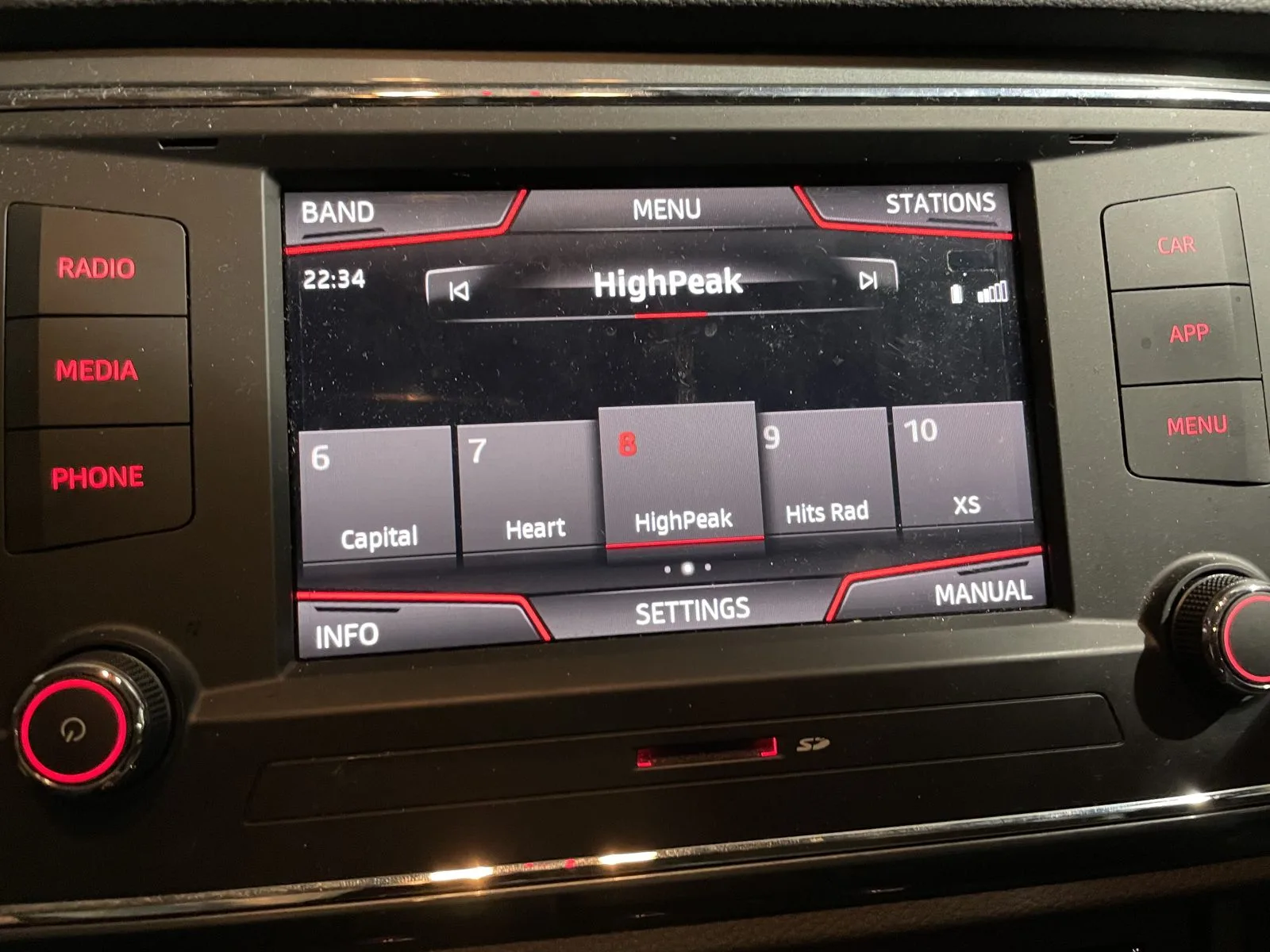
- PS (Program Service): the station’s short name, eight characters, the one shown permanently on the receiver.
- PI (Program Identification): a unique identification code, invisible to the listener, that lets the receiver recognise the station.
- PTY (Program Type): the programme genre (news, rock, classical…), useful for automatic sorting.
- RadioText: a longer message, often the current title and artist or a message from the station.
- CT (Clock Time): the time and date, which let the car radio set its own clock.
- AF (Alternative Frequencies): the list of other frequencies for the same station, to switch seamlessly as you drive.
- TA/TP (Traffic Announcement / Traffic Program): the travel flags, which interrupt the current audio for a traffic bulletin.
- EON (Enhanced Other Networks): information about stations on the same network, to relay traffic from another service.
PS vs RadioText: the scrolling-name trap
A very common abuse is to scroll the current title through the PS field, character by character, to get around its eight-character limit. That breaks the standard: PS is meant to stay fixed, it is the station’s name. Scrolling it tires the display, hurts station recall and becomes unreadable while driving. Good practice is clear: a stable PS for the name, and RadioText for dynamic information such as the title and artist.
RDS in the broadcast chain
RDS is produced by a dedicated encoder at the end of the chain, just before the transmitter. That encoder receives the station’s fixed data and the dynamic information sent live by automation: it is often the playout system that pushes the current title to RadioText. The encoder sits after audio processing and the on-air processing chain, because it has to inject its subcarrier into the final multiplex without disturbing the stereo pilot. A badly set RDS, too hot or out of sync, can degrade stereo separation: it is a level setting not to be neglected.
RDS, RDS2 and the digital era
The standard has evolved with RDS2, which adds data streams, allows full character sets and even the transmission of station logos. In parallel, DAB+ digital radio natively carries far richer metadata, with text and images. But FM and its RDS remain massively present in receivers, and consistency between a station’s FM display and its digital display is now a matter of branding as much as of engineering.
Setting RDS injection and avoiding the pitfalls
RDS may be discreet, but its injection level has to be set carefully. That injection is expressed as deviation: too low and receivers read the data poorly and show an unstable name; too high and the subcarrier eats into the stereo and degrades channel separation. The usual value sits around a few kilohertz of deviation, set in line with the rest of the multiplex. The phase of the 57 kHz relative to the 19 kHz stereo pilot matters too: the two are linked, and an encoder has to lock cleanly to the pilot.
The most common pitfalls are not technical but operational: a PI code inconsistent between frequencies of the same network, which breaks AF following; alternative-frequency lists left out of date; traffic flags left on permanently until they get ignored; or RadioText sent without cleanup that displays stray characters. An encoder well integrated with automation, fed clean metadata, solves most of these issues.
One last thing to watch: the modern car increasingly aggregates sources, and automatic switching between a station’s FM, DAB+ and IP streams relies on consistent identifiers. A well-kept RDS, with a correct PI, is what lets a hybrid receiver recognise that it is indeed the same station from one medium to the next.
My take
RDS is a textbook case of frugal, unkillable technology: a few bytes per second, and yet it still shapes the experience of millions of in-car listeners. The real issue is not technical but editorial — a clean, stable PS, a RadioText kept up to date, consistent traffic flags, and the station gains clarity without spending a cent. Too many stations neglect this detail when it is their permanent shop window on the dashboard. In the age of DAB+ and streaming, looking after your RDS is still a way of respecting the listener who tunes in the old-fashioned way.