Two stations can air the same track and not sound alike at all: one seems wide, dense, instantly “radio,” the other flatter or more tiring. What sets them apart happens in a link the listener never sees, sitting between the studio and the transmitter: the broadcast processor, or audio processing. It gives a station its sonic signature and, above all, protects the transmission chain. Understanding its stages is understanding why radio does not sound like a file player.
Why process the sound before air
Three reasons justify this processing, and none is cosmetic. First, consistency: a single playlist runs an old, poorly mastered track, a very loud jingle and a host’s voice back to back; without processing, the listener would spend their time riding the volume. Then, protecting the modulation: an FM transmitter will not tolerate exceeding a maximum deviation, and in the digital domain 0 dBFS is a wall you cannot cross. Finally, signature: every station wants a recognizable character, more or less dense, more or less bright. These goals overlap with those of broadcast loudness, but processing goes further: it does not just measure, it shapes in real time.
The chain, stage by stage
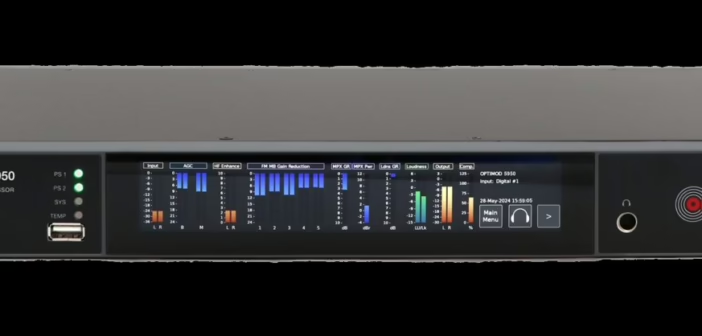
A broadcast processor runs several treatments in an order that makes sense. Read it as a funnel: stabilize, equalize, densify, then protect.
- Wideband AGC — a slow automatic gain control that catches the big level swings from track to track, presenting the rest of the chain with a roughly constant signal. The input stabilizer.
- Equalization — the station’s tonal color is decided here: more or less low end, presence, top. A big part of an outlet’s sonic identity.
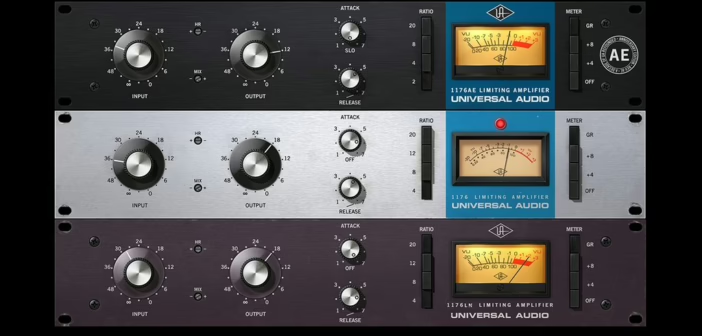
- Multiband compression — the heart of the system. The spectrum is split into several bands treated independently, which lets you densify the bass without crushing the voice, bring out presence without hissing. This is what gives that “pro” density a single wideband compressor cannot.
- Limiter / look-ahead — it prevents any overshoot by anticipating peaks, without the pumping of a brutal limiter.
- Final clipper — the last line of defense. It shaves the remaining peaks to gain the fractions of a decibel of perceived level that make an outlet’s “power.” Too much clipping and the sound fills with distortion: the trickiest setting in the whole chain.
This sequence echoes the logic of a contribution chain: each stage prepares the next, and the order is not negotiable.
The stereo generator and the MPX chain (FM-specific)
On FM, one last stage comes into play, invisible in the digital domain: the stereo generator, which builds the composite, or MPX, signal. It adds the sum (L+R), a 19 kHz pilot that tells receivers they are getting stereo, and the difference (L−R) modulated around 38 kHz. On top of that comes pre-emphasis (50 µs in Europe, 75 µs in the US), a boost of the highs at transmission compensated at reception to improve the signal-to-noise ratio. The quality of this generator and respect for the MPX mask determine how clean the stereo is and how much room is left for subcarriers like RDS. On DAB+ and web radio, there is no MPX: you go out digitally to an encoder, with different loudness constraints.
FM, DAB, streaming: one setting does not fit all
| Platform | Main constraint | What processing aims for |
|---|---|---|
| FM | Deviation, pre-emphasis, MPX | Density and modulator protection, controlled clipping |
| DAB+ / HD | Low-bitrate codec | Less clipping, preserve the codec |
| Streaming | Platform loudness | Consistent LUFS target, true peak in check |
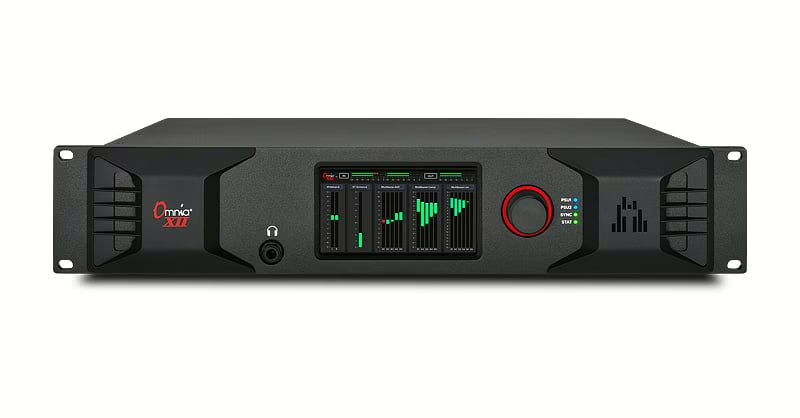
The same station often airs on all three at once, with distinct settings per output. Pushing a very dense FM preset into a low-bitrate DAB encoder is counterproductive: the codec, already struggling, turns clipper distortion into audible artifacts. Modern processors therefore run several chains in parallel — one of the selling points of the latest Omnia and Orban generations.
The “always louder” temptation
For years, the loudness race pushed stations to squash their sound to “pop” out of the receiver. The result: dense but tiring outlets, where any extended listen becomes a chore. The shift of streaming platforms to loudness normalization changed the game: on a service that levels everyone to the same perceived loudness, over-compressing no longer makes you louder — it only makes you flatter. The right setting seeks balance: density that gives body without killing the dynamics, a recognizable signature without aggression. That is where the engineer’s craft outweighs the processor’s spec sheet. That processed signal then happily travels over the audio-over-IP networks of a modern facility.
My take
Broadcast processing is one of the few fields where you hear a bad setting instantly without being able to name it: that radio sound that “tires” you after ten minutes is almost always a clipper pushed too far. Multiband compression remains the discipline’s finest invention, capable of density without mush — as long as you resist the urge to add more. With loudness normalization on the streaming side, the volume race loses its last excuse, and that is good news: a well-set outlet is now the one you can listen to for a long time. The best processor in the world will not save a greedy preset.