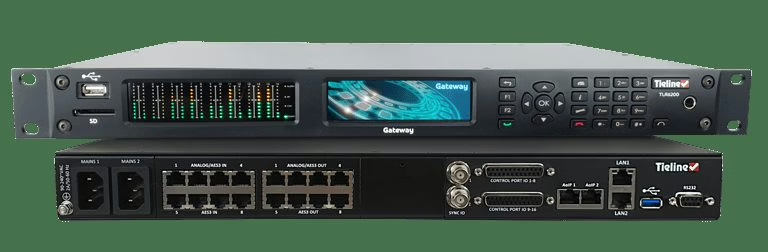
When a station calls a match on the other side of the country, or a reporter goes live from a pavement, the sound has to travel from the field to the studio in real time, cleanly, with no dropout. That journey rests on a piece of gear you never hear on air: the contribution codec. It encodes the audio, sends it over a link — today almost always IP — and reconstructs it at the far end. Misunderstood, it turns a live show into a nightmare of latency and dropouts. Mastered, it makes distance invisible.
Contribution, STL, distribution: what are we talking about?
The word “link” covers several uses worth separating. Contribution is the path from the field to the studio: a correspondent, an OB van at a festival, a remote guest. The STL (studio-transmitter link) connects the studio to the transmitter. Distribution, finally, carries the programme out to relays and affiliates. All three share the same family of tools — codecs — but their constraints differ: contribution often demands low latency to converse with the on-air chain, while an STL favours quality and stability on a permanent link.
Not to be confused with the in-facility audio-over-IP of a control room (Dante, AES67, ST 2110), which runs on a managed local network. The contribution codec crosses the wide world: the public internet, managed networks, cellular. That is a whole different playing field, where nothing is guaranteed.
From copper wire to IP
Links have changed a great deal. For years we used dedicated analog lines, then ISDN — robust but now being retired in most countries. IP has swept the board: managed links with guaranteed quality of service, but also, increasingly, ordinary internet, more temperamental and far cheaper. On top of that, bonded cellular — combining several 4G/5G modems — has become the go-to for the field, where no cable can be run.
The algorithms: the quality, latency, bit-rate triangle
Encoding audio always means arbitrating between three conflicting demands: sound quality, latency and the bit rate required. You cannot maximise all three at once. Linear (uncompressed PCM) offers the best quality and the lowest latency, at the cost of a high bit rate — perfect on a generous link, unthinkable on a constrained network. At the other end, heavy compression saves bandwidth but adds delay or degrades the sound.
Between those extremes, several families coexist. MPEG codecs, notably the AAC family (including AAC-ELD, built for low latency), remain widespread. Opus has emerged in recent years as the best compromise for IP contribution: open, highly efficient, it delivers excellent quality at a remarkably low latency and adapts finely to the available bit rate. Enhanced apt-X rounds out the low-delay picture. The right instinct is not to chase “the best codec” in the abstract, but the one that fits today’s link: linear when bandwidth is plentiful, Opus in the vast majority of cases, AAC-ELD when every millisecond counts.
Holding the link over an imperfect network
The real challenge is not encoding, it is surviving a network that drops packets and varies their delay. Several mechanisms handle this. The jitter buffer smooths out irregular arrivals by storing a moment of audio before playback: the larger it is, the more stable the link but the higher the latency — a constant trade-off, often managed adaptively. Forward error correction (FEC) adds redundant data to rebuild lost packets without asking for them again. Packet loss concealment fills the gaps inaudibly. And redundancy — sending the stream over two separate network paths — protects sensitive live shows.
For two codecs from different makers to understand each other, the industry relies on interoperability standards: the SIP protocol for call setup and the EBU ACIP (Audio Contribution over IP) recommendation. Thanks to them, a field codec can call the studio’s regardless of brand — a huge step up from yesterday’s proprietary links. It is this same all-IP logic that let Radio France build a fully redundant backbone for the Concert de Paris.
Bonded cellular for the field
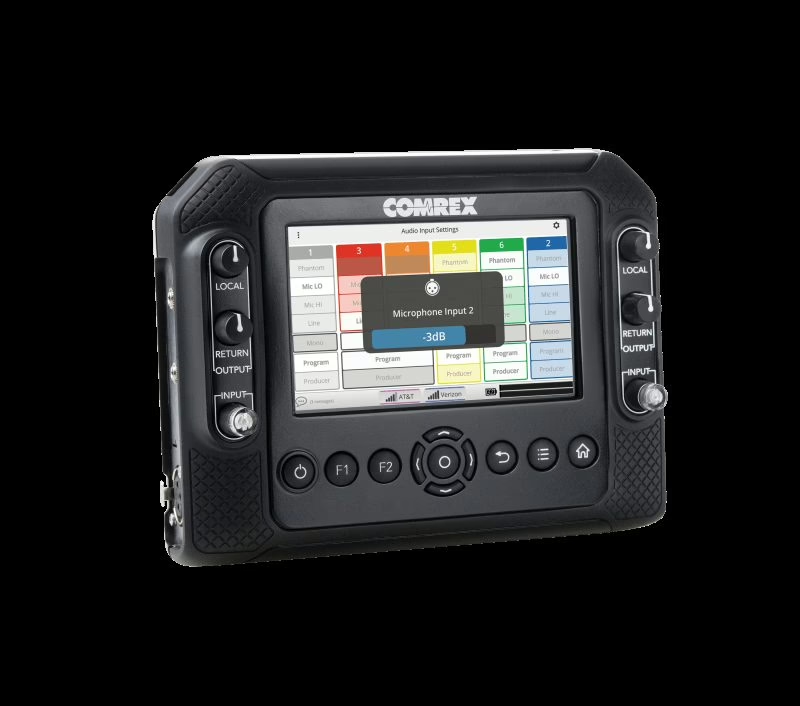
When no fixed line is available — a roadside, a grandstand, a festival in an open field — bonded cellular takes over. The principle: add up several modems, often on different carriers, to combine their throughput and guard against each one’s coverage gaps. If one cell saturates, the others compensate. It has become the reference tool for mobile reporting and sport, with portable units that fit in a backpack. The trade-off is latency, higher than on a wired link, which you must anticipate whenever there is a two-way with the studio.
Latency and conversation: mix-minus
As soon as a link serves an exchange — an interview, a two-way — latency creates a concrete problem: if the remote guest hears themselves come back with a delay, conversation becomes impossible. The solution is mix-minus (or N-1): you send the guest the programme minus their own voice. This principle, at the heart of monitor management and intercom systems in broadcast production, is inseparable from working with codecs: a fine link routed wrongly in mix-minus is still unusable.
Choosing and setting up well
A few markers to stay on track:
- Match the algorithm to the link: linear if bandwidth allows, Opus by default, AAC-ELD for the lowest latency.
- Set the jitter buffer as tightly as possible: large enough for stability, short enough not to weigh down the dialogue.
- Enable FEC and redundancy on high-stakes live shows; always have a plan B (a second link, backup cellular).
- Check SIP/ACIP interoperability beforehand if the two ends are not from the same maker.
- Plan mix-minus during preparation, not once the guest is already on air.
The codec is also where level and dynamic consistency are set before air, upstream of on-air processing and loudness control: a clean contribution makes the rest of the chain easier.
My take
The codec is the link you only notice when it fails — which is exactly why it deserves attention. The move to IP and to Opus has made links more flexible and far cheaper, at the price of a new demand: the network becomes the real subject, and latency the variable to watch. The good news is that SIP/ACIP standards ended brand lock-in, and bonded cellular freed reporting from the tyranny of the cable. One rule does not age, though: always prepare a backup link. On air, redundancy is never a luxury.