Take two radio stations, play the same track on each, and listen: one sounds round and settled, another aggressive and forward, a third bright and airy. Yet the source file is identical. What separates them is neither the mic nor the console: it is what happens just before the transmitter, in a link the public ignores and professionals call on-air processing. The broadcast processor is a station’s sonic signature, its identity card. Understanding what it does is understanding why radio sounds like no other medium.
Why process the sound before broadcasting it?
On-air processing meets three needs the studio alone cannot. First, consistency: one channel plays an old, poorly mastered track, a recent jingle, a presenter’s voice, an ad spot. Without processing, the listener would spend their time riding the volume. Second, technical protection: an FM transmitter has strict modulation limits it must not exceed, on pain of spilling onto the neighbouring station. Third, identity: a station wants a recognisable, competitive sound that grabs the ear during a dial-scan.
The broadcast processor therefore takes any audio feed and turns it into a homogeneous, controlled, signed signal. This is not about making sound louder in the naive sense: it is about making it constant, dense and safe, while keeping an intended colour.
The chain, link by link
A modern broadcast processor strings together several stages, each with a precise job. You find them, under varying names, in every serious machine on the market.
- Wideband AGC: a slow gain control that catches large level swings between sources, presenting the rest of the chain with an already-levelled signal.
- Multiband compression: the spectrum is split into several separately treated bands. This is the heart of the sonic character: here you decide the station’s low/mid/high balance, independent of the original mix.
- Multiband limiter: it caps each band to hold levels, without letting an instrument stab through.
- Bass management: a treatment dedicated to the low end, for bass that is present but does not eat the modulation.
- Final clipper: the most delicate stage. It shaves the ultimate peaks for perceived loudness, at the cost of a distortion you must master so it stays inaudible.
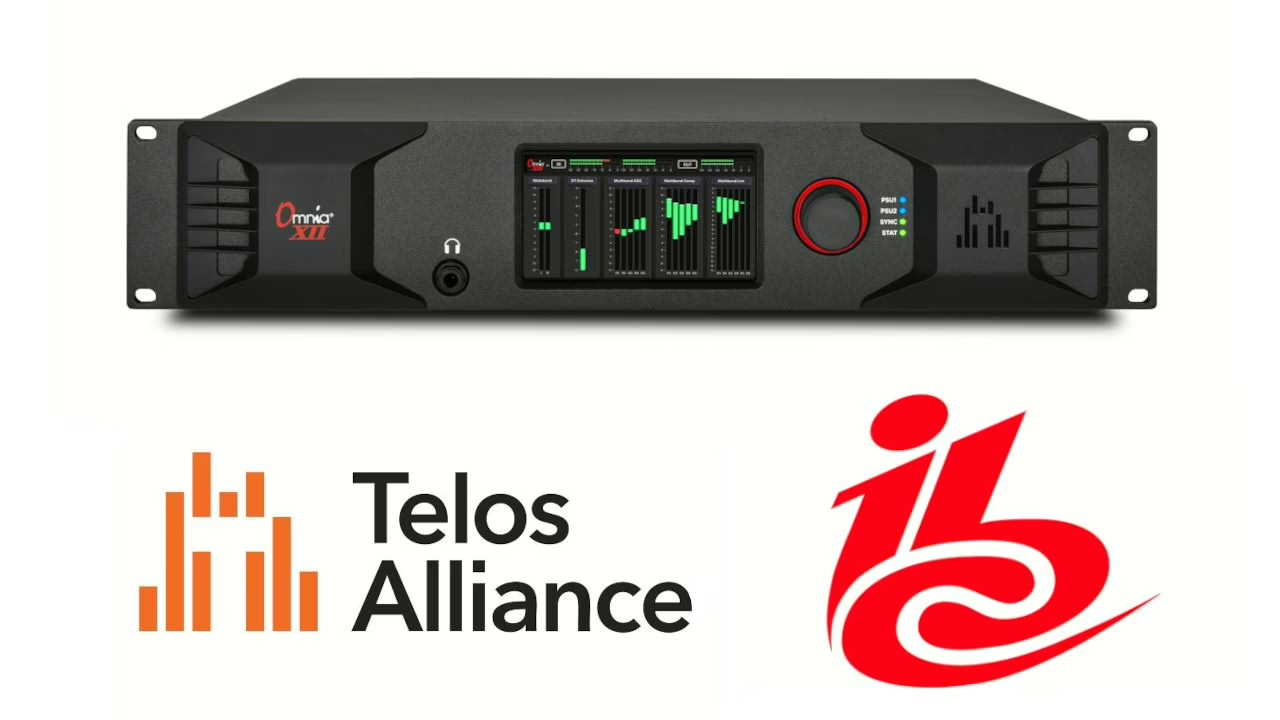
That last link deserves a pause, because it is where the difference plays out between a loud, tiring sound and a loud but bearable one. All the manufacturers’ research today is on clippers that gain perceived level without the harshness and listening fatigue of over-aggressive processing. That is exactly the aim of recent processors like the new FM, HD and DAB broadcast processor shown this autumn, whose architecture combines wideband AGC, multiband compression and limiting, dynamic EQ and refined bass management.
The FM specificity: MPX, pre-emphasis and modulation
FM imposes constraints neither streaming nor DAB know. The stereo signal is encoded in a multiplex, the MPX, and the system applies pre-emphasis: highs are deliberately boosted on transmission, then lowered on reception to improve the signal-to-noise ratio. The consequence: the processor must manage a very tight high-frequency budget, or it saturates the modulation the moment a track is rich in top end. It is an invisible but decisive part of the craft: on FM, gaining loudness without overflowing the treble is a tightrope act.
DAB+ and streaming shed the MPX but bring another player: data compression. Over-aggressive processing upstream creates artefacts that worsen once the stream is encoded. A good processor therefore adapts its work to the delivery channel, and stations often run different settings for FM, DAB and web from a single source.
Processing and loudness: two logics to reconcile
Here is a point that often confuses. On FM, the loudness war long reigned: louder than the neighbour, whatever it takes. But the streaming world runs on the opposite logic, loudness normalisation: platforms pull everyone to a common target, cancelling the benefit of a crushed signal. We detailed that shift in our explainer on broadcast loudness and the EBU R128 standard.
The broadcast processor sits at the hinge of two worlds: it must stay competitive where loudness still pays, and clean where it no longer does. The underlying trend is clear, and healthy: quality and consistency increasingly win over raw power. A dense but open sound, one that does not tire after ten minutes, beats a wall of sound that drives listeners away.
Where on-air processing sits in the chain
The processor slots in at the end of the chain, after the console and the audio-over-IP distribution, just before the transmitter or the streaming encoder. On modern plants it is often itself a network resource, fed over AES67 and controlled remotely from a web interface, just like the AoIP radio consoles that feed it. A single point, at the end of the chain, decides how a whole station sounds: which makes its setup both strategic and fearsomely sensitive.
My take
I have always been fascinated by this link, because it concentrates a tension unique to radio: technique in the service of an identity. Setting a broadcast processor is not ticking boxes, it is defining what a station sounds like, which bass it owns, which brightness it claims, how far it pushes before it tires. I have heard too many stations sabotage themselves through over-processing, confusing loud with good. The finest stations are those that understood on-air processing is not a loudness weapon but a signature tool. The good news is that the new generation of processors, better endowed in power and algorithmic finesse, finally delivers density without harshness. What remains is the hard part, which money cannot buy: the taste of the person doing the tuning.