New brand, new take on rhythm in modular: Vostok Instruments is one of those young Eurorack makers betting on multi-channel analog. Its Sigma module, shipping since September 2026, is a rhythm-focused gate processor that turns four input signals into a shower of usable gates — up to twenty-three simultaneous outputs. Enough to drive a modular drum voice, run sequencers and fire envelopes from a handful of triggers.
Four inputs, twenty-three gates out
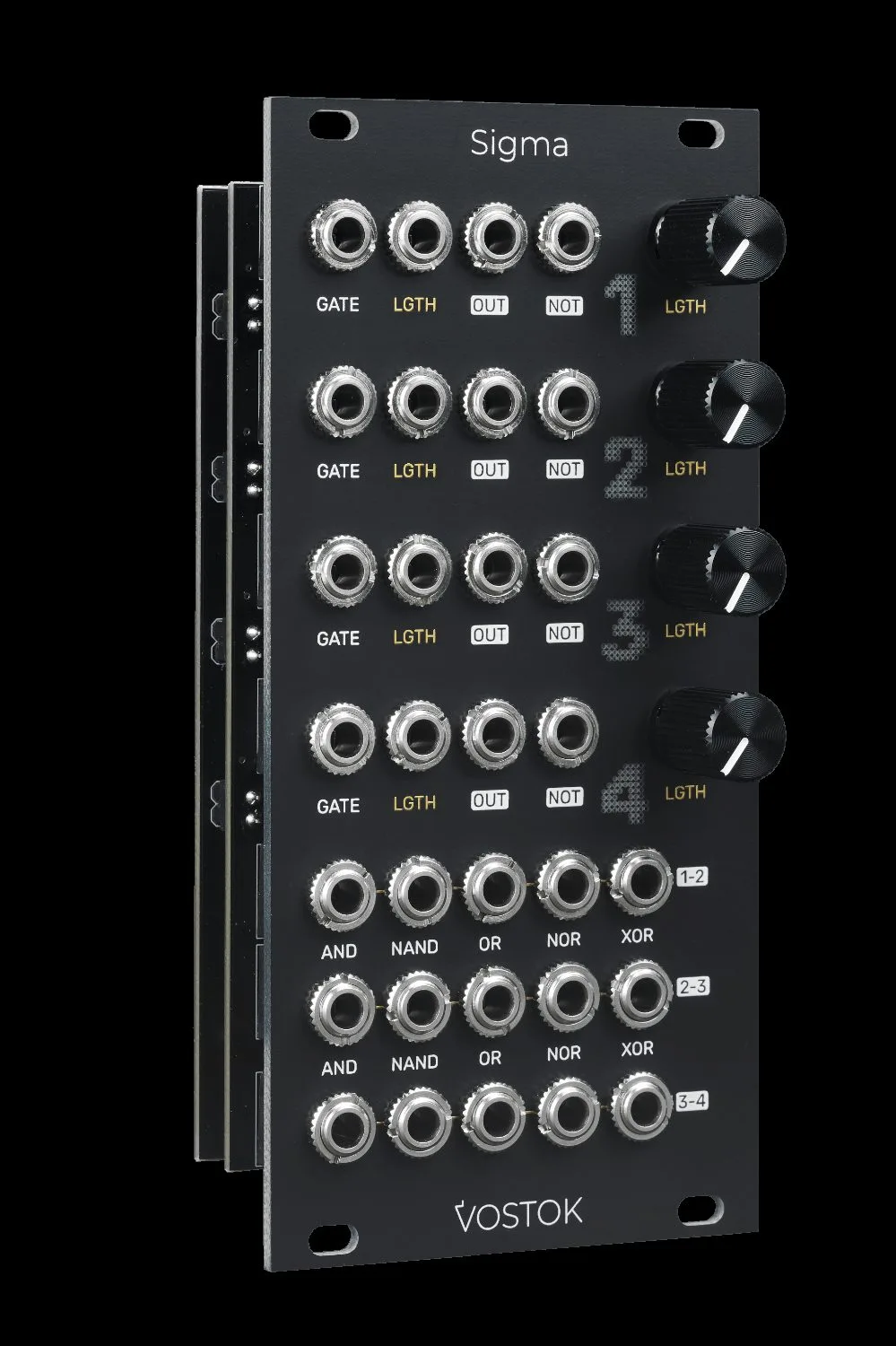
Sigma’s principle is as easy to state as it is rich in use: from four gate inputs, the module generates up to twenty-three simultaneous gate signals. Each channel takes a gate input and a duration knob with a CV input, and offers a gate output plus a NOT output (the logical inverse). That’s already eight outputs from four channels alone, before you even reach the logic section.
A digital core, analog logic
Where Sigma stands out is its hybrid architecture. A digital core handles the four voltage-controlled gate-length processors, while a fully analog logic section builds new events with minimal latency. That section combines each pair of length-processed gates using analog Boolean circuits, producing fifteen more outputs: AND, NAND, OR, NOR and XOR for each channel pair. It’s this combinatorial layer that blows the number of available rhythms wide open from just a few triggers.
| Spec | Sigma |
|---|---|
| Type | rhythmic gate processor |
| Inputs / outputs | 4 gate inputs, up to 23 simultaneous gate outputs |
| Per channel | gate input, duration with CV, gate and NOT outputs |
| Logic | AND, NAND, OR, NOR, XOR per channel pair (15 outputs) |
| Format | Eurorack 12 HP, 30 mm deep, 70 mA (+12 V / -12 V) |
What it changes in a patch
In practice, Sigma is a generator of polyrhythms and variations. You feed a clock and a few divisions into its inputs, set the durations, then draw from the logic outputs to feed percussion, sequencers or envelopes. The richness comes from the combinations: the same set of inputs gives very different patterns depending on whether you use the AND, XOR or NOT outputs. For a rhythm-focused modular, it’s a concentrate of possibilities in a small format. The module comes as an assembled version or as a self-build kit.
Priced around €255, Sigma is for people who build their own modular drum machine rather than those after a ready-made sound. It makes no sound on its own: it’s a rhythmic brain whose value only shows once it’s patched into sound sources. But to animate a system, it opens a playground that’s rare at this price.
Frequently asked questions
Does Sigma make sound?
No. Sigma is a gate processor: it generates and combines trigger signals, not sound. You need to patch it into percussion modules, envelopes or sequencers to hear it. It’s a rhythmic brain, not a sound source.
How do you get twenty-three outputs from four inputs?
Each channel provides a gate output and a NOT output, so eight outputs from four channels. The analog logic section adds fifteen outputs by combining channel pairs through AND, NAND, OR, NOR and XOR operators, bringing the total to twenty-three.
Why a part-digital, part-analog architecture?
The digital core handles gate length precisely, under voltage control, while the analog logic builds the new events with minimal latency. That split combines setting precision with processing responsiveness.
Do you need to solder to use it?
No. Sigma comes as an assembled version, ready to patch. It’s also offered as a self-build kit for those who prefer DIY, but that isn’t required.
My take
Sigma backs a sound idea: Boolean logic applied to gates is a goldmine of polyrhythms, and running it in analog keeps the responsiveness intact. Turning four inputs into twenty-three usable outputs is a lot of rhythmic material per centimetre. You have to enjoy building your patterns rather than picking them from a menu, and accept that it won’t sound on its own. But for anyone building a modular rhythm section, it’s the kind of quiet brain that ends up steering the rest of the system.