Make Noise is bringing its flagship case up to date. Announced on 12 October 2026, the 4 Zone CV Bus Case returns in a 208 HP, 7U format, paired with a new CV Big Bus that takes the modulation bus from four to eight channels. Behind the format sits a simple, valuable idea for anyone building a large modular system: separate the power supplies so noisy modules can’t pollute the sensitive ones.
Four genuinely isolated power zones
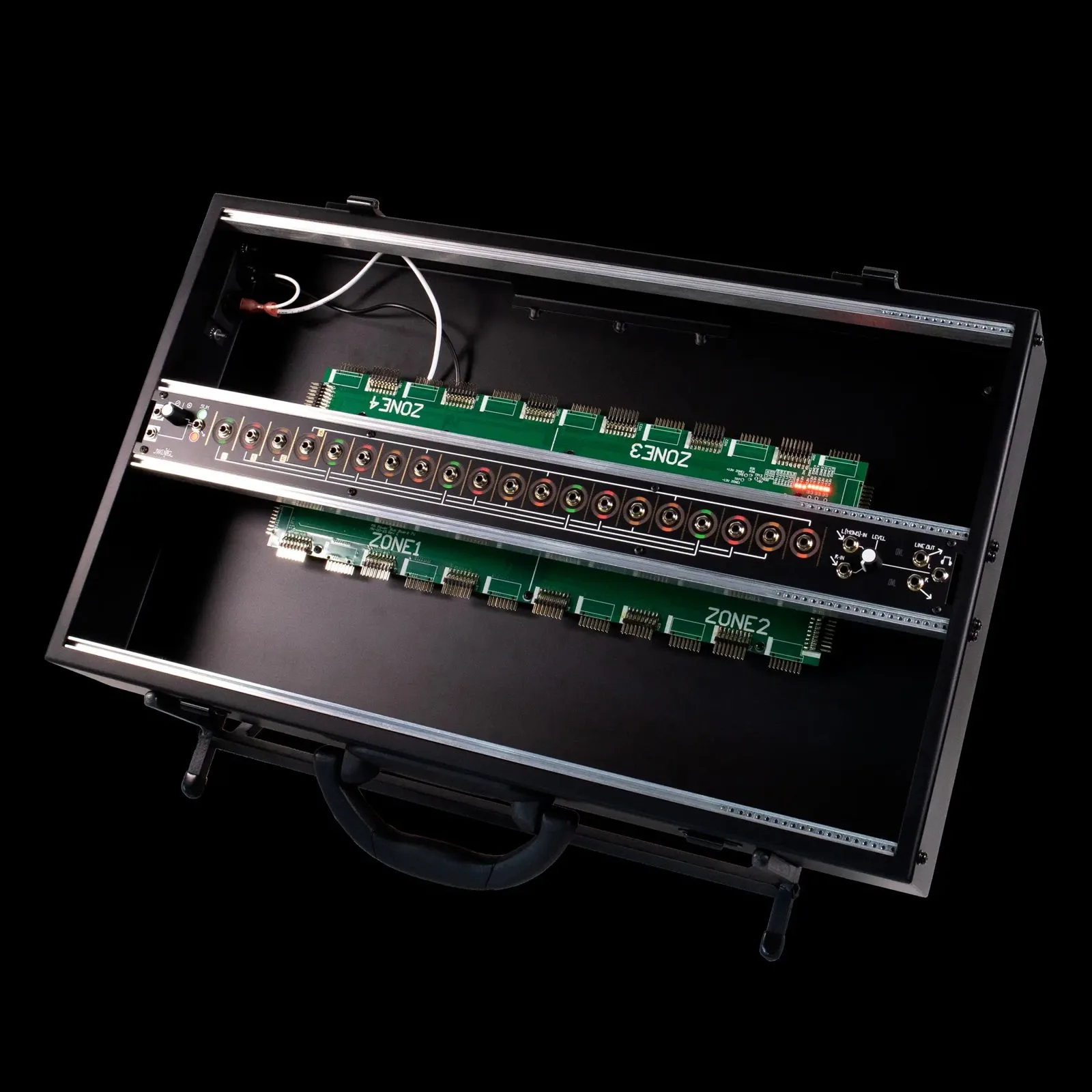
The heart of the case is its four-zone power system. Each zone has its own +12 V and -12 V rails and its own ground return, while the +5 V is shared across all four. In practice, you can hand one zone to digital oscillators or fast-clock modules, often a source of noise, and reserve another for VCAs, filters and sensitive inputs. It’s the kind of detail that never shows on a spec sheet but makes itself heard on a complex patch. Rated capacity is 4 A on +12 V, 2.4 A on -12 V and 1 A on +5 V.
A chassis built for touring and the studio
The case uses powder-coated metal in matte black, matched to the brand’s Black & Gold modules. Black anodised tapped aluminium rails replace the old sliding-nut system, making module mounting easier. The removable lid closes over a fully patched system, and both the power connector and switch are recessed for safer transport. Two 104 HP rows take 3U modules, with the central 1U row occupied by the CV Bus.
| Spec | 4 Zone CV Bus Case |
|---|---|
| Format | 7U, two 104 HP rows (208 HP) |
| Power | 4 isolated zones (±12 V + dedicated ground per zone), shared +5 V |
| Capacity | +12 V: 4 A, -12 V: 2.4 A, +5 V: 1 A |
| Central row | 1U occupied by the CV Bus |
| Build | matte-black powder-coated metal, tapped anodised rails, removable lid |
The CV Bus and the new CV Big Bus
The CV Bus, in the central row, distributes control voltages across the whole system through a bank of headers, with its own mixer and visual indicators for level, rate and polarity. The idea dates back to 2013 and Alessandro Cortini’s personal system. The 2026 news is the CV Big Bus: it doubles the channel count from four to eight to keep up with the modulation density of the New Universal Synthesizer System. It’s also sold as a standalone upgrade and works with both the 7U case and the 4 Zone.
Priced around $949 (about €1,099), the 4 Zone CV Bus Case isn’t aimed at the beginner starting out in 3U. It’s an architect’s case, for someone who treats a system as an instrument in its own right and wants to control its power and modulation all the way down.
Frequently asked questions
What are the four power zones for?
Each zone has its own ±12 V rails and dedicated ground return. That electrically isolates noisy modules (digital oscillators, clock modules) from sensitive ones (VCAs, filters), cutting interference in a large system. The +5 V stays shared across all four zones.
What’s the difference between the CV Bus and the CV Big Bus?
The original CV Bus distributes four channels of control voltage across the system. The CV Big Bus, new for 2026, doubles that to eight channels for denser modulation. It’s available separately and fits both the 7U case and the 4 Zone.
Can you transport the case patched?
Yes. The removable lid closes with the system fully wired, and the power connector and switch are recessed to avoid snags. The powder-coated metal build is aimed at mechanical durability on the road.
How many HP of modules can you fit?
The case offers two 104 HP rows for 3U modules, 208 HP in total. The central 1U row is reserved for the CV Bus and doesn’t take standard modules.
My take
Power is the part you ignore until the day a digital oscillator makes an idle VCA sing. Four genuinely isolated zones are the real value here, far more than the finish matched to the house modules. Moving the CV Bus to eight channels lands well for busy systems where modulation travels everywhere. That said, this case speaks to advanced modular users: at this price and size, you’d want to already know why you need four separate supplies. For those people, it’s a well-made backbone.