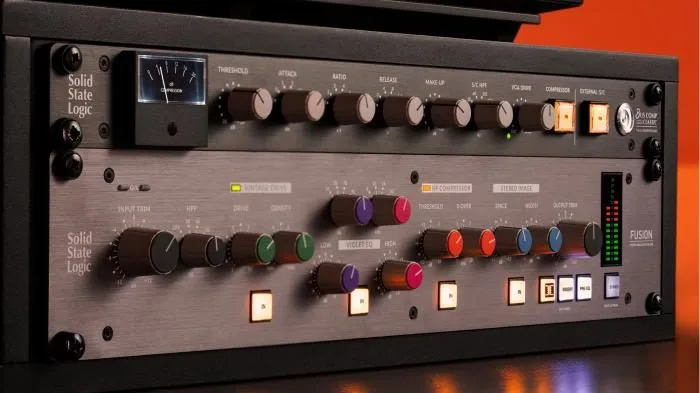
It’s one of the most copied compressors in studio history, and Solid State Logic has just put it back in a standalone box. Shipping since October 2026, the Bus Comp Classic carries the circuit of SSL’s famous console bus compressor into a 1U rack, adding a handful of modern refinements. For anyone mixing in the box but dreaming of that legendary “glue” on the master bus, this one turns heads.
The original circuit, not an emulation
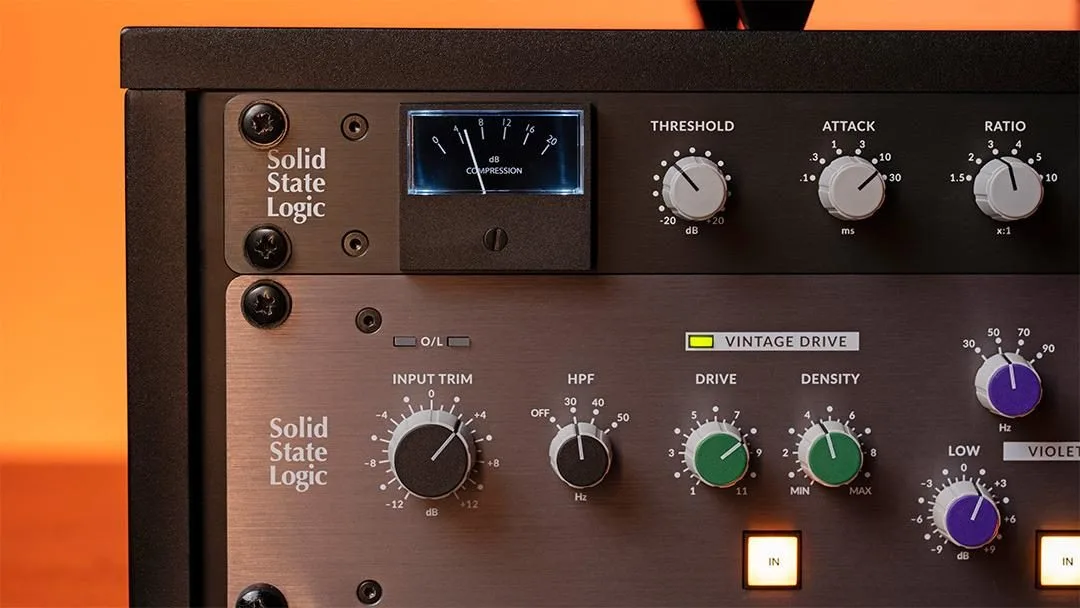
The Bus Comp Classic is built on THAT 2181 VCAs in the audio path and SSL’s own sidechain design, with a VCA in its feedback loop — exactly the architecture that gave the SSL master bus its signature. You get the six-position stepped controls for threshold, attack, ratio and release, a 2:1 soft-knee mode and an Auto release setting. Nothing is left to chance: these are the settings generations of engineers know by heart.
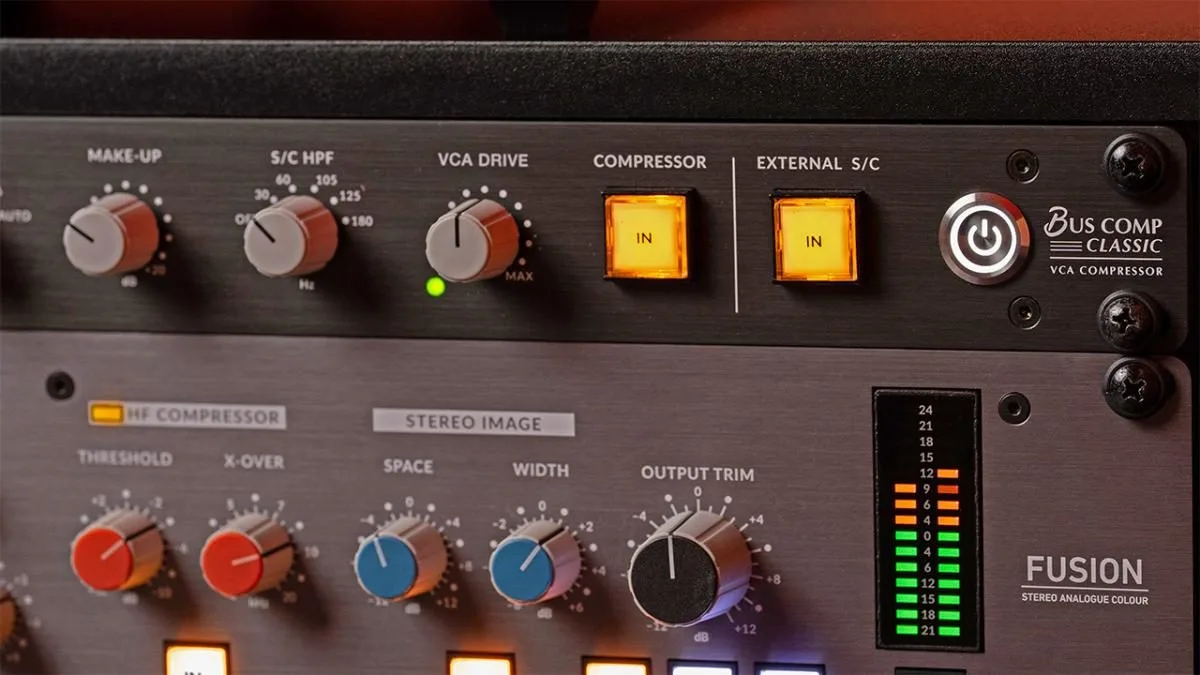
VCA Drive, the real new trick
The headline of this version is a continuously variable VCA Drive control. At low settings the VCAs run balanced — clean and transparent, true to SuperAnalogue precision. Push the Drive and the VCAs switch to unbalanced operation: harmonic distortion climbs, up to around 10% THD at the top, and the sound gains colour and character. You move from surgical precision to a fuller, 4K-console-style grit without changing units. It’s the kind of control that turns a utility into an instrument.
Sidechain and connections
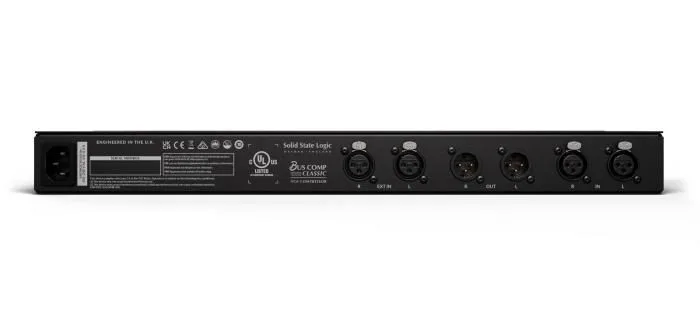
On the detection side, the Bus Comp Classic has a six-position sidechain high-pass filter to stop low end from triggering the compression and keep the mix’s foundation intact. Add a genuine stereo external sidechain input, valuable for de-essing, ducking or compression driven by another source. Connections come down to two XLR in and two XLR out, and an illuminated analogue VU meter watches gain reduction — lighting only when the compressor is working.
| Spec | Bus Comp Classic |
|---|---|
| Type | stereo VCA bus compressor (THAT 2181) |
| Controls | stepped threshold, attack, ratio, release (6-position), 2:1 soft-knee, Auto |
| New feature | variable VCA Drive (balanced to unbalanced, up to ~10% THD) |
| Sidechain | 6-position high-pass filter, stereo external input |
| Format / I/O | 1U, 2 XLR in / 2 XLR out, illuminated analogue VU meter |
Priced around $1,799 (about £1,290), the Bus Comp Classic isn’t cheap, but it offers the real circuit — not a software approximation — in a format that fits any rack. For a hybrid studio that wants an analog anchor on its master bus, it’s a remarkably coherent proposition.
Frequently asked questions
How does it differ from the bus compressor built into SSL consoles?
The Bus Comp Classic uses the same THAT 2181 VCA circuit and the same sidechain detection as the console bus compressor, in a standalone 1U box. It adds a VCA Drive control and a stereo external sidechain input, both absent from the original console version.
What does the VCA Drive control do?
It moves the VCAs from balanced, transparent operation to a more coloured unbalanced mode. At the top, harmonic distortion reaches around 10%, adding character on a master bus or in parallel processing. It’s a continuous control, not a switch.
Can you use it for parallel compression?
Yes. With XLR ins and outs and an external sidechain input, it suits parallel processing as well as bus mixing. The sidechain high-pass filter keeps low end from driving the gain reduction too hard.
Does the VU meter stay off at idle?
Yes. The illuminated analogue VU meter lights only when the compressor is actually acting on the signal. That’s intended behaviour, not a fault.
My take
Pulling the SSL bus compressor out of the console and into a 1U rack was expected, but it’s the VCA Drive that makes this interesting: one knob to slide from transparency to colour without reaching for another unit. The original circuit does the rest, and it has little left to prove on a master bus. The price is that of a character piece, not an impulse buy. The question isn’t whether it sounds good — it’s whether you mix enough on your bus for dedicated hardware to genuinely change how you work.