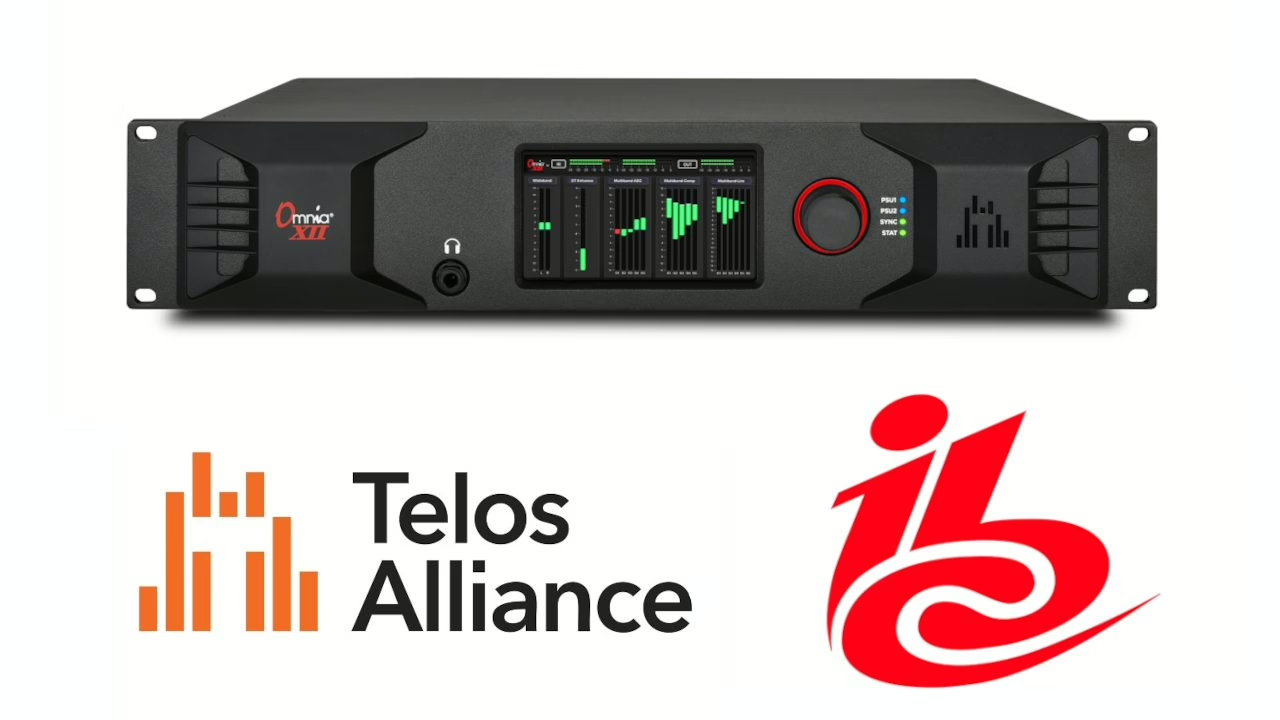
Telos Alliance is using IBC 2026 to bring the Omnia XII to Europe, the new flagship of its broadcast processing line. Unveiled in the US earlier this year, the box targets FM, HD Radio and DAB on-air processing with a fully reworked architecture and a brand-new clipping stage. In a business where on-air sound is still a station’s signature, this is a launch that matters.
A new flagship for on-air processing
The Omnia XII follows a line that shaped modern radio, from the Omnia.9 to the Omnia.11. Designed by Frank Foti and the Omnia team, it fits into two rack units and pairs a colour display with local controls and an HTML5 browser-based remote you can drive from any device. Telos claims eight times the processing power of anything it has built before, along with a modular software architecture meant to take on new features and standards through updates rather than freezing the product at launch.
What the new processing chain changes
At its core sits a full dynamics chain, where each stage sets up the next before the signal hits the transmitter. The building blocks you would expect from a high-end air chain are all here, but reworked:
- a wideband AGC to settle the input level ahead of any multiband work;
- five bands of multiband AGC and compression to manage spectral balance and density;
- six bands of multiband limiting to hold the signal without crushing the music;
- a dynamic EQ and refined bass management to shape the low end without letting it swamp the modulation;
- a dynamic RDS encoder and integrated ratings watermarking.
The house QuickTweak system lets you move several interrelated parameters at once instead of chasing a dozen independent sliders, a real time-saver when a preset needs adjusting on air without wrecking the whole balance.
Clemenza, a clipper built against listener fatigue
The real news is the final stage. After the multiband section, the signal hits a clipper named Clemenza, whose stated goal is to deliver competitive on-air loudness without the distortion and listener fatigue that so often come with aggressive processing. That is the whole point of modern radio processing, and it is where a station’s reputation is won or lost.
I have spent enough time in the control room and in technical management to hold a firm view here: chasing loudness is a bad trade. A signal pushed too hard into the clipper may win the first few seconds of a dial-flip, but it tires the ear and loses the listener twenty minutes in. A clipper that stays clean at high density is exactly what you want from a processor at this level. The verdict, of course, will come from hearing it on real, varied programming, the only judge that counts.
Connectivity, AoIP and operation
On the back panel, the Omnia XII covers analogue, AES3 and composite output, along with Livewire+ / AES67 audio-over-IP and a redundant AoIP network. An external insertion point lets you drop a third-party device into the chain, such as an audience-measurement system. Loudness metering and RDS encoding round out a package built to slot into an existing IP infrastructure rather than force a redesign of the station’s audio network.
If you already run an audio-over-IP plant, the unit will speak the same language as the rest of your facility, which is now the price of entry into a modern infrastructure, a point we broke down in our guide to the latest broadcast console generation.
The takeaway
The Omnia XII does not reinvent on-air processing, but it brings together a muscular dynamics chain, a clipper that promises loudness without harshness, and fully remote operation. Its home turf is the on-air sound, where the question of loudness and how it is measured is fought over every day. Full specifications are published on the Telos Alliance website.