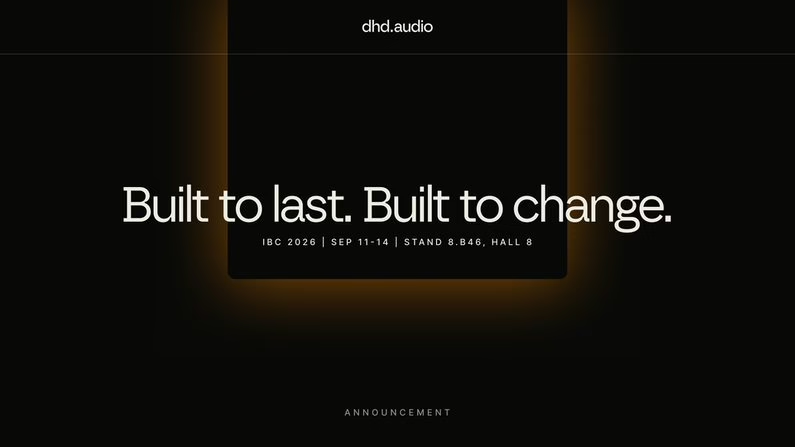
Ahead of IBC 2026 (Amsterdam, September 11-14), German manufacturer DHD is readying what it calls one of the most radical advances in its 30-year history: a third-generation audio mixing console. The exact name stays under embargo until the show’s first day, but the direction is clear—modular, IP-controlled, and above all designed not to send existing investments to the scrapheap.
A third generation with no investment cliff
Here’s the point that matters most to operators: the new console stays compatible with the digital processing cores DHD has deployed since 2020. In other words, a radio station or broadcaster that installed a DHD core in recent years can upgrade its mixing surface without replacing the whole infrastructure. In a sector that thinks in 15-year investment cycles and round-the-clock operation, that continuity is often worth more than any feature list.
The console sits within a modular architecture built for networked audio production: scalable processing capacity, IP-based control, integration with existing processing cores. DHD explicitly ties the approach to the EBU’s Dynamic Media Facility vision—the idea of a software-defined facility where resources are allocated dynamically rather than locked into dedicated hardware.
Gear for every point in the chain
The intended scope covers most links of a broadcast infrastructure: on-air studios, main control rooms, OB trucks and SNG vans, ingest stations and edit suites. That’s DHD’s logic from its current ranges—from the compact SX2 to the large-format RX2, with fanless, PC-free DSP cores—carried to a new generation of surface.
The longevity bet
The manufacturer sums up its philosophy in a line: built to last doesn’t mean staying the same—it means achieving change efficiently and cost-effectively. That’s exactly the message a radio or TV technical director wants to hear: not the promise of an annual revolution, but the assurance that an installed base can be modernised in stages.
My take
I’ve spent enough time around control rooms and technical management to know that in broadcast, real value isn’t measured by a console’s feature count but by its reliability over time and the pain—or absence of pain—of a migration. A station doesn’t go off air; you don’t swap a control-room core the way you change a plugin. By betting on backward compatibility rather than a clean slate, DHD is talking to the people who operate, not just the ones who buy. The surface itself, held back for IBC’s opening day, is what remains to be seen.
The announcement fits a broader broadcast shift toward software-defined mixing and audio-over-IP, already seen with Wheatstone VMX and the Lawo Edge One stagebox. For the technical foundations, see our guide to Audio over IP: Dante, AES67 and SMPTE ST 2110. The manufacturer’s show programme is on DHD’s site.