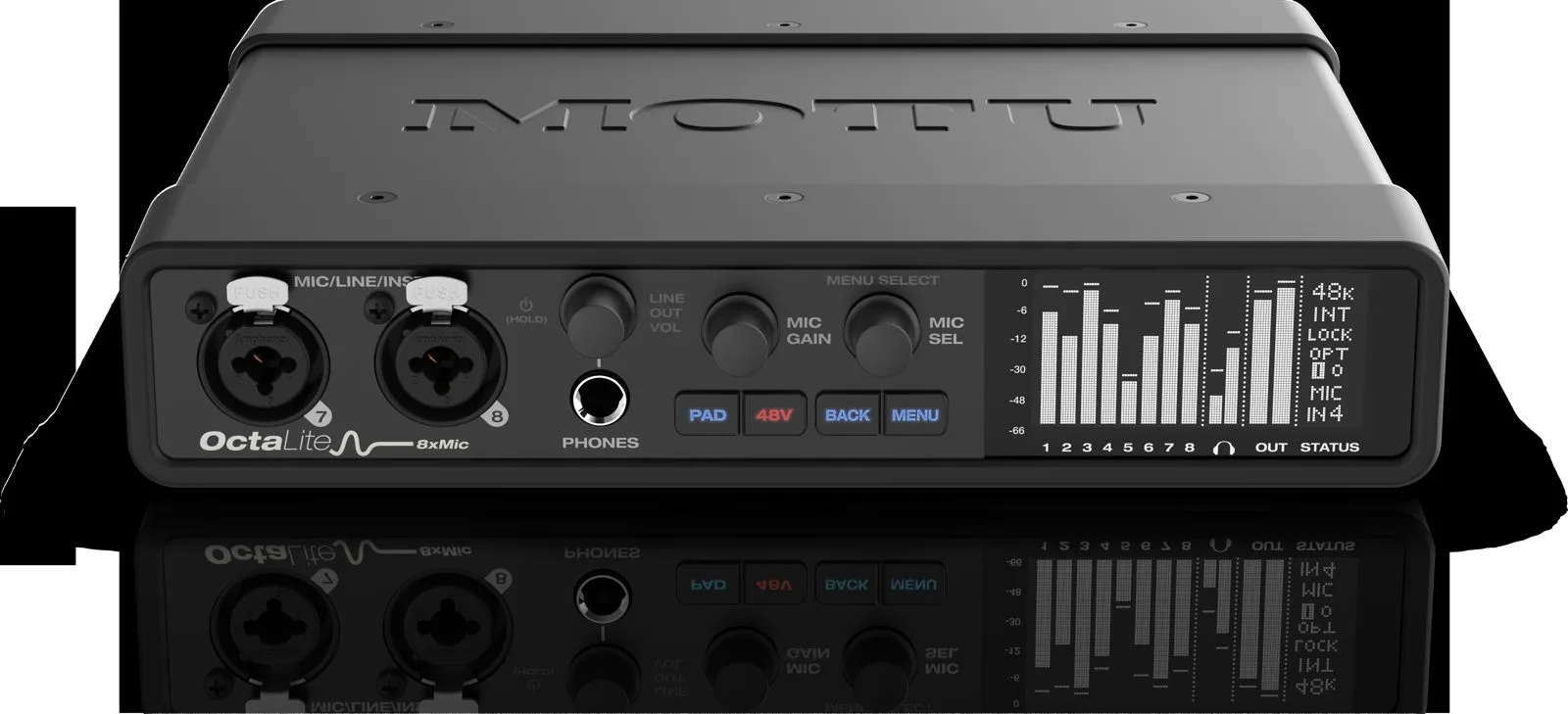
MOTU rounds out its interface range with the OctaLite, a half-rack box built to track eight sources at once without hogging a full rack. On paper it is a 16-in/12-out unit packed into a steel chassis topped by a large OLED meter. In practice it is a direct answer to a familiar frustration: having enough quality preamps on hand without giving up portability.
A half-rack that captures eight sources at once
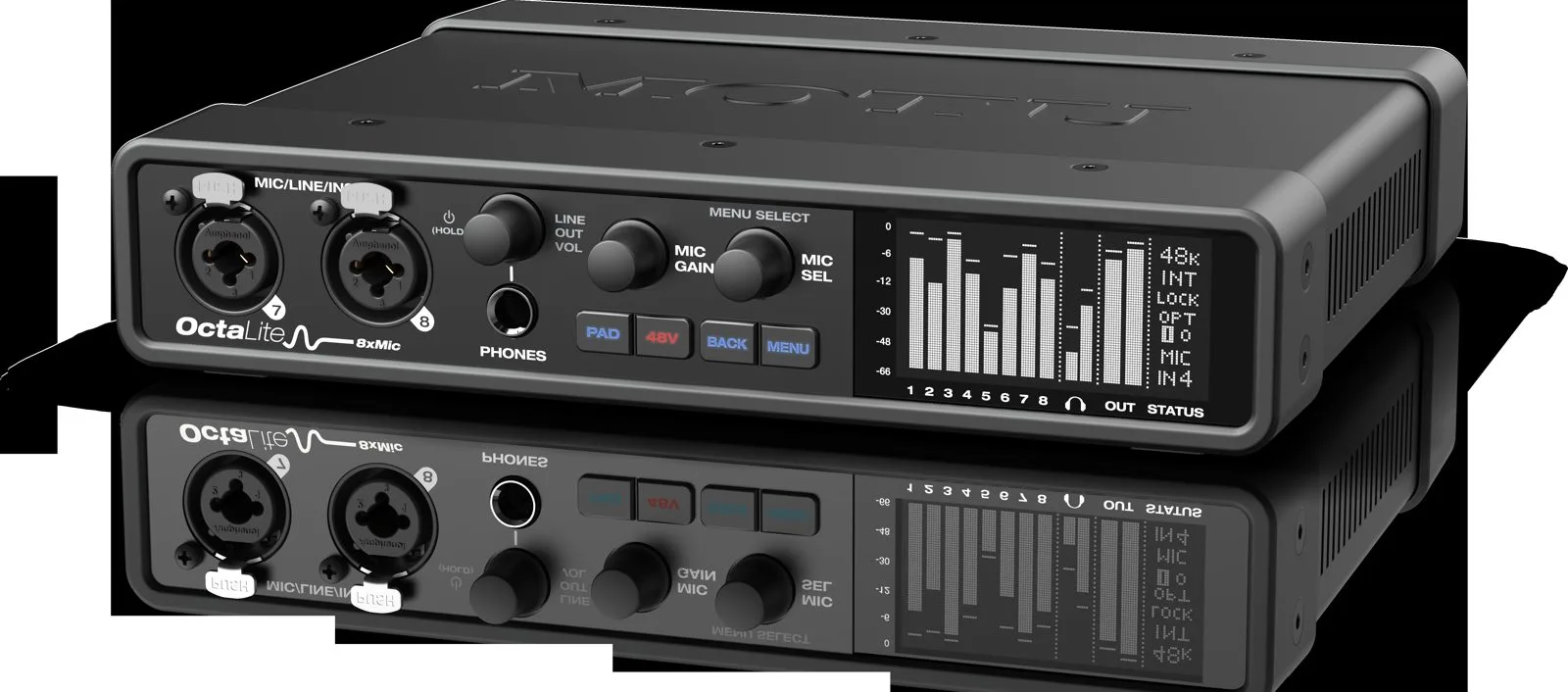
The front panel lines up eight XLR/TRS combo inputs that take mic, line and Hi-Z instrument signals. Round the back sit two balanced TRS line outputs, a dedicated headphone output, and a pair of optical ports switchable between ADAT and TOSLink. Everything talks over USB-C in class-compliant mode: plug it in and it works, iPad included. The half-rack format is no footnote — it slips into a bag, sits on the corner of a desk, and racks up with the right kit.

Generous preamps and high-end conversion
Each preamp delivers up to 74 dB of gain, a -20 dB pad, switchable 48 V phantom power per channel and Burr-Brown op-amps, for a quoted -129 dBu equivalent input noise. For conversion, MOTU fits ESS Sabre32 technology with an ES9026PRO DAC: 125 dB of output dynamic range and -114 dB THD+N. It records up to 192 kHz. These are numbers you normally expect from pricier interfaces, and that is exactly where the OctaLite wants to score.
| Spec | MOTU OctaLite |
|---|---|
| Configuration | 16-in / 12-out, half-rack |
| Preamps | 8 XLR/TRS combo (mic/line/instrument), +74 dB, -20 dB pad, 48 V per channel |
| Conversion | ESS Sabre32 (ES9026PRO), 125 dB dynamic range, up to 192 kHz |
| Optical | 1 in / 1 out ADAT or TOSLink, SMUX |
| Connection | USB-C class compliant (Mac, Windows, iOS) |
| Latency | 2 ms round trip at 96 kHz (32-sample buffer) |
CueMix 5: latency-free monitoring, with effects
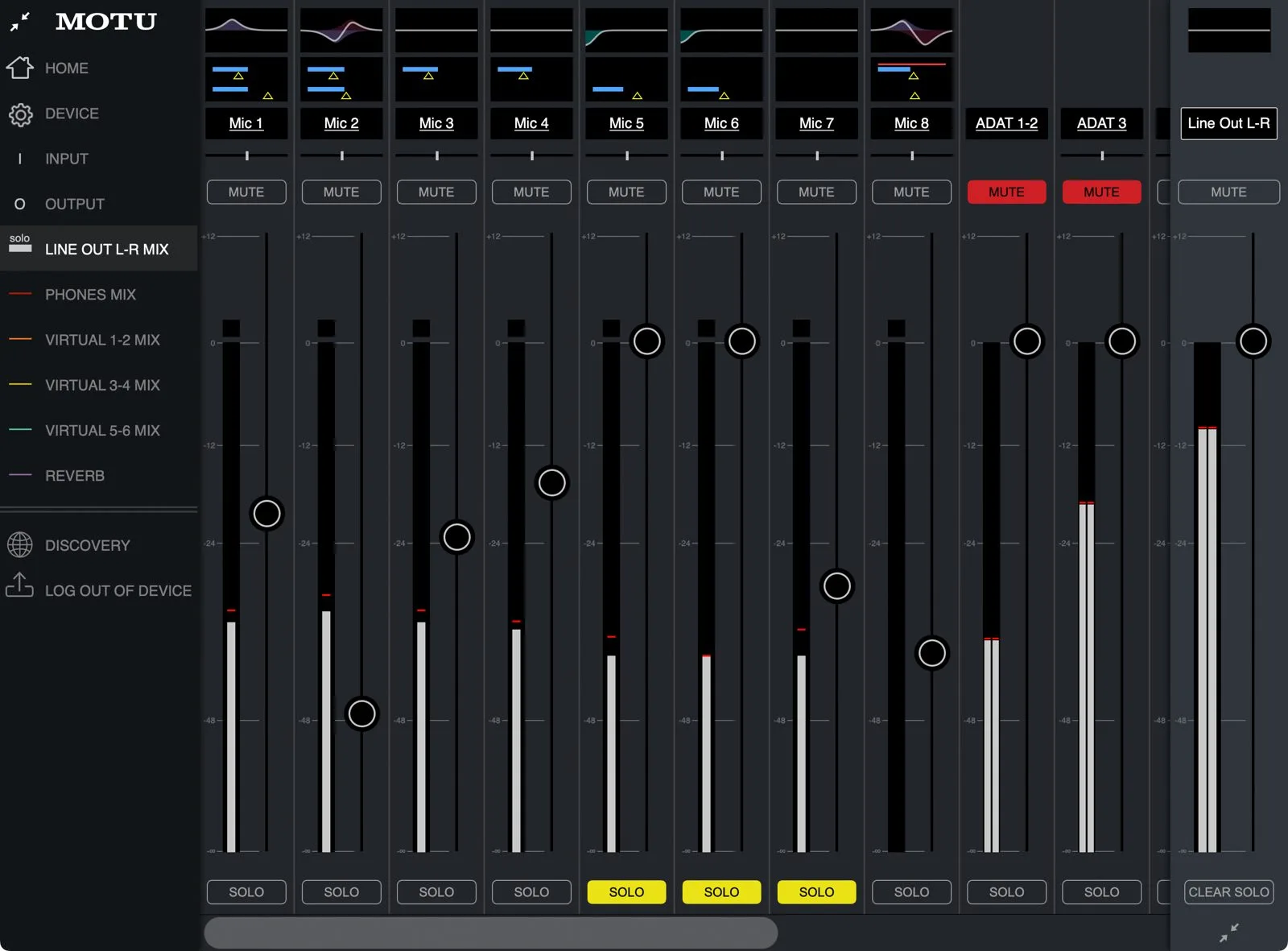
The OctaLite carries its own DSP and the CueMix 5 mixing app (Mac, Windows, iOS). You build independent mixes for the line outputs, the headphones and loopback, with reverb, dynamics and a 4-band parametric EQ you can apply to monitoring or to the recorded tracks. Loopback offers three virtual buses, handy for live streaming or podcasting. With a 2 ms round trip measured at 96 kHz, monitoring through the computer becomes an option again — but internal mixing is still the way to play without delay, a topic we covered in our guide to audio latency.
The optical expander: eight more inputs for the interface you already own
This is the box’s cleverest trick. Thanks to its optical ports, the OctaLite doubles as an optical expander: it adds eight mic/line/instrument inputs to an UltraLite-mk5, an 828, a 16A or any interface with an ADAT input, over a single optical cable. In other words you don’t replace your interface — you extend it the day a session needs more channels. Anyone after a character desktop interface instead will look at the Universal Audio Volt Gen 2, but the OctaLite plays a different tune: channel count and flexibility.
Price, software and availability
The OctaLite is announced at $849.95 MSRP. It ships with the Performer Lite workstation, more than a hundred virtual instruments and around 6 GB of loops and samples — a solid starting point for beginners and a useful companion to a Digital Performer 12 you already run. It needs macOS 12 or Windows 11, and works with iOS 13.5 and later. The full product page is on MOTU’s site.
My take
The OctaLite nails its brief: eight clean preamps, conversion that holds its own against interfaces costing twice as much, and that neat optical-expander trick that turns the box into eight extra inputs for an interface you already own. The half-rack format earns its keep both on the road and on a crowded desk. At $849.95 the pricing is sharp without feeling cut-price. The real question isn’t quality — it’s there — but whether you genuinely track eight sources often enough, or whether something smaller would do.