The equalizer is the first processor you reach for on a channel, and the one least understood. It often gets reduced to “turn up the highs, turn down the lows,” when it actually decides where each instrument sits in the mix. EQ is not about fixing a flaw: it is about sharing out the frequency space so everything holds together. This guide covers the basics properly — what an EQ really does, the filter types, the architectures and the method for equalizing without doing harm.
What an equalizer does
An equalizer changes the level of certain regions of the spectrum while leaving the rest alone. The audible spectrum runs roughly from 20 Hz to 20 kHz, and the ear hears it in regions: the lows (body and weight), the low-mids (warmth, but also mud), the mids (presence and intelligibility), the high-mids (attack and bite) and the highs (air and sheen). Each band of an EQ acts on one of these regions, boosting it or cutting it.
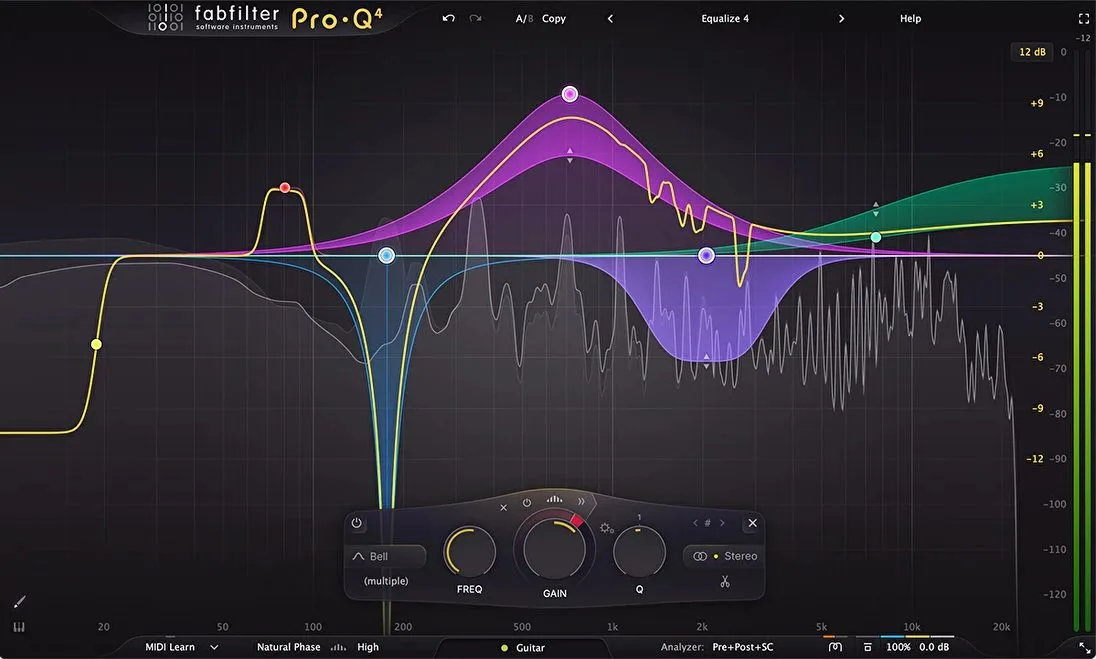
The whole craft lives in three settings per band: the target frequency, the gain applied, and the width of the move, called Q. A high Q acts on a narrow, surgical zone; a low Q acts wide and musical. Set wrong, Q is the main reason an EQ move “shows”: too narrow and it sounds artificial, too wide and it upsets regions you never meant to touch.
The filter types
Behind each band sits a filter type, and picking the right one is half the job. Here are the shapes you meet every day and what they are really for.
| Filter | Shape | Typical use |
|---|---|---|
| Bell (peak) | A bump or dip centered on a frequency | The all-rounder: dig out a resonance, add presence |
| Shelf | Lifts or lowers everything above (or below) a point | Brighten the highs overall, add body in the lows |
| High-pass | Removes everything below a frequency | Clean sub-lows, clear room for bass and kick |
| Low-pass | Removes everything above a frequency | Darken a source, push an element back in the mix |
| Notch | A very narrow, deep dip | Kill a problem tone: mains hum, feedback, resonance |
The high-pass deserves a special mention: it is the most profitable move in mixing. Applied with judgment to sources that have no business in the lows (vocals, guitars, cymbals), it frees up a huge amount of energy for the bass and kick, with no audible loss. Watch its slope, though: too steep a high-pass introduces phase shift and ringing near the cutoff.
Parametric, semi-parametric, graphic
Equalizers also differ by architecture. The parametric gives you all three controls (frequency, gain, Q) on each band: it is the mixing standard, because it is precise and transparent. The semi-parametric, common on consoles, fixes Q and lets you set only frequency and gain: faster, less surgical. The graphic, with its rows of sliders on fixed frequencies, is mostly a sound-reinforcement and system-tuning tool, not a fine-mixing one.
Finally there is the dynamic equalizer, a hybrid of EQ and compressor: the band only acts when the frequency crosses a threshold. It is the ideal tool for a resonance that only bothers you on loud notes, or for taming sibilance — work close to that of the de-esser.
Minimum phase or linear phase?
A classic “minimum-phase” EQ shifts the phase slightly around the frequencies it changes. That is not a flaw: it is what gives it its musical character, and most legendary analog EQs work this way. A linear-phase EQ preserves phase at the cost of latency and possible pre-ringing on transients. Keep it for mastering and stereo-bus work, where phase coherence matters most; in everyday mixing, minimum phase stays the better choice.
The method: subtract before you add
The rule that improves you fastest is simple: fix by cutting rather than boosting. To find an offending zone, temporarily raise a narrow bell, sweep the spectrum until the ugly frequency jumps out, then lower it instead of lifting it. You remove what bothers before adding what is missing. The result is cleaner, more natural, and leaves headroom.
A few field reflexes: EQ while hearing the element in the context of the mix, never in long solo — a guitar that is gorgeous soloed can be a disaster in the whole. Think in terms of space: if two sources fight in the same zone, dig one to let the other breathe, rather than lifting both. And keep a light hand: most good EQ moves are a few decibels, not fifteen.
EQ in the chain
Order matters. A high-pass placed before the compressor keeps sub-lows from needlessly triggering gain reduction. Conversely, color EQ often works better after compression, to shape an already dense sound. This dialogue between EQ and dynamics is at the heart of mixing: it extends into the different compressor types and gets formalized in the mastering chain, where the order of processors becomes decisive.
Two useful extensions once the basics are in: Mid/Side EQ, which lets you treat the center and the sides of a stereo signal separately, and the placement of EQ relative to effects — a high-pass on the reverb send keeps the mix from flooding with diffuse lows. The equalizer is never alone: it is the tool that prepares the ground for all the others.
My take
The equalizer rewards restraint. Mixes that breathe are almost never the ones with the most boosting: they are the ones where each source was cleared of what cluttered it. If one habit had to stick, it would be the subtractive sweep, because it trains the ear as much as it cleans the sound. The rest — linear phase, dynamic EQ, Mid/Side — only matters once that base is in place. A good EQ is not heard; it makes room, and it is precisely when you do not notice it that it has done its job.