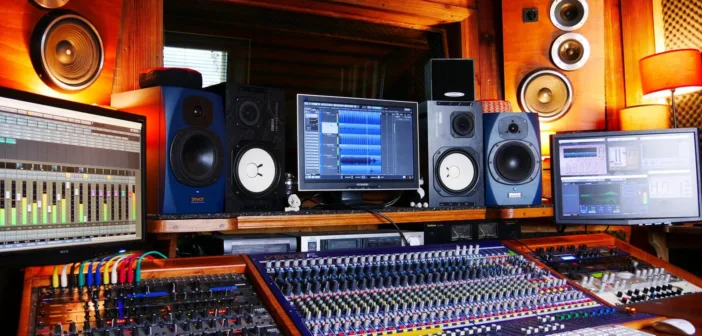
In a modern radio or TV control room, analogue cabling has all but vanished. In its place, an Ethernet network moves audio channels between microphones, consoles, recorders and transmission lines. Ravenna is one of the technologies that make this possible. Born in 2010 in the ALC NetworX labs, it now runs in gear from Lawo, DirectOut, Digigram and Merging Technologies, and forms the backbone of many broadcast studios.
What a Ravenna network carries
Ravenna is not a hardware brand but a method for moving audio over IP. Each audio stream becomes a series of RTP packets, the same real-time protocol used by voice over IP, sent across an ordinary Ethernet network. A studio can route several hundred channels over a single fibre pair, where whole multicore looms were once needed.
Two mechanisms make it reliable. First, a shared clock: every device synchronises to a master clock through PTP (IEEE 1588), so that samples stay aligned to the microsecond. Second, a description of the streams: each source publishes its parameters (channel count, sample rate, format) in an SDP file, and discovery mechanisms such as mDNS let devices find each other on the network. Our article on PTP and clocking covers that central role of timing.
Ravenna and AES67, close cousins
You cannot discuss Ravenna without AES67. The latter is an interoperability standard published in 2013: it sets a common baseline (PTP, RTP, a defined PCM format, a given packet size) so that different audio-over-IP systems can talk to each other. Ravenna came first and reaches wider, but it is AES67-compatible: a properly configured Ravenna stream meets the AES67 profile and therefore talks to Dante, Livewire or other gear, as long as that gear speaks AES67. For the shared baseline, see our guide AES67 explained.
The difference is scope. AES67 sets a minimum for interoperability, while Ravenna offers a full environment, with more flexible sample rates and packet sizes, fine-grained discovery and supervision tools. Inside a homogeneous studio, you use Ravenna’s own features; as soon as you need to talk to another world, you fall back on the AES67 common denominator.
Against Dante and ST 2110
The question comes up often: Ravenna or Dante? Both carry audio over IP, but Dante is Audinate’s proprietary solution, with its closed ecosystem and in-house tools, while Ravenna builds on open standards (RTP, PTP, SDP) with no single licence. The first appeals through ease of deployment, the second through openness and its presence at the high end of broadcast. The two meet through AES67.
On the television side, Ravenna and AES67 sit inside a larger frame: the SMPTE ST 2110 standard, which splits video, audio and data into separate streams. Its ST 2110-30 and -31 sub-parts describe audio transport precisely, and rest on the same RTP and PTP foundation. A compliant Ravenna audio stream therefore slots naturally into an ST 2110 plant. For the overview, revisit our tour of audio over IP.
Where you meet Ravenna
Ravenna first took hold in radio and in classical recording, two worlds that need many channels and a flawless clock. You find it in large broadcast consoles, from Lawo in particular, in DirectOut converters and stageboxes, and in high-end recording interfaces. The most common AES67 profile runs at 48 kHz, 24-bit linear, with a one-millisecond packet size: useful markers when two brands have to talk to each other. Recognising a stream starts there, since sample rate, format and packet size must match end to end.
Latency, redundancy and setup
The latency of a Ravenna network depends on packet size: the smaller the packet, the lower the latency, at the cost of a heavier network load. Studios often work around 1 millisecond for live work, and raise the packet size when latency matters less. To protect a live feed, the ST 2022-7 mechanism sends two copies of the stream over two separate network paths: if a packet is lost on one side, the receiver takes the other, with no dropout.
In practice, a Ravenna network needs a carefully set up switch: quality of service to give audio priority, correct PTP handling (boundary or transparent clocks) and a clean addressing plan. The hard part has barely moved since the early days of audio-over-IP: the network becomes the link to take care of, and a clear plan beats expensive gear that is badly configured. A remote-link codec often sits at the end of the chain, a topic covered in our article on the contribution codec.
My take
Ravenna’s appeal lies in its bet on open standards, at a moment when everyone wanted their own protocol. Choosing Ravenna means backing interoperability over a walled garden, and the bet has aged well thanks to AES67. For a broadcast plant meant to last ten years and talk to varied gear, the argument holds. The trade-off is the network itself, which demands solid IP skills. The good news: those skills are now shared between the audio world and IT, and that is for the better.