Whenever sound has to travel a long way to reach the air, from transmitter to studio, from a stadium to the control room, from a guest to the show, it goes through a contribution codec. It is a pair of boxes, one at each end, that compresses the audio, sends it over a link and rebuilds it on the far side with broadcast-worthy quality. The craft has lived through three ages: analogue lines, digital over ISDN, then IP, which rules today.
What a contribution codec is for
In broadcast language, “contribution” covers everything that feeds the chain before final transmission. Three uses come up again and again. The studio-to-transmitter link (STL) carries the finished programme from the studio to the transmitter site. The remote feeds a reporter’s voice or a concert’s sound back to the control room. The studio-to-studio link joins two sites of the same group. In all three, the need is the same: quality close to a wired feed, controlled latency, and a link that holds over time.
From ISDN to IP
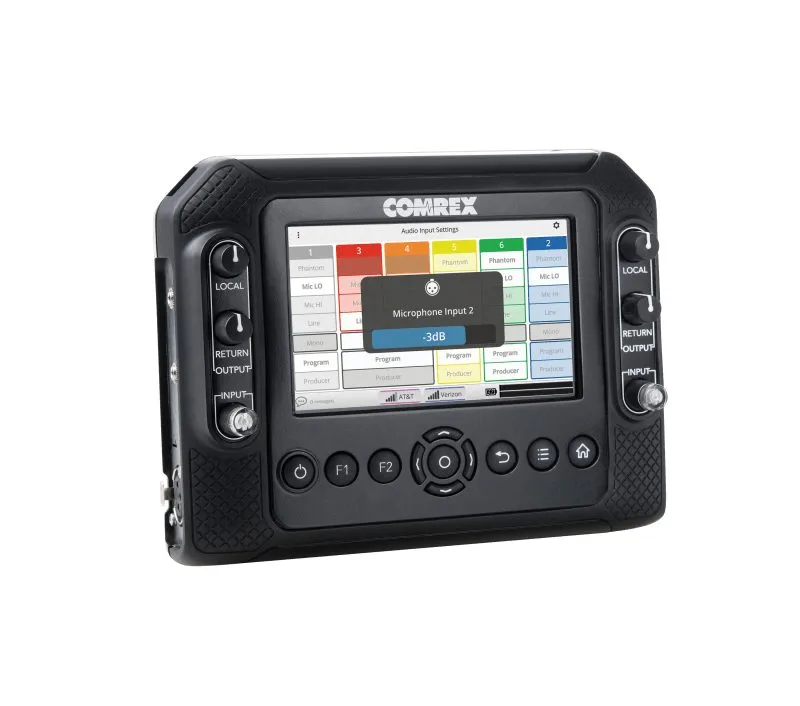
Through the 1990s and 2000s, contribution ran over ISDN, the circuit-switched digital network. Codecs such as the Telos Zephyr encoded voice in MPEG Layer 2 or 3, or in G.722, and gave a stable but costly and inflexible link. IP turned the table over. An IP codec sends its packets over the public internet, a dedicated line, fibre or a 4G/5G mobile link. Cost collapses, reach becomes worldwide, but a challenge appears: the network is no longer guaranteed.
The real problem is the network
An IP network drops packets, delivers them out of order and with a variable delay, the well-known jitter. For a live feed, gaps are out of the question. Modern codecs cope with several defences. The jitter buffer absorbs delay variation by adding a few tens of milliseconds of margin. Forward error correction (FEC) and packet duplication make up for losses. Above all, bonded links aggregate several connections, say two SIM cards and a wired connection, to spread the stream and survive the loss of one. Comrex calls this CrossLock, Tieline calls it SmartStream: the idea is the same.
Which algorithm for which feed
A contribution codec does not always encode with the same algorithm. The choice turns on three criteria: latency, bitrate and quality. Opus, open and very low latency, has become the default for interactive feeds. The AAC family (AAC-LD, AAC-ELD, HE-AAC) offers a good quality-to-bitrate balance. MPEG Layer 2, G.722 and uncompressed linear PCM keep their place case by case. The more quality and robustness you want, the more bitrate you need; the more interactivity you want, the lower the latency has to go, which eats into the margins.
Making two brands talk, ACIP
A Comrex codec had to be able to call a Tieline or AEQ codec. For that the EBU defined ACIP (recommendation Tech 3326, with the SIP profile Tech 3368): common ground on signalling and on a shared set of algorithms. With it, you dial a SIP “address”, the far codec rings, and the two units negotiate a format they both speak. The big names (Comrex, Tieline, AEQ, WorldCast/APT, Telos) play along, even if each adds its own extensions.
The return path matters as much as the feed
A remote contributor needs to hear the air to stay in time, but not their own voice delayed back, which is unbearable. So the codec runs a return path, the IFB, that sends the programme back minus their own contribution. That is exactly the mix-minus principle applied to the remote link. For callers on the phone, the same need goes through the telephone hybrid. And when the feed becomes streaming to a platform, you move to other protocols, as our SRT vs RTMP comparison shows.
Where the codec sits in the chain
On arrival at the studio, the codec plugs into the console and joins the usual control-room flow, often on an audio-over-IP network in Dante or AES67. To see how it all links from mic to air, our guide to the self-op radio studio gives the overview. The contribution codec is only one link, but it is the one that decides whether your live feed holds or drops.
My take
The move to IP democratised field broadcasting like nothing else: a backpack, two SIM cards, and a local station runs an FM-quality live feed from anywhere. The flip side comes down to one word, the network, still the link to watch before every show. A solid link plan, a backup path and a carefully set buffer beat the most expensive codec. The technology has caught up; the discipline of preparation has not been handed off.