Some product names become common nouns. In FM radio, “optimod” is one of them: in the studio and at the transmitter, the word routinely means the broadcast processor, whatever the brand. This year, Orban’s Optimod range turns fifty. A good moment to tell how a box sitting between the console and the transmitter shaped the sound of the FM band, and why so many units are still running.
1975, one box to rule them all
Bob Orban was no newcomer when he founded Orban Associates with John Delantoni in 1975. Back in 1967 he had sold his very first product, a stereo synthesizer, to New York station WOR-FM, before a stint at Stanford. The same year the company was born came the Optimod 8000, the brand’s first FM processor and the first unit to bring audio processing and the stereo generator together in a single chassis. Until then, stations stacked separate compressors, limiters and stereo encoders. Orban put it all in one box, built around the 75-microsecond pre-emphasis curve that FM requires.
The 8000’s internal chain stayed single-band. It ran a FET compressor-limiter, drawn from Bob Orban’s Stanford work, a pre-emphasis limiter, a clipper and overshoot-compensated low-pass filters to hold excursion without spilling out of the channel. Simple on paper, but calibrated to a fine point for one precise goal: to sound loud and clean without ever overmodulating.
Multiband, then all-digital
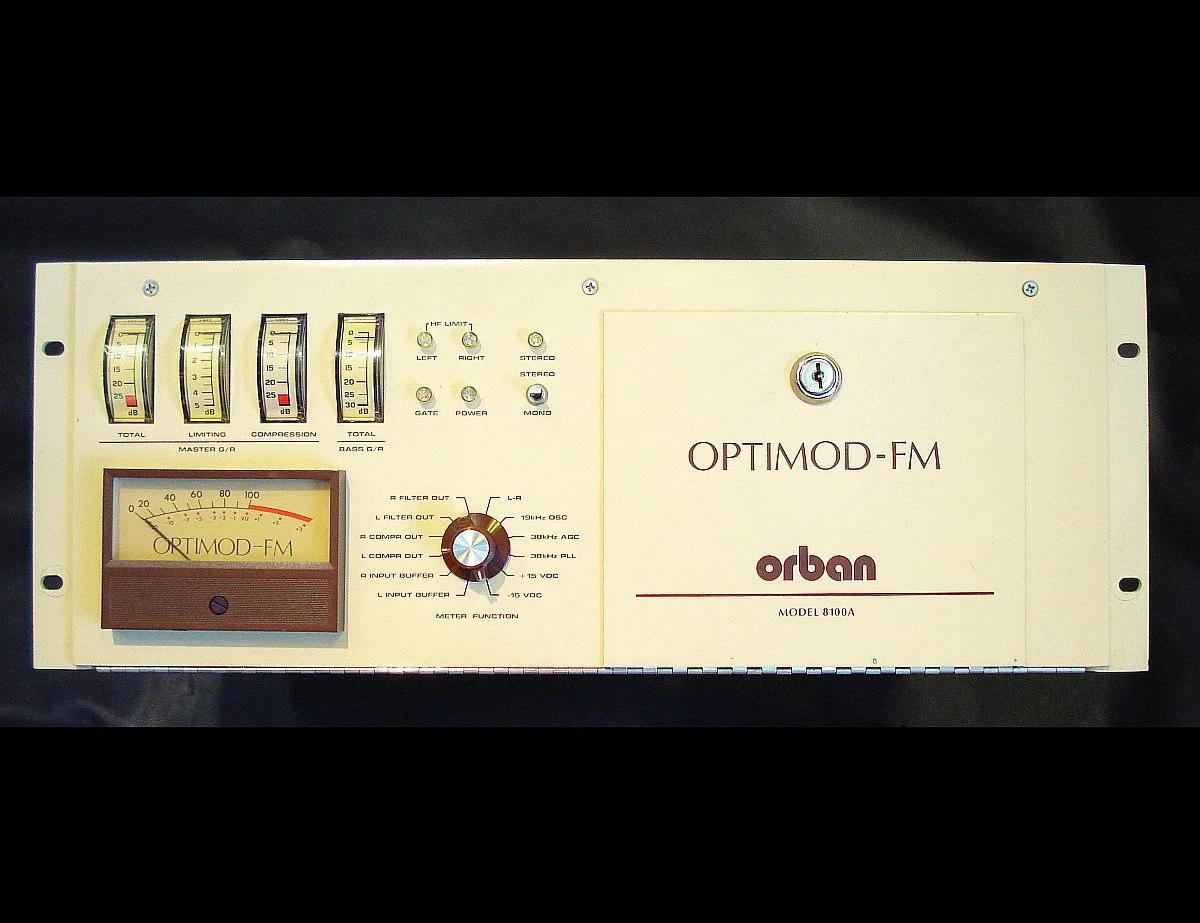
The race for density soon pushed further. To rival the custom chains of the big American stations, Orban understood that multiband compression would be the key, and he settled on six bands. That work led to the Optimod 8100, which became the house’s biggest commercial success and cemented the “Optimod sound” on the band. Splitting the spectrum into bands lets you densify each zone without the lows smothering the highs, and the other way round.
The next step was software. The Optimod 8200 introduced fully digital DSP processing, with a two-band AGC followed by a multiband stage. From there, flexibility exploded: presets, fine adjustment, updates. Generations followed, up to today’s platforms that fold FM broadcast, digital radio and streaming into one machine. To understand what the chain produces at the output, our article on FM MPX details the composite signal and the 19-kilohertz stereo pilot, and the one on radio on-air processing places the processor in the full chain.
Why it lasts
An Optimod’s longevity comes from its place in the chain. Sitting just before the transmitter, it protects modulation and gives the station its sonic identity, two jobs you do not tinker with. A processor that does this work well stays in service for years, and older units keep genuine working value. Orban likes to point it out: a fifty-year-old 8000, still operational, was shown at the 2025 NAB Show for the range’s anniversary.
The brand’s industrial path, by contrast, has been eventful. Harman bought Orban in 1989. Circuit Research Labs took over in 2000 and moved manufacturing to Tempe, Arizona, in 2005, before acquiring Germany’s Dialog4 in 2006. In 2016, Daysequerra, owned by David Day, took on Orban USA; in 2020, Orban Europe GmbH took charge of worldwide sales. Through all these changes of hands, the Optimod line never stopped, and the customer list stays striking: ABC, BBC, CBS, Disney, ESPN, FOX, iHeart, NBC, NHK, SKY. The brand claims tens of thousands of users.
These historical and technical landmarks are gathered notably in the anniversary feature published by audioXpress and in Bob Orban’s interviews with Radio World.
The processor, a signature link
People often reduce the broadcast processor to a matter of loudness. That forgets it carries a station’s signature: the same track does not sound alike on two competing FMs, and the processor setting has a lot to do with it. Too much density tires the ear, too little lets rivals seem more present. The balance is a search, and that know-how is exactly what Orban sold for half a century. To place the meters worth watching, see our comparison VU, PPM, peak or loudness and our guide to broadcast loudness.
My take
Few audio products can claim to have given their name to a whole category. The Optimod got there because it solved a real problem, protecting modulation while forging an identity, and did so with consistency. The finest compliment is those 1970s machines still in service: in a trade where gear dates fast, radio keeps its safe bets. The real question today is no longer FM alone, but the coherence of a station’s sound across FM, DAB and streaming at once.