Picture a stage where the entire PA sits behind the musicians. No front-of-house boxes aimed at the crowd from the wings, no floor monitors: a single wall, several storeys tall, throwing sound over the band’s heads into the room while also serving as the players’ monitoring. That wall existed. The Grateful Dead hauled it around from March to October 1974, and it was called the Wall of Sound.
One obsession, sound without distortion
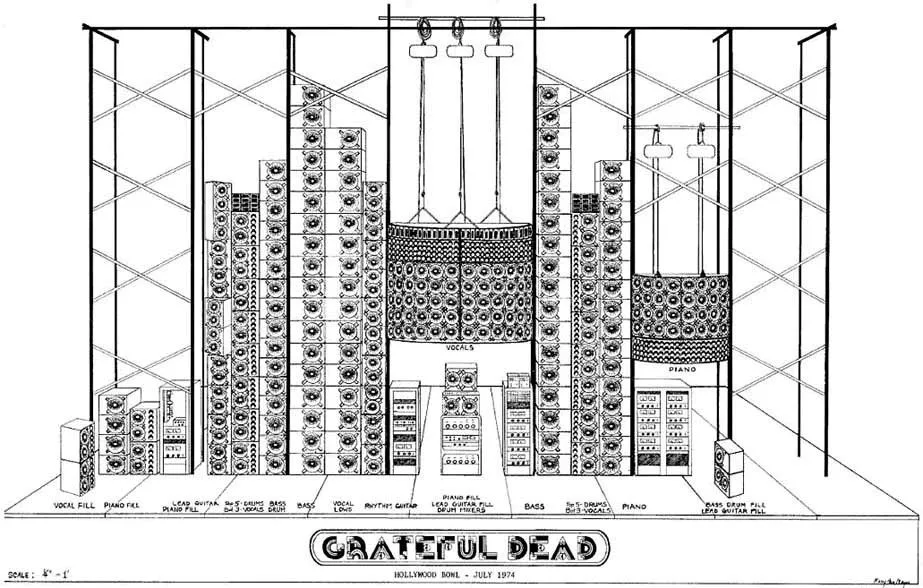
The idea came from Owsley “Bear” Stanley, sound engineer and a figure of California’s counterculture. His brief was a single demand: a distortion-free system, clear enough to hear every string. With Dan Healy and Mark Raizene from the band’s crew, and Alembic engineers Ron Wickersham, Rick Turner and John Curl, the team designed from 1972 a PA built for crowds that already reached 100,000 people. The drawing below is by Wickersham’s own hand.
Eleven channels, one instrument per column
The founding principle is simple to state, dizzying to build: one instrument, one channel, its own speakers. The Wall of Sound combined six independent systems spread over eleven separate channels. Vocals, lead guitar, rhythm guitar and piano each had their own channel and column. Phil Lesh’s bass ran through a quadraphonic encoder that sent each of the four strings to a separate channel and set of speakers. One more channel carried the kick drum, two others the snare, toms and cymbals. Because each speaker reproduced only one source, intermodulation distortion, the kind that appears when several signals mix in one amplifier, almost vanished. Without naming it so, the designers had just built the first large-scale line array in the history of sound reinforcement.
The wall that monitored itself
Putting the whole PA behind the band solved the monitoring question: the players heard exactly what the audience got. But it created a major feedback risk, with microphones singing straight into the speakers. The fix, invented by Stanley and Alembic, is still one of the most elegant ever seen on a stage. Each singer had two matched condenser capsules, spaced 60 mm apart and wired in reverse polarity to each other. The singer aimed at the top mic; the bottom one mostly picked up the ambience, meaning the sound of the wall. Summing the two signals in a differential amp cancelled whatever was common to both capsules, and only the voice survived.
The numbers of a monster
Sources differ on the exact configuration, because the Wall evolved over the months. Two tallies are the references.
| Tally | Speakers | Amplification | Power |
|---|---|---|---|
| Setup A | 604 speakers | 89 solid-state amps of 300 W, 3 tube amps of 350 W | 26,400 W |
| Setup B | 586 JBL + 54 Electro-Voice tweeters | 48 McIntosh MC-2300 of 600 W | 28,800 W RMS |
The system projected usable sound to 180 metres and stayed audible at 400 metres before wind degraded it. The whole rig weighed about 75 tons and needed four semi-trailers and twenty-one crew. To keep up with touring, two to three full sets of scaffolding travelled in parallel and leapfrogged from venue to venue while one was built and another struck. Band historian Dennis McNally documented the logistics in detail.
Too big to last
A rough version had been shown as early as 9 February 1973 at Stanford’s Maples Pavilion: every tweeter blew on the first song. It took another year for the full system to tour, on 23 March 1974 at the Cow Palace in Daly City, California. Seven months later, the Wall of Sound was retired. The weight, the cost and the insane logistics had beaten it. But its legacy ran through all of modern sound reinforcement: the line source, the separation of sources, monitoring from the main system. When you choose today between a point source and a line array, or spend an evening tuning a system, you are walking in the footsteps of that wall.
My take
The Wall of Sound was never going to become a standard: nobody could move 75 tons of speakers from town to town. Yet it is one of the finest failures in the history of the craft. The instinct to separate sources for clarity was right, the differential-mic trick was brilliant, and the line-source idea was twenty years ahead. The monster was forgotten, the ideas were kept. That was worth seven months of madness.