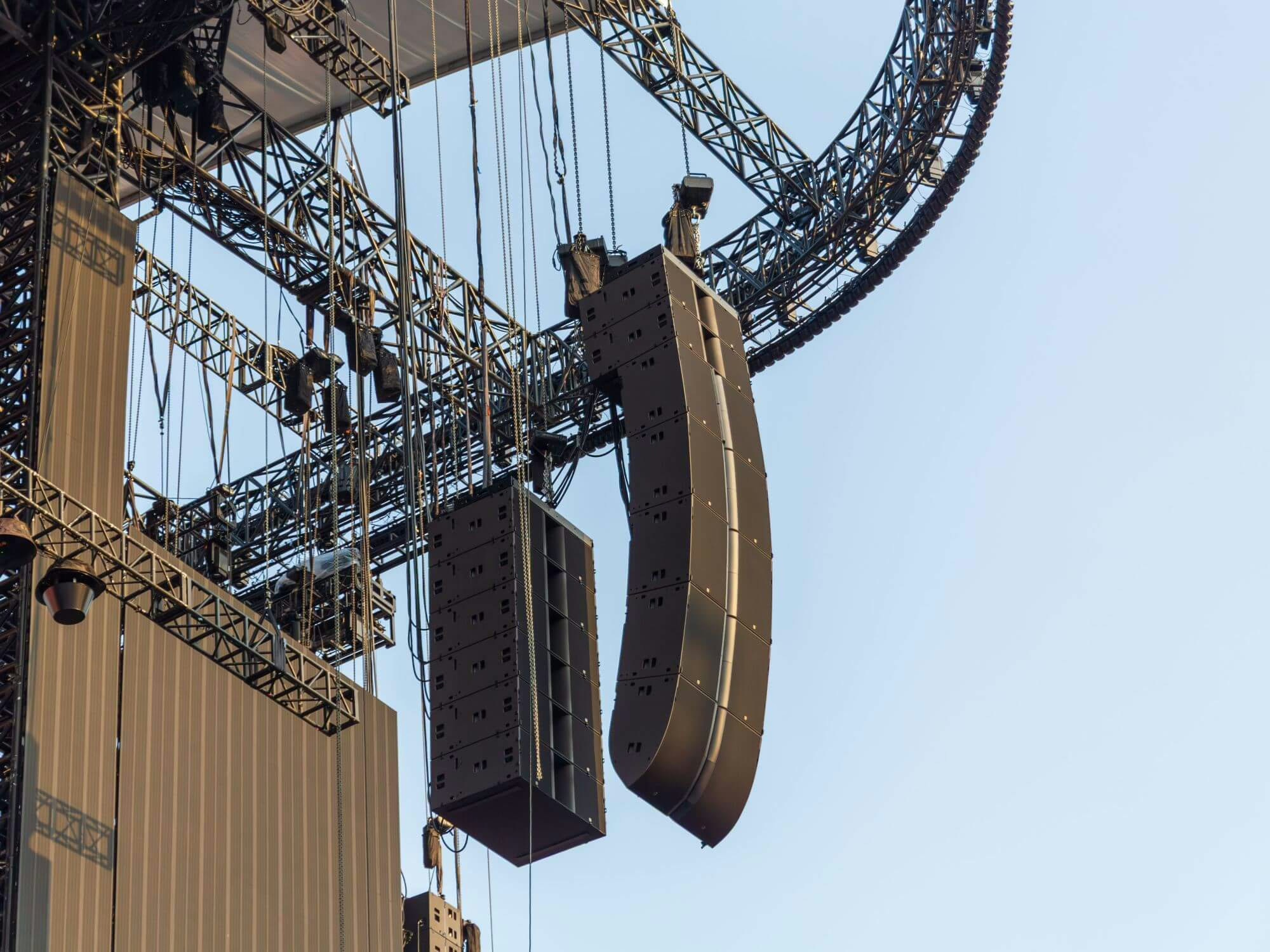
For twenty-five years the line array — the “line source” — has taken over stages worldwide, to the point where it’s all you see: those garlands of hanging boxes flanking the stage. But stacking loudspeakers isn’t enough to make a line-source system. Behind the familiar object lies a precise piece of physics, and mistaking it for “lots of drivers” leads to badly designed, badly aligned rigs. Let’s set it straight.
The principle: coupling sources so they behave as one continuous line
A single loudspeaker radiates as a point source: sound goes everywhere and its level drops by roughly 6 dB per doubling of distance (inverse-square law, spherical radiation). That’s a lot: at 20 metres you’ve already lost a huge amount of energy.
Now line up several identical sources, very close together and in phase, over enough height: they stop behaving as independent sources. Their waves couple and sum constructively. The whole then radiates as a line source, with a cylindrical wavefront rather than a spherical one. The decisive result: in that zone, level drops by only about 3 dB per doubling of distance. That’s exactly what lets a line array “throw” to the back of a stadium where a stack of point sources would run out of breath.
Near field, far field: the nuance that changes everything
That advantageous cylindrical behaviour doesn’t exist everywhere in the room. It only holds in the near field of the line. Beyond a certain distance — the transition distance — the system reverts to spherical behaviour and gets its 6 dB per doubling back.
And that transition distance depends on two things: the physical length of the line and the frequency in question. The longer the line, the further the near field reaches; the higher the frequency, the further too. That’s why a line that’s too short “isn’t a line array” in the low end: four boxes don’t couple bass the way twelve do. Grasping this spares you the classic disappointment of the small flown rig that’s a line array in name only.
| Point source | Line source (near field) | |
|---|---|---|
| Wavefront | Spherical | Cylindrical |
| Loss per doubling of distance | ≈ 6 dB | ≈ 3 dB |
| Vertical control | Low | High (length-dependent) |
| Best suited to | Small rooms, short throws | Large audiences, long throws |
Curvature: hugging the shape of the audience
A perfectly straight line would send all its energy into a narrow horizontal plane — ideal for maximum throw, disastrous for covering the front rows right under the boxes. Hence curvature: each box is angled relative to its neighbour by an adjustable inter-box angle.
The alignment logic is almost always the same: the top of the line, barely curved, projects far toward the back; the bottom of the line, more sharply curved, “unrolls” sound onto the near rows. Manufacturers’ prediction software computes these angles from the room geometry and rigging position, aiming for the most even field possible from front row to last. It’s there, in curvature and rigging, that most of the result is decided.
Why vertical control is so good (and horizontal is another matter)
The line array excels at controlling the vertical plane: line length governs directivity in the lows and mids, while curvature shapes top-to-bottom coverage. That’s what lets it aim energy at the audience rather than the ceiling or the walls — buying clarity and gain-before-feedback.
The horizontal plane, by contrast, doesn’t depend on the line but on each box’s waveguide, with a given coverage angle (90°, 120°…). Hence the crucial choice of model to match the width to cover, and sometimes separate arrays for the sides or balconies.
Bass and alignment: where it’s really won or lost
Low frequencies couple poorly in a hanging vertical line, so they’re almost always handed to separate subwoofers, ground-stacked or flown, arranged in arcs, cardioid or end-fire to control their directivity. The recent arrival of subs like the Yorkville EL24S is a reminder of how strategic this part of a live rig is.
Then comes the step that separates a handsome rig from good sound: alignment. Time-aligning (delay), phase-aligning and gain-matching the main hangs, the delay towers, the front-fills and the subs, compensating for air absorption in the highs over long distances, EQing the array without wrecking it — all of that is a rigorous method we detail in our dedicated guide to live sound system alignment. A badly aligned line array sounds worse than a well-set point source: power never replaces coherence.
When to use it… and when to skip it
The line array isn’t an end in itself. It shines whenever you must cover a large audience with long throw and an even field: festivals, stadiums, big halls. In a low-ceilinged club, with little depth and a close audience, a well-placed point source system will often do better, more simply and for less. Fetishising the flown line routinely leads to over-sizing installs that gain nothing from it.
After years of mixing live, my take is simple: the line array is a superb tool, not a talisman. Badly curved, badly aligned, too short for the room, it disappoints. Well thought out, it makes the system vanish in favour of the music. The real work isn’t hanging boxes — it’s prediction, curvature and alignment. As for brands, everyone has a favourite; I have an admitted soft spot for Meyer Sound’s precision and rate d&b highly, but the best system is still the one that’s right for the room, properly deployed. The rest is just hardware.
To carry on backstage, see also how to set up stage monitors and install an in-ear monitoring system, two links that round out a concert’s signal chain.