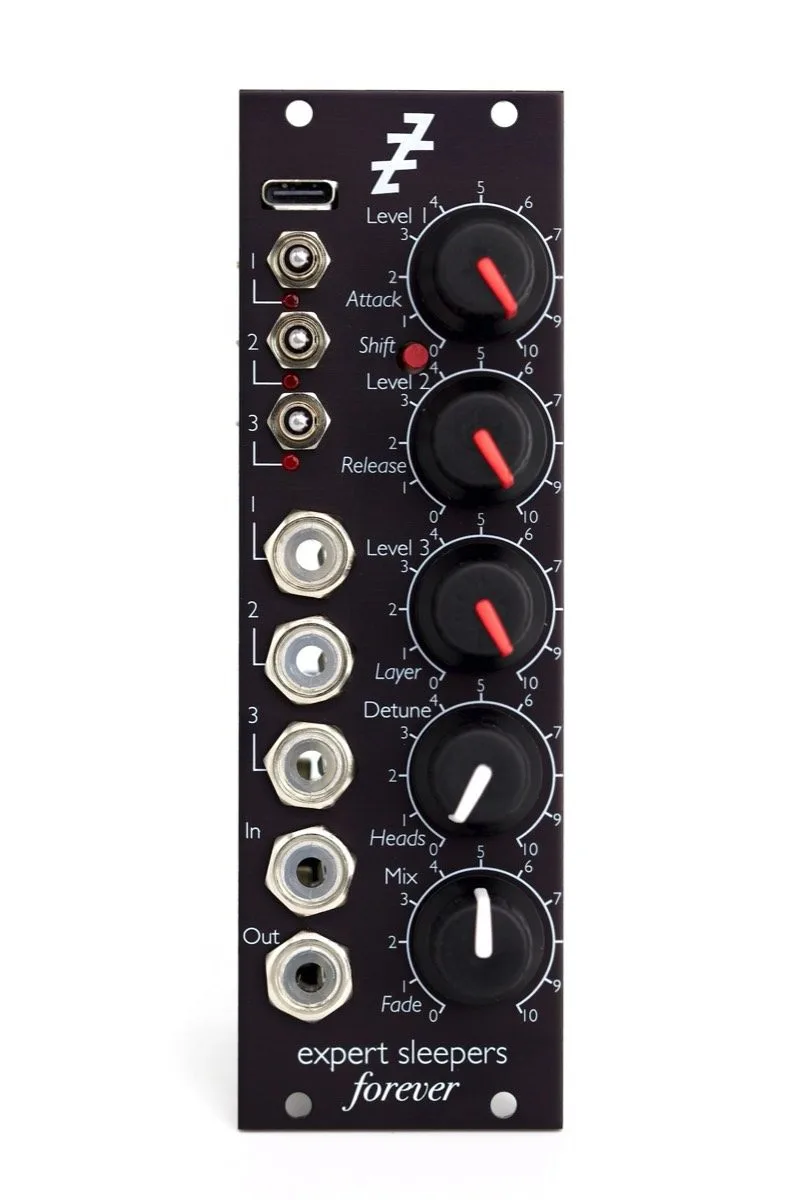
Expert Sleepers, Andrew Ostler’s brand known for its ES-series interfaces and the swiss-army disting, is spinning off one of its most striking algorithms into a dedicated module. Forever, shown at Superbooth 2026 and now available, takes the Temporal Freeze algorithm from the disting NT and turns it into a Eurorack audio-freeze and infinite-sustain module. The idea: capture a sonic moment and make it last indefinitely, cleanly, without the loop artefact you hear too often.
Three freeze voices, one audio input
Forever works on a single audio input with three independent buffers. Each freeze voice has its own gate input and a toggle switch: you trigger the freeze by hand or via CV, depending on whether you’re playing live or driving the module from a clock or sequencer. The three buffers act on the same input signal, each with its own level control, and a master dry/wet amount balances the direct sound against the frozen textures. In practice, you can stack three freezes captured at different moments of the same source and let them evolve in parallel.
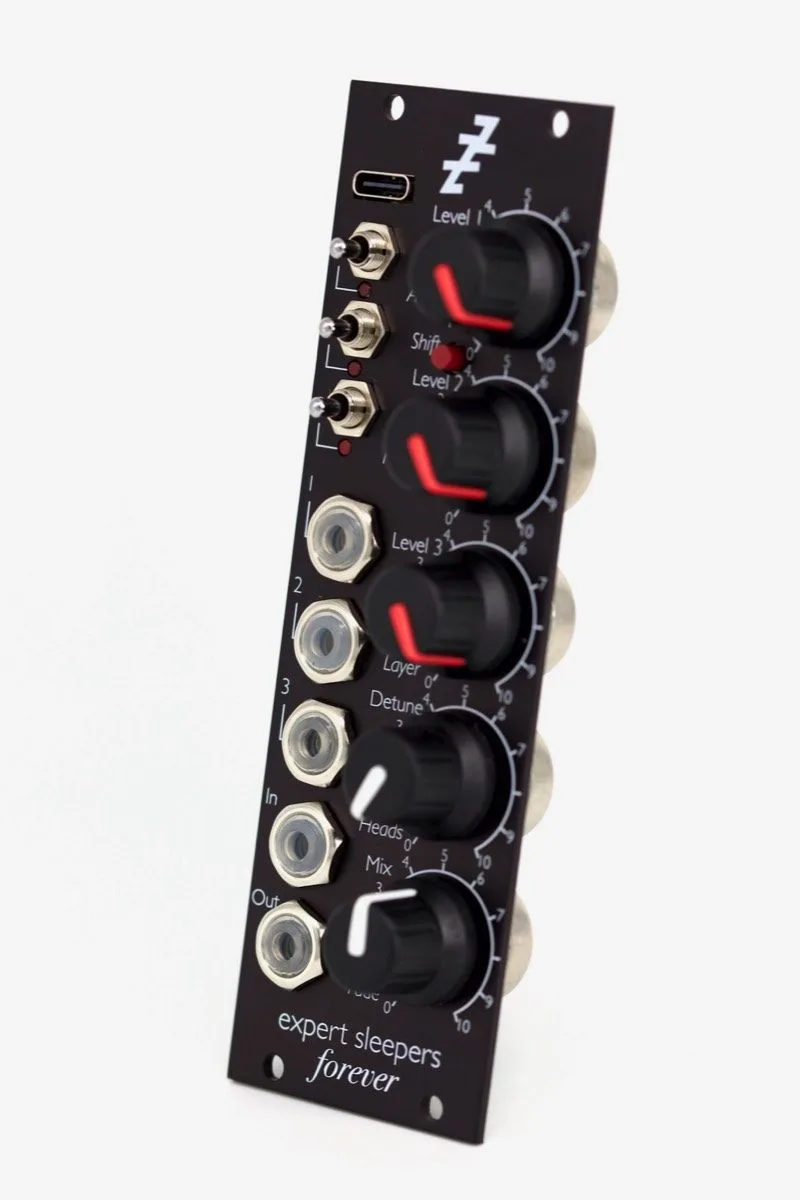
Two details lift the module above a plain freeze: each voice can overdub—layering into the buffer instead of simply freezing it—and each voice can play its contents back an octave down. That’s enough to build pads, drones and harmonic beds from a held note, a chord or a sound grabbed on the fly, without leaving the rack.
Compact and connected
On format, Forever fits in 8 HP at 36 mm deep—reasonable for a module that does this much. Stated current draw is 48 mA on +12 V and 8 mA on -12 V, and a USB 2.0 class-compliant MIDI port rounds out the connectivity. That USB socket is an Expert Sleepers signature: it opens the module to updates and computer control, in line with the rest of the brand’s range.
The pricing is clear: around 226 € excluding tax (£229 inc VAT in the UK, US$279 in the States). That’s the price of a specialist effect module, not a toy; but quality audio freeze is exactly the kind of function you end up reaching for on nearly every patch.
To place Forever in the modular ecosystem, see our piece on Erica Synths Konstrukt-8, and to understand the movement sources that will animate your freezes, our explainer on the LFO. The official page is on the manufacturer’s site.
Frequently asked questions
How does Forever differ from the disting NT’s Temporal Freeze?
Forever uses the same algorithm, but gives it a dedicated module with a physical interface: three voices, each with gate and toggle, plus individual levels and a global dry/wet. Where the disting NT shares its resources across many algorithms, Forever is entirely devoted to freezing, which makes the gesture more direct in performance.
Can the freezes be triggered hands-free?
Yes. Each voice has a gate input, so you can trigger freezes via CV from a clock, a sequencer or any trigger source. The toggle switch remains available for manual play; both approaches coexist.
What does the octave-down playback do?
Each voice can replay its buffer contents transposed an octave down, on top of overdubbing. It’s useful for creating sub-bass or drones from a high source, or for thickening a frozen texture without adding another module.
How much space does it take, and how does it update?
Forever takes 8 HP at 36 mm deep, drawing 48 mA (+12 V) and 8 mA (-12 V). It carries a USB 2.0 class-compliant MIDI port, which also connects it to a computer in Expert Sleepers’ usual way.
My take
Audio freeze has become a modular reflex, but there’s a gulf between a freeze that clicks at the loop and a true sustain that holds. Forever bets on the clean Temporal Freeze algorithm and a three-voice layout that invites stacking rather than replacing. Overdub and octave-down turn a simple freeze into a small texture workshop, which justifies the dedicated format over a disting slot. At this price, the real question isn’t the module’s worth but the space it takes in the rack—and 8 HP is easy to find.