For three decades, the reverb you heard most on records did not come from a processor but from a sheet of steel. The plate laid its dense, bright character over thousands of vocals and snares. It is still a go-to tool in the mix, now mostly as a plugin, and understanding how it works helps you use it with intent rather than by habit.
How a plate makes reverb
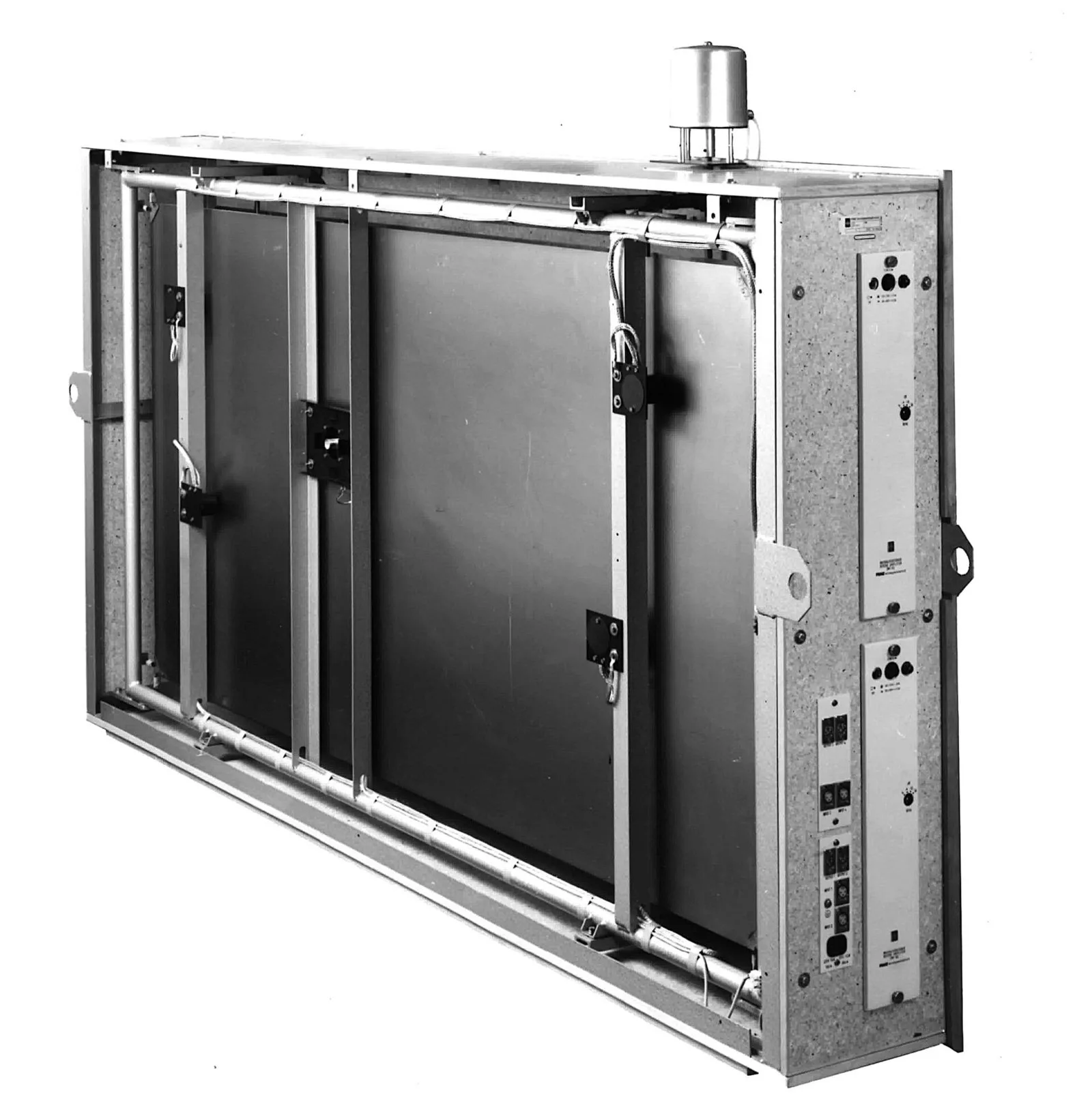
A reverb plate is mechanically simple. A large steel sheet, often close to one by two metres, is tensioned inside a rigid frame. A driver, built like a loudspeaker voice coil, takes the audio signal and sets the sheet vibrating. Those vibrations travel through the metal, reflect off the edges and blend into a very dense field. Two contact pickups, placed away from the driver, read the plate’s motion and provide an output, in stereo when there are two. A movable damping pad, brought closer to or farther from the steel, absorbs energy and sets the decay time, from under a second to several seconds.
The whole thing lives in a sealed, isolated box, because the sheet also picks up room sound. The best-known plate, the EMT 140 launched in 1957 by German maker Elektromesstechnik, weighs close to two hundred kilos and takes up a wardrobe’s worth of space. Later versions, such as the gold-foil EMT 240, shrank the footprint while keeping the sonic signature.
The sound of a plate
A plate does not try to imitate a room. It produces no identifiable early reflections and no realistic sense of space: the reverberant field arrives almost instantly, very dense, with a smooth metallic sheen that flatters the upper mids. That absence of “scenery” is exactly its strength in a mix. You add depth and sustain to a vocal or a snare without pushing it back into an imaginary room, and without blurring clarity. The key control is decay time, varied continuously by the damper. A short, bright decay suits a fast track; a long decay lays a bed under a ballad.
Plate, spring, chamber and digital
The plate belongs to the family of artificial reverbs, alongside the spring and the echo chamber. The spring, smaller and cheaper, also vibrates mechanically but sounds more coloured, with that characteristic boing of guitar amps. The echo chamber is a real treated room where sound is played back and re-captured: more natural, but bulky and hard to tune. Digital first set out to reproduce these behaviours by computation, then to go beyond them. To place these families next to each other, our guide to reverb types in the mix runs through the controls that matter. On the algorithmic side, the Lexicon 480L set its own colour, while convolution reverb captures the response of a real space, including a real plate.
Using a plate in the mix today
Most studios no longer own a physical plate, but the plugins that model or convolve it are plentiful and excellent. A few habits make the difference. Put the plate on an aux send, not an insert, to feed several sources with the same reverb and keep control of the amount. Work the pre-delay, that short gap before the tail starts, to separate the reverb from the source and protect the vocal’s articulation. EQ the return without hesitation: a high-pass around 200 or 300 hertz keeps the low end from clogging, and a gentle dip in the top tames the sheen when it hisses. On a vocal, a medium-decay plate adds density without moving the singer away; on a snare, it adds tail and body. In stereo it widens; in mono it stays focused and sits better in a busy mix.
A plate pairs well with a short delay placed before it, a combination that shaped the sound of many records in the seventies and eighties. The point is to use it like seasoning: you notice it when you mute it, not always when it plays.
My take
The plate is still the most versatile reverb for vocals, and it is rarely chance when a mix starts to sound “pro” the moment a well-set one goes on. Its instant density solves in a second what a room reverb complicates: you add substance without adding distance. Today’s models are more than good enough for everyday work, and a convolved EMT 140 remains a safe bet when you want that exact grain. The classic trap is level and return EQ, two simple moves that separate a plate carrying the mix from a plate drowning it.