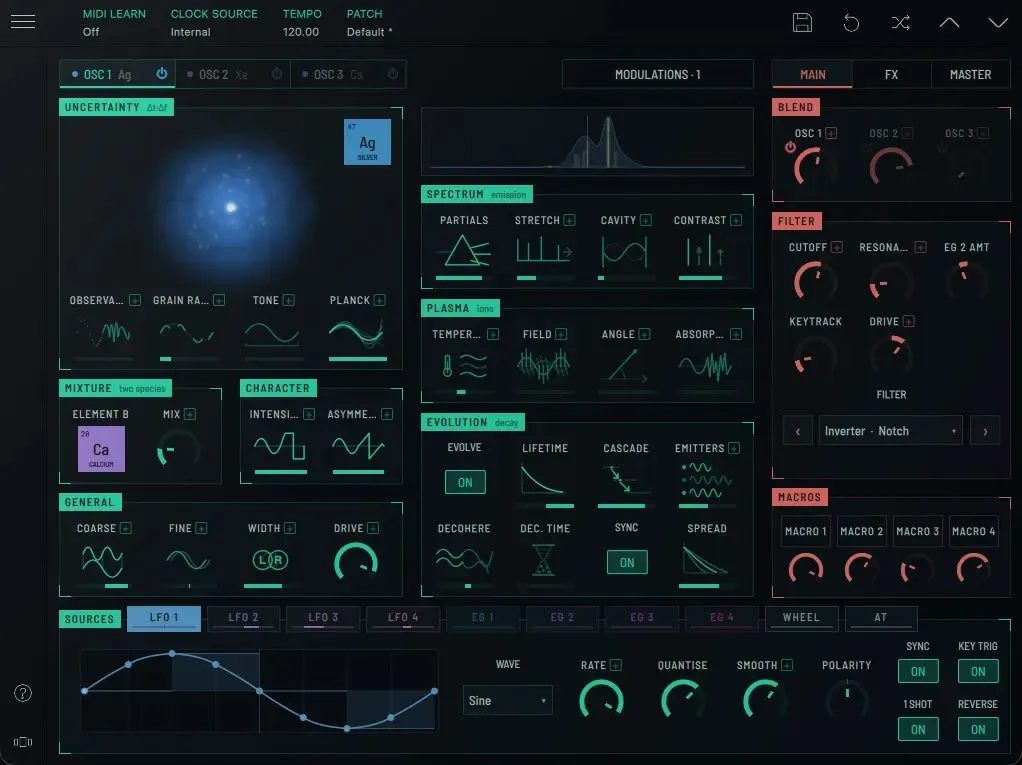
Additive synthesis is often pictured as tame stacks of sine waves. The Portuguese studio Imaginando, already known for DRC and FRMS, flips that with Colapso: a software synth whose partials are not picked at random but taken from the measured emission lines of 22 chemical elements, some 422 catalogued frequencies in all. Each oscillator therefore “plays” the spectral signature of an element, from hydrogen to mercury. The idea could have stayed a physicist’s gimmick; instead it delivers a genuinely expressive instrument.
Three oscillators, two elements, a shifting shape
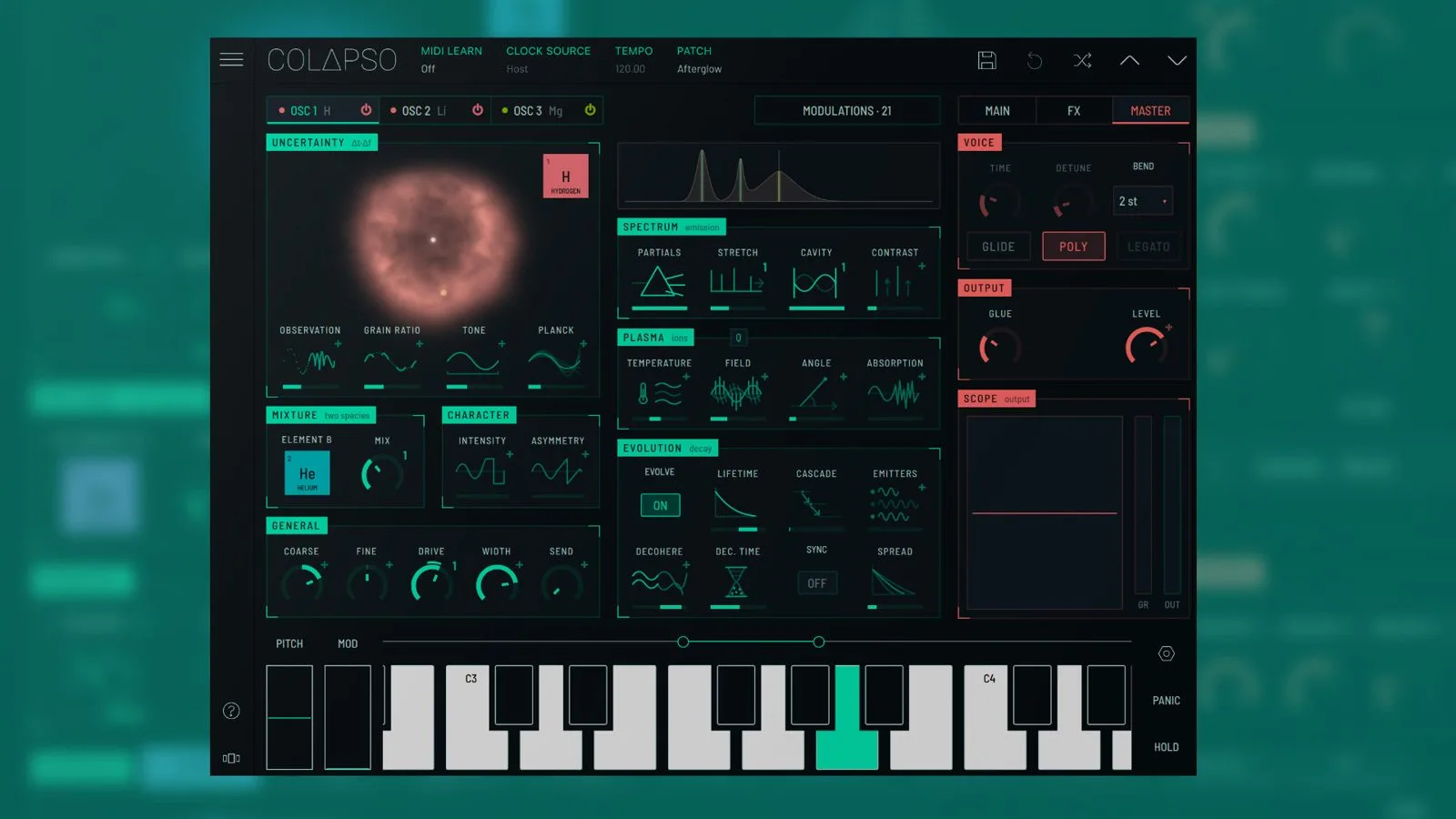
Colapso lines up three oscillators per voice, each able to stack up to sixteen partials from one element, with the option to morph toward a second. Polyphony reaches eight voices, in Poly, Mono or Unison modes, with detune, glide and legato. So far, nothing exotic. What changes everything is the pair of controls called Observation and Planck: a sonic take on the uncertainty principle that trades timing precision against pitch precision. Push one and the sound slides from a pure tone toward granular grains. That is where Colapso becomes a playground rather than a wavetable bank.
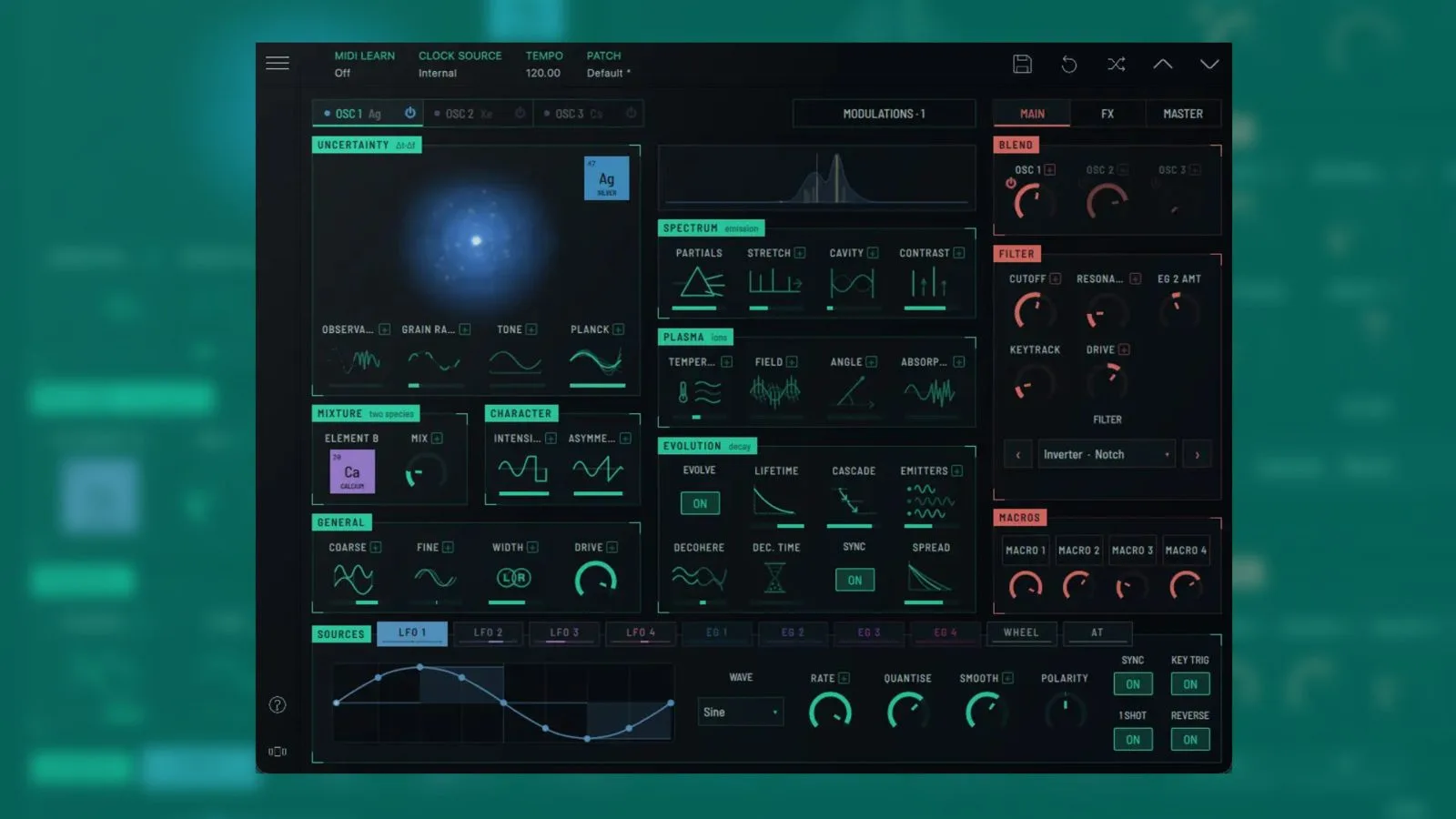
Around them, a set of spectral controls puts you in charge of the material: Mix morphs one element toward another partial by partial, Stretch widens or narrows the intervals between partials, Cavity pulls the spectrum back onto the harmonic series, Temperature rebalances levels and, at high “heat”, ionises the spectrum to swap in another. Add Field (which splits each partial into three and spreads them in stereo), Absorption (a crossfade of the tone into noise, with a notch at each partial), plus Lifetime and Cascade on the time envelope. The vocabulary is unusual, but each parameter has an audible, predictable effect once you have tamed it.
Modulation and filtering worthy of a real synth
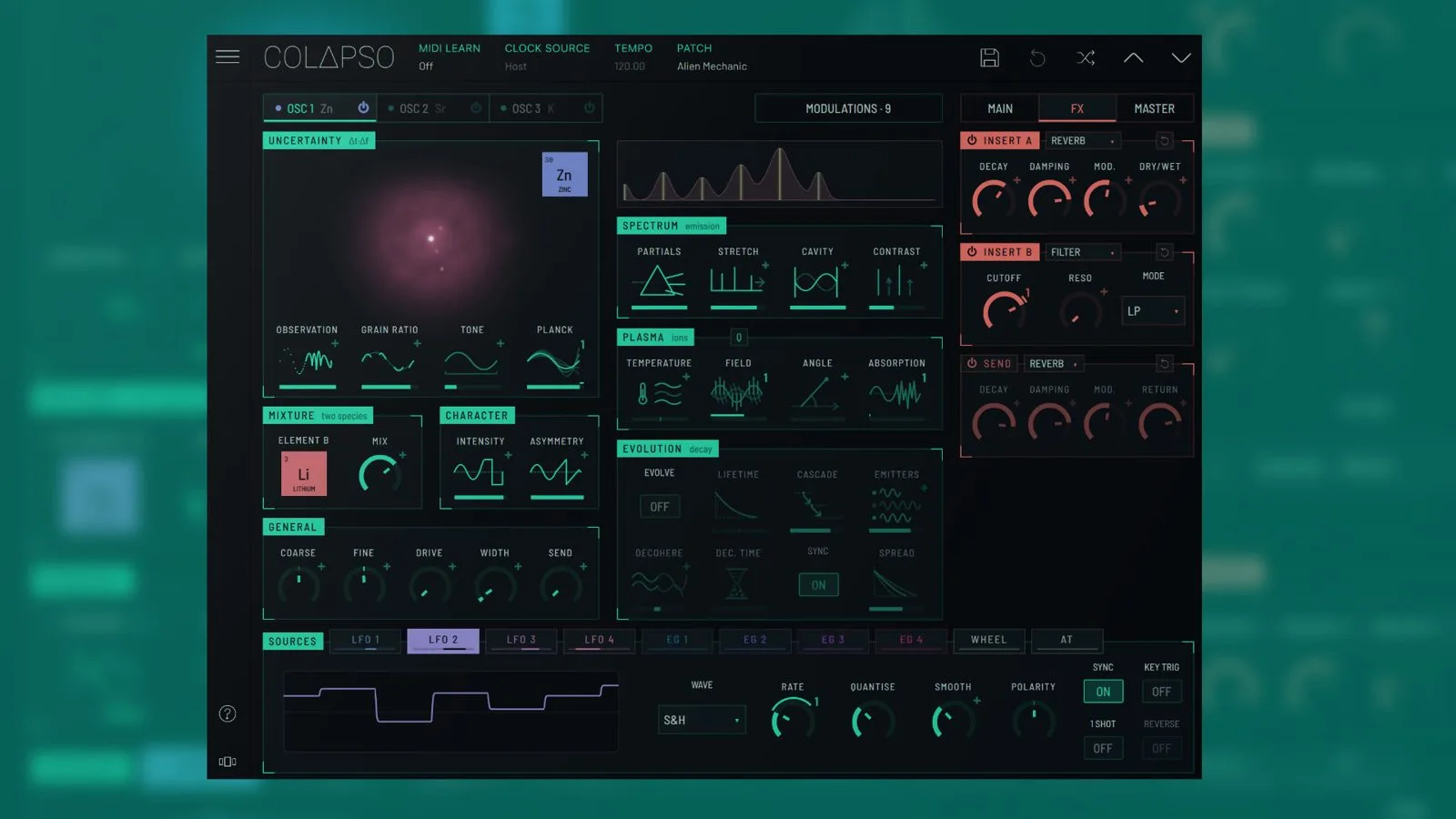
Far from a mere spectral generator, Colapso carries what you need to build living patches: four LFOs (sine, triangle, saw, square, sample & hold, 0.01 to 40 Hz or tempo-synced), four envelopes drawn node by node (1 ms to 8 s per stage), and per-voice modulation driven by wheel and aftertouch. On filtering, nine circuits per voice — state-variable, ladder, comb, formant and others — with drive and key tracking. The effects chain has two inserts in series (eight types), one send per oscillator (chorus, phaser, delay or reverb) and a bus compressor on the master.
So this is a full synth, not a curiosity. For anyone who wants to grasp what is really happening under the hood, our explainer on additive synthesis clarifies the logic of partials, and the one on granular synthesis pinpoints the tip toward grains that Observation triggers.
Platforms, formats and price
Colapso runs on macOS 13+ (universal binary, Apple Silicon native) and Windows 10+ 64-bit, in VST, VST3, AU and standalone formats, with MIDI learn, host sync, MIDI clock and Ableton Link. iOS and Android are not on board for now. On price, the standalone licence starts at €69 (down from €89), for up to five computers, with a rent-to-own plan at €8.90/month and a Colapso + DRC + FRMS bundle at €189. An unlimited-time demo lets you try it, at the cost of a burst of noise every minute. The official product page has the full detail. It joins a wave of concept-driven hybrid synths, alongside the recent Spitfire Audio Phoenix.
My take
The emission-line concept could have been a neat marketing story; what saves it is that Observation and Planck genuinely change the nature of the sound, not just its colour. You move from a crystalline tone to grainy textures without switching tools, which is exactly what you want from a synth you explore rather than program. At €69 the entry ticket is fair for an instrument this deep, and the additive format fills a real gap in many plugin collections. The risk is the learning curve: the scientific vocabulary will put off anyone who wants a preset and nothing more. For sound designers and the curious, though, it is a hard invitation to turn down.