Telos Alliance has taken its Zephyr Connect SE past the step that really counts: shipping. After its announcement, the codec is now in production and reaching broadcasters. In a product family — the Zephyr line — that all but invented the radio contribution codec, that real-world availability is worth pausing on, especially as the SE targets a precise niche: the power of a modern codec in a tiny, silent box.
Compact, silent, built to live anywhere
The Zephyr Connect SE is built on a compact, fanless and therefore completely silent hardware platform. That detail changes everything depending on where it goes: you can sit it in a control room where the faintest fan noise is audible, or at the foot of a transmitter in an isolated technical room. Telos says you can line up as many as three units side by side in a single rack space — handy for densifying a rack without wasting room.
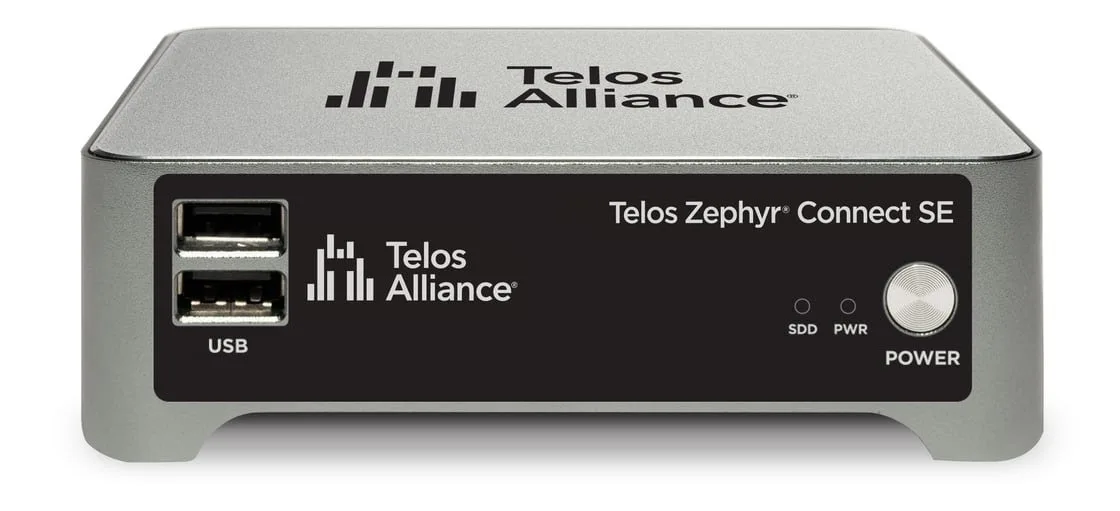
The SE is also designed to coexist with what’s already installed: it is described as fully compatible and interoperable with iPort HD and with Zephyr Connect. In other words, it slots into an existing Telos estate without forcing a wholesale replacement.
One codec, expandable to four
In its base configuration, the Zephyr Connect SE carries one bidirectional stereo codec. But the unit is expandable: through additional licences you can scale up to four codecs in the same box. That software-led approach lets you start small and add channels as needs grow, without buying new hardware.
The intended use cases are broad:
- Studio-to-transmitter link (STL): carry the programme to the transmission site.
- Network distribution: feed several points from a single source.
- Multi-channel link to remote studios: tie several control rooms together.
- Streaming encoder: paired with a streaming server, to feed an online station.
Networking and codecs: the serious stuff
On transport, the SE handles Unicast streams over UDP and TCP as well as UDP Multicast, and it natively supports Livewire+, Telos Alliance’s AES67-compatible audio-over-IP. So you stay firmly inside the world of standards-based audio networks, a subject we cover in our guide to broadcast audio codecs.
For encoding, Telos uses genuine Fraunhofer IIS codecs: AAC, AAC-LD, AAC-HE, AAC-HEv2, MP3 and MP2, with Enhanced aptX as an option. That guarantees reference-grade interoperability and quality for contribution and distribution. And the SE extends the compact logic we saw with the Axia Pulsar AoIP console, while fitting the kind of remote workflows we explored in our look at REMI remote production.
My take
A codec that makes no noise, fits three to a rack space and grows by licence rather than by buying more hardware: that’s exactly what broadcasters need right now, between shrinking control rooms and estates kept running longer. The choice of Fraunhofer codecs and compatibility with existing Telos gear remove the two real thorns of a codec rollout. The open question is the licensing model: billing extra channels is convenient to start with, less so for anyone who knows up front they’ll want all four. One to judge with the box in hand, but on paper it’s the kind of tool that makes an engineer’s life simpler.