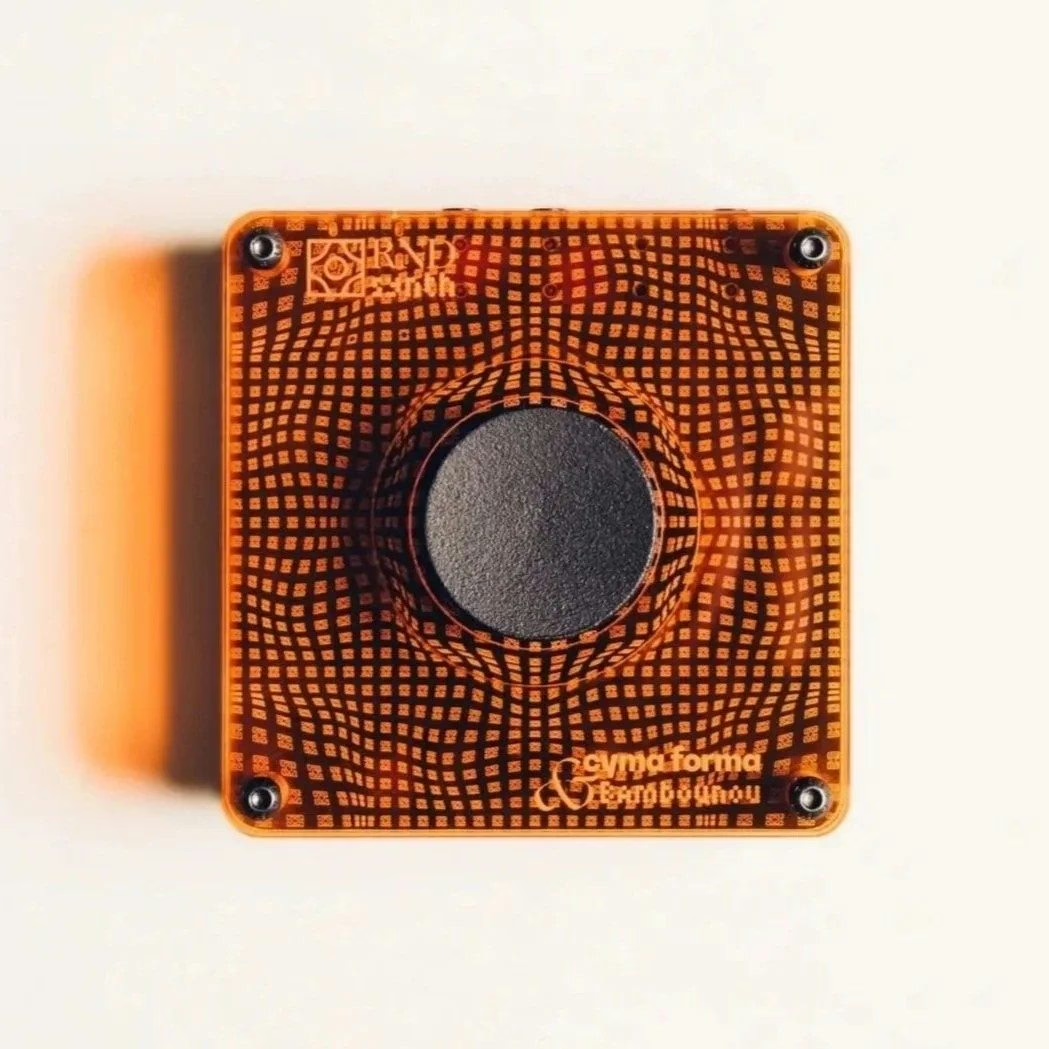
Against synths that pile on menus, the RND makes the opposite bet: one button, and each press invents a piece of music. Born from a collaboration between maker Cyma Forma and French artist Bambounou, this compact instrument fits in one hand and offers its user a simple deal — trade control for inspiration.
One button, over four billion possibilities
The principle is radical. With each press of the single button, the RND randomises all of its parameters: sounds, synthesis settings and sequence data all change at once, for an entirely new musical idea. A patch can hold up to four simultaneous instruments, each with its own sequence across four tracks. Cyma Forma claims more than four billion possible combinations: you’ll never stumble onto the same thing twice by chance.

Eight synthesis engines under the hood
Behind that apparent simplicity sits a real sound box: eight synthesis engines — subtractive, FM, acid, noise, speech, Karplus-Strong, supersaw and additive — cover a wide spectrum, from analog grain to modeled plucked string. Add twenty scales, five filter types and MIDI and sync modes. On the output side, the RND sends four audio tracks over USB-C, has a stereo mini-jack output, USB-C MIDI I/O and analog sync. Each instrument track can even be output separately over USB for recording or individual processing.
Why it matters
The RND isn’t a precision machine, it’s an idea machine — a kick-starter when the blank page looms, or a playing partner that takes you where you wouldn’t have gone. At €125 excluding VAT, the entry ticket is deliberately low for such a singular object. It joins the family of instruments built for spontaneity, like the Teenage Engineering EP-40 Riddim groovebox, and its supersaw engine echoes Native Instruments’ Super*Saw. Details are on the Cyma Forma site.
My take
The idea is as cheeky as it is fun: hand creation over to chance and keep a single gesture, a press. The risk with such a concept is that it wears thin once the surprise fades; the eight engines and multitrack USB output save it, because they let you capture a gem and rework it seriously in a DAW. At €125, the RND works less as a central instrument than as a session starter, something you reach for when inspiration is short. For anyone who likes being surprised, it’s a hard invitation to turn down — and Bambounou’s involvement is more than a marketing line.
Frequently asked questions
How does the single button work?
Each press randomises all of the instrument’s parameters — sounds, synthesis settings and sequences — to generate a complete, fresh musical idea. That’s the heart of the concept: you trigger surprise rather than tweak each parameter.
Which synthesis engines does it offer?
Eight: subtractive, FM, acid, noise, speech, Karplus-Strong, supersaw and additive. Add twenty scales and five filter types, enough to cover a wide range of timbres.
Can you record the tracks separately?
Yes. The RND sends four audio tracks over USB-C, and each instrument track can be output independently, for multitrack recording or individual processing in a DAW.
Is it a standalone instrument?
It has a stereo mini-jack output, analog sync and MIDI, so it can play on its own or in a setup. USB-C also opens the door to multitrack recording on a computer.