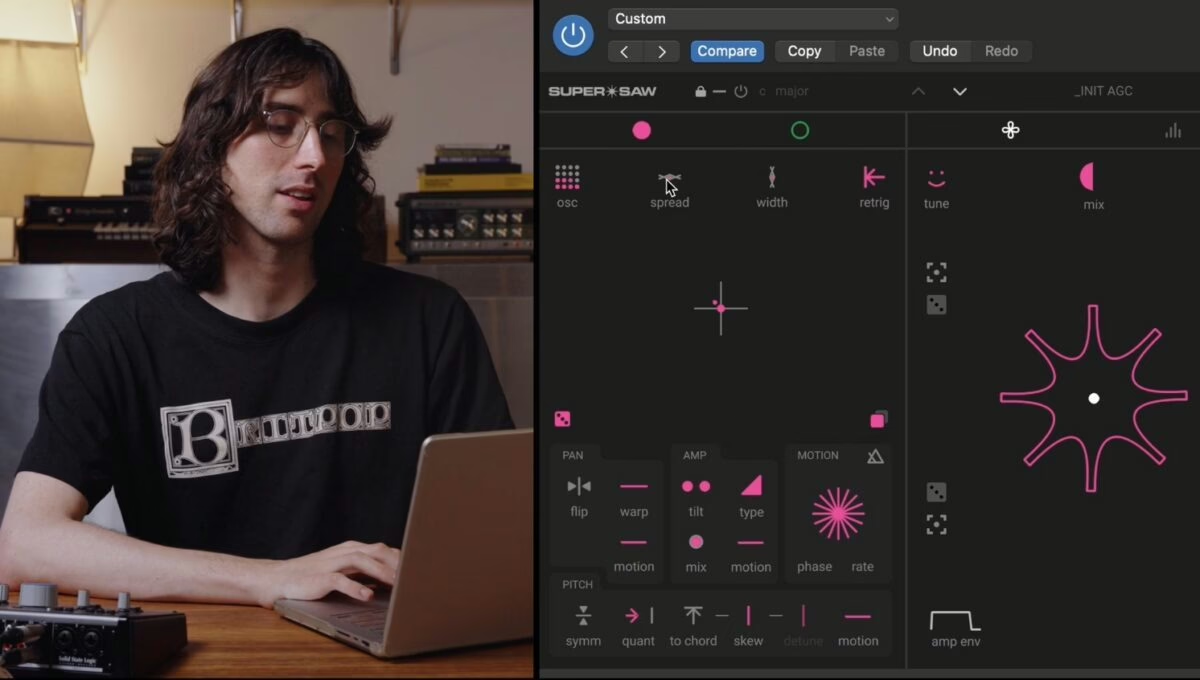
Native Instruments has turned A. G. Cook’s signature sound — the man behind Charli xcx, Caroline Polachek and Oklou — into a dedicated soft synth. Super*Saw isn’t another preset pack: it’s a sawtooth-stacking machine built around gesture, and it’s out now for $99.
A one-trick synth — and that’s the point
The supersaw is hardly new. Roland popularised it back in 1996 with the JP-8000, whose oscillator stacked seven slightly detuned sawtooth waves into the wide, shimmering pad that became the cliché of trance and, later, of two decades of electronic pop. What Native Instruments does with Super*Saw is hand that over-familiar idea to someone who turned it into a language: A. G. Cook, PC Music founder and chief architect of the hyperpop sound.
The plugin is deliberately narrow. No exotic wavetables, no granular engine — just two oscillator banks of sixteen saws each, thirty-two stackable, detunable sawtooths in total. This is total specialisation, the opposite of a do-everything synth, and that focus is exactly where the value sits.

The Morpher does the heavy lifting
The clever part isn’t the oscillator count, it’s how you drive them. Super*Saw puts a four-corner Morpher at the centre of its interface: you store four patch states at the corners of a square and drag a point that interpolates continuously between them. Pan, amplitude, pitch, chord — that point’s motion can be routed to multiple destinations, tracing a star-shaped path. You go from a blissed-out chord to a metallic wall of dissonance without multi-track automation or juggling instances.
Cook describes the two-layer logic as “a comedic duo”: one half can go completely off the rails while the other holds the line. Musical constraint tools — chord, scale, quantize — keep the chaos playable, while deviation controls let you deliberately push things into dissonance. It’s a synth that thinks in gestures, not in pages of parameters.
Under the hood
- Oscillators: 2 banks of 16 sawtooths, per-voice detune and offset, individual glide.
- X/Y Morpher: four corners with assignable star motion (pan, amplitude, pitch).
- Filters: low-pass, band-pass, high-pass, 2-pole and 4-pole slopes.
- Effects: built-in chorus, delay and reverb.
- Constraints: chord, scale and quantize to keep everything musical.
The visual design comes from Simon Whybray, Cook’s longtime collaborator, and the instrument integrates natively with Komplete Kontrol keyboards and Maschine. The preset library spans a deliberately wide range, from floating harmonies to rave leads and impossibly smooth glides.
Why this launch is smart
The real story here is strategic, not technical. Selling a single-purpose synth for $99 under a named producer means selling a promise of results: “the sound of those records, right now.” In an era when every wavetable synth offers ten thousand ways to get lost, an instrument that locks down one territory and makes it instantly playable has real value — especially for a generation that learns production by ear, not from the manual.
The internal timing makes the release even easier to read: while the parent group goes through a reshuffle and brands leave the fold, a cheap, strongly branded consumer launch is exactly the kind of move that puts Native Instruments back at the centre of the conversation.
My take
I’m instinctively wary of “signature” instruments — they often reek of merch. This one interests me for a specific reason: it doesn’t sell an artist, it sells a constraint. Having lived the shift from analogue to the computer from the inside, I learned that a good tool isn’t the one that does everything, it’s the one that gets your hands in the material immediately. A $99 supersaw that favours gesture over drop-down menus is the right philosophy — the open question is whether the engine really beats what you already get by stacking three oscillators in any DAW synth.
Price and availability
Super*Saw is available now for $99 / €99 in VST/AU/AAX formats and through Komplete Kontrol and Maschine — a classic NI launch price that puts it firmly in impulse-buy territory rather than serious-investment territory. See the official product page for system requirements.