



EVE Audio is rolling out Origin, its free application for Windows and macOS that gives you control over all the digital processing in EXO series monitors. Eight‑band EQ, delays, recallable scenes and correction filters: the Berlin manufacturer is turning its nearfield range into a genuine networked monitoring system, designed for multichannel and immersive setups.
Origin, the missing piece in the EXO ecosystem
Launched at the end of 2025, EVE Audio’s EXO series was, until now, based on a quirk well known to the brand’s users: all adjustments are made on the back of the monitor, via a small OLED screen and the SMART Control Knob. Handy for a stereo pair on a desk, much less so once you line up four, eight or twelve speakers. That is exactly the gap Origin fills: the application promised at launch and now available as a free download.
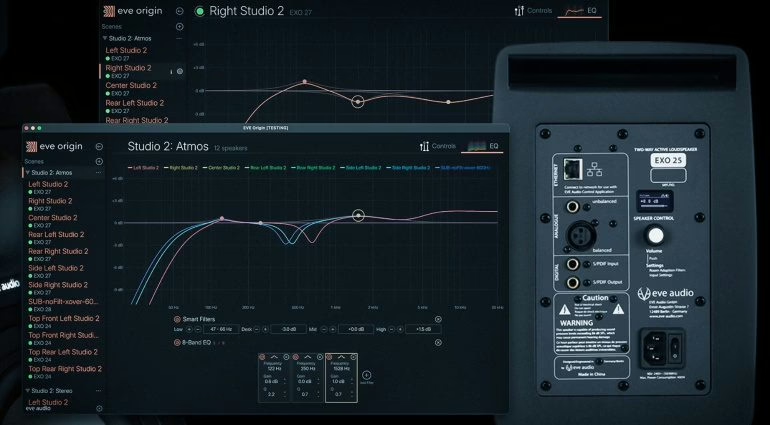
The principle is simple: each EXO includes an Ethernet port. You connect the monitors to the network, and Origin takes control of the entire system from your computer. No more walking around the speakers to EQ a rear monitor that’s hard to reach: everything is centralised on screen, with instant visual feedback.

What you actually control
Again, EVE Audio is not content with a simple remote volume panel. Origin exposes all of the onboard DSP in the EXO range:
- input level and selection (balanced XLR, RCA, S/PDIF);
- input sensitivity, switchable between -10 dBV and +4 dBu;
- delay, adjustable speaker by speaker, in milliseconds as well as centimetres;
- Smart Filters for room correction, with a graphical display;
- an eight‑band parametric equaliser, each band offering frequency, gain, Q factor and filter type, adjustable to the exact value or directly on the curve.
Two design choices are worth highlighting. First, the Scenes function: you store a complete configuration for the entire system and recall it with a single click, allowing you to switch instantly from a mixing session to a production session, or from stereo monitoring to multichannel playback. Then, and this is the point that really matters, the settings are stored in the monitors themselves. You can close Origin, unplug the computer: the calibration stays in place. The software is there to configure the system, not to run the audio continuously.
Where Origin really comes into its own: multichannel and Atmos
It’s in immersive setups that the tool really changes things. In a 7.1.4 system, time alignment and level matching for each speaker determine how convincing the spatialisation is. Managing those delays by hand, OLED after OLED, is a real slog. Origin displays the entire system on a single page and lets you set each listening position in the context of the others. For anyone working in Dolby Atmos mastering or building a surround studio, it’s a huge time‑saver, and it offers the promise of calibration that’s repeatable from one session to the next.
The EXO range in brief
Four two‑way models, all built around the new EXO Precision AirMotion tweeter (an in‑house Air Motion Transformer ribbon) combined with the GDC waveguide to widen the listening area, plus an aluminium woofer. All of them share XLR, RCA and 24‑bit / 192 kHz S/PDIF connectivity, the rear OLED display and, now, Origin control.
| Model | Woofer | Response | Max SPL | Guide price |
|---|---|---|---|---|
| EXO 24 | 4″ | 54 Hz – 24 kHz | 104 dB | €479 |
| EXO 25 | 5″ | 44 Hz – 24 kHz | 110 dB | €589 |
| EXO 27 | 6.5″ | 41 Hz – 24 kHz | 116 dB | €699 |
| EXO 28 | 8″ | 37 Hz – 24 kHz | 120 dB | €949 |

My take
Putting monitoring on the network and storing calibration in the speaker itself is absolutely the right direction, and it resonates with me all the more because I spent years as a studio technical director aligning monitoring by ear and with a tape measure. Seeing a manufacturer offer this level of control for free, when the high‑end competition has long used it as a justification for premium pricing, is excellent news for smaller facilities. One caveat, though: a correction EQ, however precise, is no substitute for acoustic treatment. Smart Filters correct a response; they don’t erase a poorly damped room. Origin is a fantastic optimisation and alignment tool; it’s not a magic wand. At this price point and with this philosophy, I’m still very happy to take it.
A positioning that shakes up the segment
EVE Audio is taking direct aim at the territory of software‑controlled monitoring systems, until now dominated by a few established names whose networked calibration comes at a hefty price. By integrating the DSP into the speaker, providing the application free of charge and keeping the 8‑inch model under the €1,000 mark, the Berlin company is making calibrated monitoring and immersive audio accessible to studios that were previously priced out. It’s a philosophy you can see elsewhere in affordable correction, for example with the Audient ORIA Mini on the hardware side, or with ATC in‑wall monitors for immersive setups at a completely different price point. The remaining question is the intrinsic long‑term sound quality of the EXO range, but on paper, the arrival of Origin turns an already serious line‑up into a coherent platform. The full spec sheet is detailed on the official EXO series page.


