BEATSURFING VRAC put an old idea back in the spotlight: take a sound that is nothing like a drum — a pad, a voice, a slamming door — and impose the behaviour of a hit on it. The concept is far from new (Waldorf Attack was doing a version of it decades ago), but VRAC made the gesture free and immediate.
Once you have caught the bug — feed a engine anything, get a playable hit back — the natural question follows: what else can take that idea further, or simply somewhere else? Let’s be honest up front: very few plugins do exactly what VRAC does (resynthesise a source while keeping its DNA, gesturally, through an XY pad). Most tackle the problem from another angle. So here they are, sorted into three families from closest to furthest, free and paid mixed together.
The closest family: reshaping a source in real time
1. Krotos Reformer Pro — the true conceptual twin

This is the only pick here that shares VRAC’s DNA: you feed it an arbitrary source — a live mic, a file, a MIDI envelope — and it reforms it in real time by driving an analysed sample library. The dynamics and grain of the input trigger a different material (footsteps, fabrics, impacts, water, fire…), with an X-Y pad to blend up to four voices. The difference with VRAC is real and worth stating: Reformer morphs your source into another texture rather than slicing it into kit pads. But the spirit — turn any signal into playable material — is exactly the same, only far more powerful. It is the sound-design tool VRAC will make you want to reach for.
En bref — Krotos Audio · paid, ~$395 (10-day trial, frequent 50% sales) · VST/VST3/AU/AAX · macOS & Windows.
→ Reformer Pro on the Krotos Audio site
Build a kit from your own sounds
Here you don’t resynthesise a continuous pad: you take any one-shots — yours, your field recordings, your homemade samples — and turn them into a playable kit. It is the other half of VRAC’s promise, the “any sound becomes a drum” part, handled through sampling and organisation rather than resynthesis.
2. TX16Wx Software Sampler — the free one to own

A full-featured sampler, free, and — the developer says so in plain words — with no limitation whatsoever. It slices a loop or arbitrary source into playable zones, maps endlessly, and its trigger matrix handles round-robin, velocity and modulators for genuinely deep homemade kits. It stays in a sampler’s read/map logic — no “drumify” engine or VRAC-style XY pad — but for zero cost, this is near-pro sampler depth you would be wrong not to have in your DAW.
En bref — CWITEC · free (optional paid Pro version) · VST2/VST3/AU/AAX · macOS & Windows.
3. Sitala — minimalism that slices a loop in one move
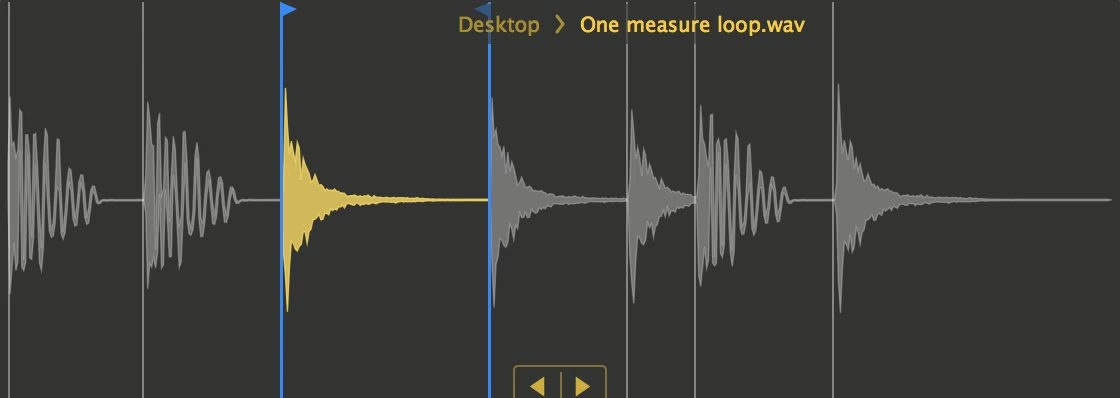
Sixteen pads, six musical controls per sound, and a transient detector that bursts a loop into hits laid out automatically across the grid: Sitala is the anti-bloat sampler, built for speed. Drop a sample, it reads dynamics and pitch to make the controls instantly musical. Mind the status: version 1.0 is still 100% free and fully functional, but the current 2.1 is now paid (around $20). Even at that price, it remains one of the fastest paths from “a sound” to “a kit that grooves”.
En bref — Decomposer · v1.0 free / v2.1 ~$20 · VST/AU/AAX + standalone · macOS & Windows.
→ Sitala on the Decomposer site
4. XLN Audio XO — when picking the sound goes visual

XO’s signature is its map: it scans your library and lays every sample out on a “galaxy” where similar sounds sit next to each other. No more folder digging — you choose by ear as you wander the space. Add instant sample swapping, a serious groove engine and drag-and-drop MIDI export, and you have one of the best tools to turn a pile of mismatched sounds into a coherent kit. It isn’t resynthesis: XO organises and sequences, it doesn’t “drumify” a continuous voice. But to tame an overflowing sample library, it is lethal.
En bref — XLN Audio · paid, €149 (10-day trial) · VST/VST3/AU/AAX · macOS & Windows.
5. Algonaut Atlas 2 — the same idea, driven by AI

Atlas 2 pushes the similarity-map principle with an AI that automatically sorts thousands of samples by sonic proximity. You pick from the map to build a kit (8, 16 or 64 pads), humanise with a variation engine, sequence, and export as MIDI or audio. It is XO’s more affordable cousin, with a standalone app on top. Same logic, same limit versus VRAC: a superb kit builder from your sounds, not a continuous-source transformer.
En bref — Algonaut · paid, ~$99 (free trial) · VST/VST3/AU/AAX + standalone · macOS & Windows.
→ Atlas 2 on the Algonaut site
6. Native Instruments Battery 4 — the reference, plain and simple

No such selection is complete without Battery. Its cell matrix has been the drum-sampler standard for years: each cell takes any WAV, AIFF, loop or REX, with its own envelope, EQ, compression and effects. Time Machine Pro for stretching, full routing, a huge electronic and hip-hop library, Komplete integration: it is the studio workhorse for beatmaking. It is a long way from VRAC’s “gesture” spirit — here you build methodically in a grid — but nothing is as reliable for making your sounds play like a drum kit.
En bref — Native Instruments · paid, €199 (update €99) · VST/VST3/AU/AAX + standalone · macOS & Windows.
→ Battery 4 on the Native Instruments site
The other route: build the hit from scratch
7. Waldorf Attack 3 — synthesise the drum instead of sampling it

Where VRAC starts from an existing sound, Attack starts from nothing: it is a pure percussion synthesiser, sculpting kicks, snares and toms from oscillators and filters, with no input source at all. I include it because it is exactly the kind of tool VRAC echoes in its own logic — imposing a drum behaviour — but through synthesis. Good news: the 90s classic came back in February 2026, fully rewritten as Attack 3. Resizable interface, enriched virtual-analogue engine, optional samples on top: for anyone chasing hits that exist nowhere else, this is the royal road.
En bref — Waldorf Music · paid, €99 · VST3/AU/AAX · macOS & Windows.
→ Attack 3 on the Waldorf Music site
Also worth a look: in the same vein, the cult Sonic Charge Microtonic (€99) remains an absolute reference for 100% real-time percussion synthesis, with a sequencer and randomisation that spit out hand-carved electronic kits in seconds.
| Plugin | Developer | Price | The job in a word |
|---|---|---|---|
| Reformer Pro | Krotos | ~$395 | Source resynthesis |
| TX16Wx | CWITEC | Free | Sampler / slicing |
| Sitala | Decomposer | Free / ~$20 | Express slicing |
| XO | XLN Audio | €149 | Kit from your samples |
| Atlas 2 | Algonaut | ~$99 | Kit + AI |
| Battery 4 | Native Instruments | €199 | Reference drum sampler |
| Attack 3 | Waldorf | €99 | Synthesise the hit |
So, which one should you pick?
If it was really VRAC’s gesture that won you over — throw a sound in, get back a hit that keeps its soul — Reformer Pro is the only true step up. If you are drowning in samples and want to turn them into kits that hold together, XO or Atlas 2 will change your life; Battery stays the safe studio choice, and TX16Wx does the essentials without spending a cent. And if you want drum sounds that exist nowhere else, go the synthesis route with Attack 3. Still, VRAC keeps a place of its own: free, gestural, immediate. None of these seven truly replaces it — they widen the palette around it. If you haven’t tried it yet, start there.