Image-Line has released FL Studio 2026, its annual update, free for all licence holders. On the menu: a completely rebuilt FLEX, cloud project backup, an assistant that operates directly inside the session, and a Transmitter plug-in that splits transients and the body of the sound. A detailed look at a packed release.
The pace is now well established: every summer, Image-Line ships a year-stamped version of FL Studio, offered to all its users under its lifetime free-updates policy. FL Studio 2026, available since 7 July and already updated to 2026.1.1, is no exception. Beneath the layer of visible new features, it is above all the deep work on everyday tools that stands out.
FLEX: a redesign awaited since 2019
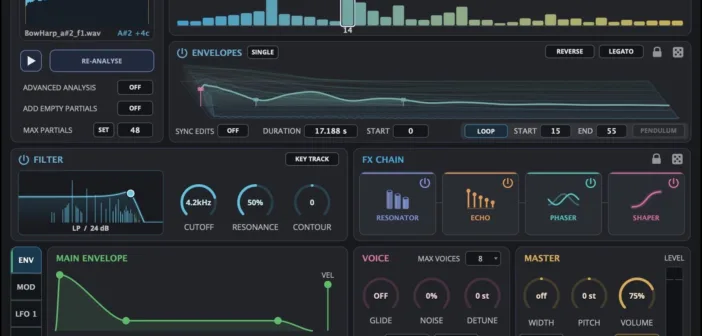
This is the centrepiece of this edition. FLEX, the in-house rompler introduced in 2019, had become the most-used instrument in the ecosystem but was starting to show its age. Image-Line has rebuilt it from the ground up. The browser is the first to benefit: cross-library search across all installed banks, more responsive preview, filtering by genre. We move from a library you browse to a library you query.
The second project is less spectacular but more decisive: a new audio engine, which Image-Line claims is up to 50% less CPU-hungry on second-generation banks. On a session loaded with dozens of instances, this kind of saving genuinely changes working comfort. The update also adds more than 200 new presets and eight Core Series packs, free for everyone.

Gopher, the assistant that acts inside the session
The headline feature is Gopher, presented as an “agentic” assistant. The difference from a simple help chatbot lies in the verb: Gopher doesn’t just explain, it executes. You ask it in natural language to organise tracks, route channels to the mixer, set levels, adjust a plug-in’s parameters or generate a phrase in the Piano Roll, and it does it. Image-Line stresses a key point in an era of widespread distrust: no data is collected or used to train a model.
The rest of the toolset follows the same utilitarian logic. Transmitter, bundled with the All Plugins edition, splits any signal into two components, transient and sustain, which you can then process or route independently — a remarkably effective way to sculpt drums or tame the body of a sound without touching the attack. The Remix a Song function combines tempo detection and stem separation in a single click, in line with what Waves has recently integrated into its ecosystem or what Steinberg offers with SpectraLayers 13. The Piano Roll gains real-time chord detection and a Chord Stamp with voice-leading modes, while Luxeverb gets a feed-forward mode.
FL Cloud: integrated backup, at last
FL Studio 2026 introduces project backup via FL Cloud. On every save, the session can be automatically copied, encrypted, to Image-Line’s servers — enough to recover a lost project or pick up a session from another machine. The developer specifies that backups remain private and are not used to train any AI. The space depends on the plan:
| FL Cloud plan | Included storage |
|---|---|
| Free | 500 MB |
| Plus | 5 GB |
| Pro | 1 TB |
On top of that come two welcome safety nets: a gain control per audio clip directly in the Playlist, and an Audio Logger that keeps the last 60 seconds of the master output so you can recover a take or an improvisation you thought was lost.

What I take away from it
Two things. First, FL Studio still carries a reputation as a beatmaker tool that hasn’t matched reality for a long time. I lived through the shift from analogue to computer-based music production from the inside, and I saw workstations that were mocked turn into production standards; this one has crossed that threshold. Second, and this is the real point, the lifetime free-updates policy remains a counter-current model in a sector that is drifting ever further towards subscriptions. Getting a rebuilt FLEX and a batch of serious tools without paying again, when half the industry now charges you for every version, is worth highlighting.
On Gopher, I remain cautious. Letting an assistant handle routing, track organisation or a first pass at levels genuinely saves time on thankless tasks. But no agent replaces a trained ear when it comes to the decisions that matter. The new feature I expect to keep using is Transmitter: splitting transient and sustain to treat them separately is an audible mixing move, not just a spec-sheet talking point. Beyond that, this version mainly confirms that a well-designed software instrument — like the sampled romplers we are seeing pop up everywhere — is defined less by its feature list than by the quality of its engine. Full details are recorded on Image-Line’s release page.