Managing the bottom of the spectrum is still one of mixing’s most thankless jobs. Too much low end and the mix turns to mud; too little and it lacks body on both a good monitor and a three-dollar earbud. That exact pain point is what SubCulture targets — the new plugin from Baby Audio, released on July 14, 2026. Its promise: build huge low end that stays musical and in tune, instead of stacking a static sine that fights your bass fundamental.

Pitch-tracking is the keystone
SubCulture’s core idea lives in one word: pitch-tracking. The plugin continuously analyses the pitch of the incoming monophonic signal and locks its engines to every note played. The direct result: the generated low end follows the bassline instead of sitting on a fixed frequency. That’s the whole difference between a sub that supports the music and one that collides with it the moment the chord changes. On sources where the fundamental wanders — a synth bass, a pitched 808, an upright — this approach avoids the beating and masking that turn a great low end into porridge.
One caveat: SubCulture works on a monophonic signal. That’s a logical constraint — pitch-tracking assumes one note at a time — but it frames the use case. You put it on a bass track, a kick, a mono lead, not on a busy stereo bus where several pitches overlap.
Three engines to shape the bottom
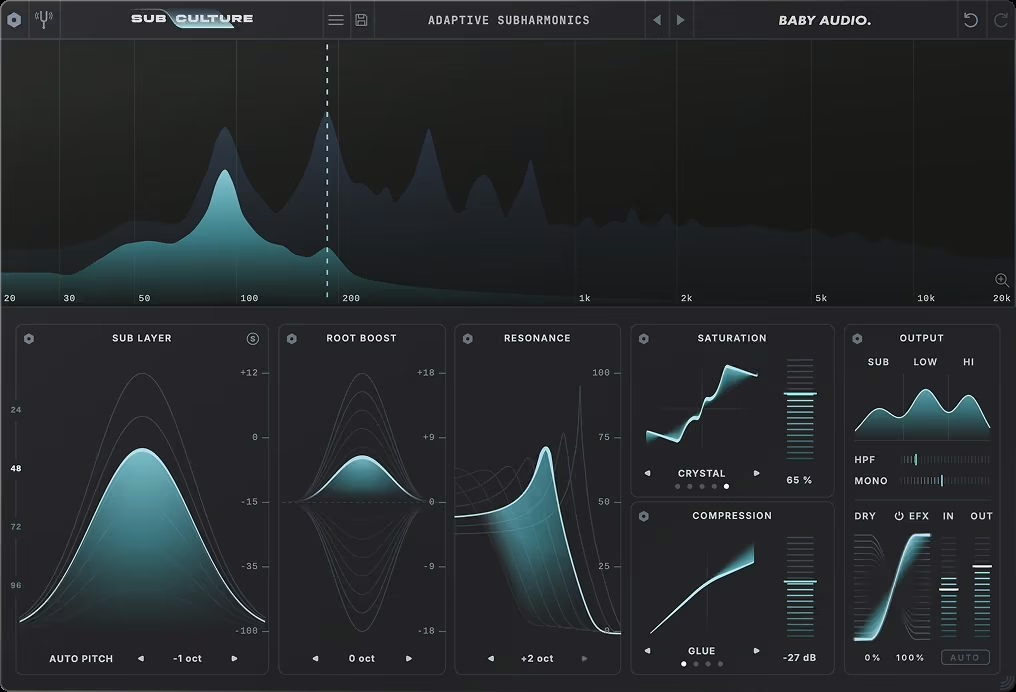
The plugin is built around three complementary engines, all slaved to the pitch-tracking:
- Sub Layer — adds a pitch-shifted sub-octave, up to two octaves below the original signal. This is the engine that reaches for the infrasound you feel more than you hear.
- Root Boost — a pitch-tracking EQ band applying up to ±18 dB at the fundamental of each note. In other words, a surgical boost that re-tunes itself as the bass moves, where a static EQ would miss the target on the very next note.
- Resonance — a parallel filter network modelled on classic analog designs, adding warmth and grain rather than a plain level bump.
Once those three engines are dialled in, SubCulture offers a stage of analog-modelled saturation and compression. That’s not cosmetic: saturation creates upper harmonics that make the low end audible on small speakers — crucial, since it’s the only way to “make a sub exist” on a phone or laptop — while compression acts as glue to seat the whole thing in the mix.

Formats, price and availability
SubCulture ships in VST, VST3, AU and AAX (64-bit) for macOS and Windows. The list price is $129, with a $79 launch price through August 31, 2026. Baby Audio also offers a “Subscribe to Own” plan — a subscription that ends in a license — and a free demo to try before you buy. US buyers will find it through the usual plugin channels alongside Baby Audio’s own store.
That positioning fits the brand’s reputation: cleanly designed plugins with slick ergonomics at a price that doesn’t sting. Baby Audio built its catalogue on that promise, and SubCulture stays on message.
My take: a useful tool, if you know why you need it
Low end that stays in tune isn’t empty marketing — it’s the real issue at the bottom of the spectrum. I’ve spent enough hours re-seating basslines in the mix to know that 90% of sub problems don’t come from a lack of level, but from masking between kick and bass, or a detuned sub smearing under the note. A tool that locks the reinforcement to the exact fundamental of each note attacks the problem at the root, and that’s smart.
That said, a plugin is no substitute for honest monitoring and a treated room. SubCulture will hand you an impressive low end on your system; you still have to check what it becomes on a club rig, a soundbar and a budget pair of earbuds. The saturation engine is exactly what does that translation, and it’s probably the section to work on first. For anyone producing electronic music, hip-hop or anything that lives by the low end, the tool makes sense — all the more so as modern studio workflows keep pushing toward this kind of targeted processing, in line with what we’re seeing from real-time stem separation and console-in-a-box hosts like dedicated bus processors.
One thing is obvious: at $79 with a free demo, the barrier to trying it is low. In a plugin market in full reshuffle, independent makers like Baby Audio thrive by solving specific problems rather than selling sprawling suites. Full details are on the product page.