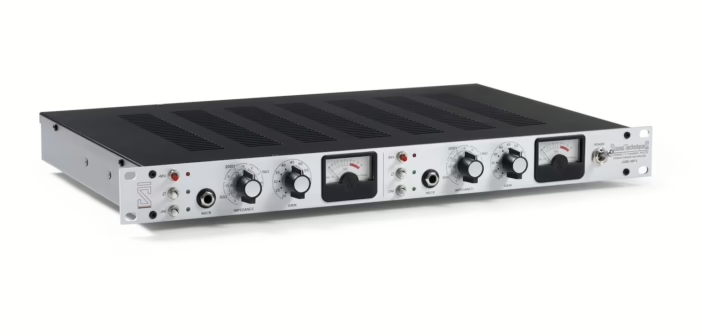
Four years after selling them, Dirk Ulrich has bought Plugin Alliance and Brainworx back from inMusic. Both brands now sit inside RCKFRC, the founder’s new holding, alongside Apogee and Manley. It’s a homecoming that says a lot about the state of the plugin market.
What happened
On 15 July 2026, Dirk Ulrich closed the acquisition of Brainworx and Plugin Alliance from inMusic. The two companies — behind some of the most widely used analogue emulations in mixing, from the bx_console range to tape, compressor and preamp models — return to the direct control of the man who created them. They join RCKFRC, the holding Ulrich has built over recent months, which already houses Apogee and Manley Laboratories.
Winfried Schapitz, who ran Brainworx before Ulrich’s exit, is back as CEO. Both sides describe the handover with the inMusic team as “professional and constructive” — this reads as an organised handoff, not a power struggle.

Full circle
Ulrich had sold Brainworx and Plugin Alliance to the Native Instruments group in 2021, staying on as CEO before shifting to an advisory role at the end of 2022 and leaving entirely in early 2024. In the meantime, Native Instruments was folded into the inMusic galaxy — the conglomerate that swept up Akai, Moog and many others. What we’re watching now is the methodical unwinding of that concentration.
And this deal doesn’t stand alone. It’s part of a break-up sequence: iZotope recently left Native Instruments to join Boris FX, and waves of layoffs have hit NI’s teams. The mega-group that was meant to rationalise audio software is coming apart piece by piece, and the original founders are collecting their chips.
What it means for your plugins
Every user asks the same fair question first: what about my licences, my authorisations, my projects? Ulrich put this at the very top of his stated priorities — protecting existing plugins, licences and projects — before even mentioning new products. The four commitments each fit on one line: preserve what exists, continue development, communicate directly, and introduce the new team with a roadmap in the coming weeks.
- Licences: continuity promised for products already purchased.
- Development: R&D maintained across the Brainworx and Plugin Alliance ranges.
- RCKFRC ecosystem: Apogee, Manley and Brainworx under one roof, with hardware/software bridges floated (real-time Plugin Alliance processing on Apogee interfaces, new plugins co-developed with Manley).
My take
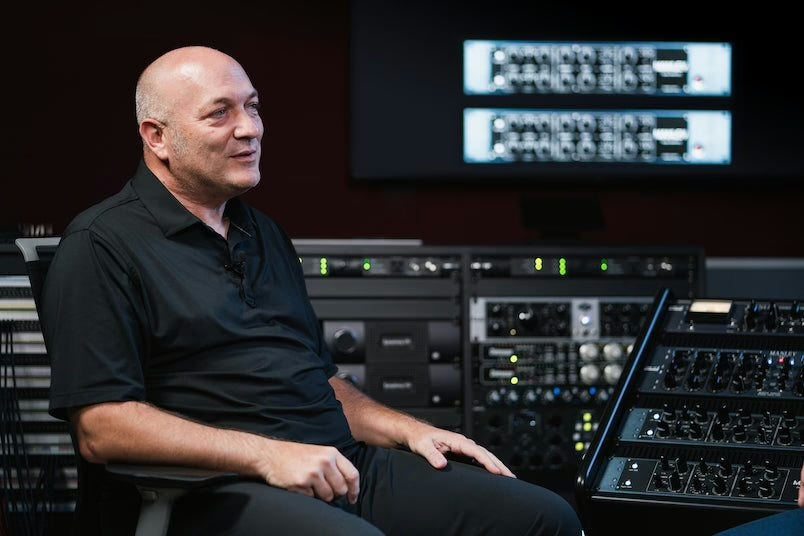
I lived the shift from analogue to computer-based production from the inside, and I’ve watched the software sector’s cycles of concentration and fragmentation play out. What’s happening here matters. The mega-catalogue logic — one account, one subscription, everything in one place — has shown its limits: when a conglomerate wobbles, tens of thousands of users start wondering whether their mixing chain will survive the next OS update. Seeing a founder take back tools he knows intimately, with Apogee and Manley under the same holding, is reassuring: we’re back to houses run by people who know exactly why a given preamp sounds the way it does. That said, RCKFRC is now becoming a small conglomerate of its own — the real test is whether Ulrich keeps his promise of closeness once it’s all consolidated.
What’s next?
In practical terms nothing changes right now: the plugins run, the licences stay valid. The detailed roadmap is expected “in the coming weeks.” Watch the hardware/software integration with Apogee and the fate of the now-overlapping ranges gathered under RCKFRC. For anyone tracking the processing industry, this episode confirms a deeper trend also visible in control surfaces and mixing tools. Plugin Alliance’s official statement will spell out the timeline.