Immersive live sound long ran into one simple snag: to prepare a show, you needed the processor. With vCore, d&b audiotechnik lifts much of that lock. The German brand is releasing a free software processing engine that lets you design, audition and pre-listen to a Soundscape project with no dedicated hardware at all — just a computer and a pair of headphones.
Soundscape, a quick refresher
Soundscape is d&b’s immersive ecosystem: an object processing engine (historically the DS100, now joined by the DS110) paired with the software modules En-Scene, to place and move sources in space, and En-Space, to recreate acoustics. In the room it moves you past plain left-right and gives every listener a sound image that matches what they see.
The friction, until now, was preproduction: hard to move a show’s design forward without the processor on hand. That is exactly where vCore comes in.
What vCore actually brings
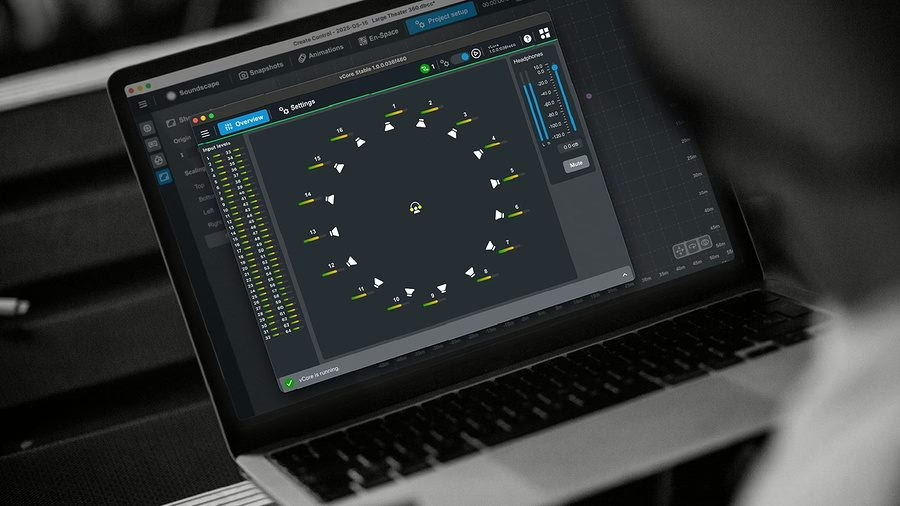
vCore is a standalone processing engine that integrates with Create.Control v1.4, d&b’s design software. It takes up to 64 inputs and produces a two-channel binaural render: a front-of-house engineer or sound designer can build the scene, lay out objects, load acoustic emulations and pre-listen on headphones — at home or on the train — before ever reaching the venue.
To feed the engine from a workstation, d&b provides the AudioBridge, routing audio straight from a DAW into vCore. The software runs on macOS and Windows and is a free download. The binaural output is useful beyond prep, too: webinars, online streams, demos — anywhere you want people to hear an immersive project without deploying a system.
Binaural rendering is not a live-only trick: it sits at the core of immersive studio mixing, as we explain in our guide to Dolby Atmos mixing. The idea is the same — give a believable spatial image on headphones so you can work away from the rig.
Why it matters for the trade
On a touring schedule, on-site tuning time is always too short. Arriving with a project already built, objects already placed and an intent already validated on headphones is margin reclaimed once the room finally opens. vCore does not replace listening in the actual space — reproduction remains a matter of system and acoustics — but it shifts a big chunk of design work upstream, where there is time to think.
It is also a teaching and sales tool: explaining Soundscape to a client or a crew becomes trivial when all it takes is a pair of headphones. And since Soundscape rides on standard audio networks to carry its channels, a refresher on the protocols never hurts: see our explainer on audio over IP.
Where it sits in the range
vCore does not make the DS100 or DS110 obsolete: binaural on headphones is not multi-output reproduction on a real system, and pre-listening stays an approximation. But in preproduction, the approximation is more than enough to make the right calls. It stays true to d&b’s logic of finely equipping the designer, much as today’s operator is equipped on a digital console like the DiGiCo Quantum638.
My take
Making a binaural preproduction engine free is the kind of move that nudges a whole craft forward. Immersive sound is still costly and complex to deploy; letting people design a show on headphones, from the sofa, clearly lowers the barrier and saves precious time once on site. Pre-listening will never match hearing it in the room, and nobody at d&b pretends otherwise. But to rough out a spatial intent, lay out objects and sell the idea to a crew, vCore lands exactly where it was needed. Worth a spin on the next tour prep.