zynaptiq is expanding its line with two complementary plugins, LOUD and WIDE. The first adds density and body to a track, bus or master without crushing the punch; the second widens the stereo image and turns a mono signal into stereo while staying mono-compatible. Two very different tools in use, but built on the same promise: a clean result fast, without stacking processors.
One philosophy: the result first, the controls second
The German company made its name on high-end spectral processing hidden behind deliberately spare interfaces. LOUD and WIDE follow that line: few visible controls, a sophisticated engine underneath. The point isn’t to take control away from you, it’s to save you from chaining three or four modules to reach a specific goal. Both run 64-bit internally and offer a fully vectorized GUI that zooms up to 200% — handy on high-density displays.
LOUD: body and density without flattening the attack
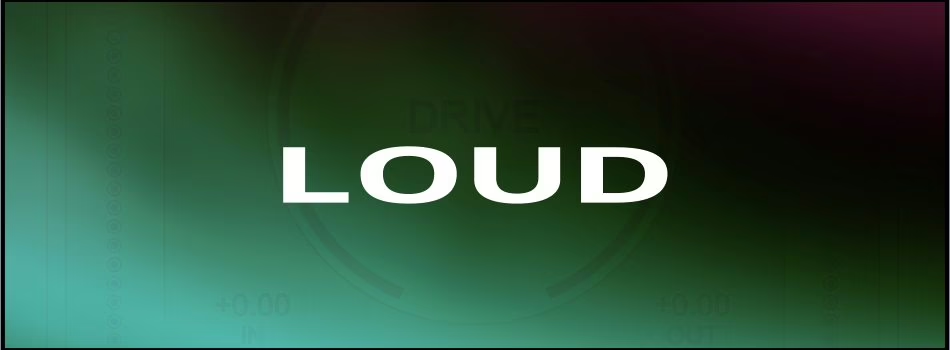
LOUD is a track, bus and master processor meant to bring a sound “into a good place” quickly: more density, more presence, more perceived level, without squashing transients. Under the hood, a single processing stage combines technology from three in-house plugins — INTENSITY 2, PUNCH and BALANCE — plus a new feed-back multi-band limiter, all in a signal path billed as light on latency and CPU.
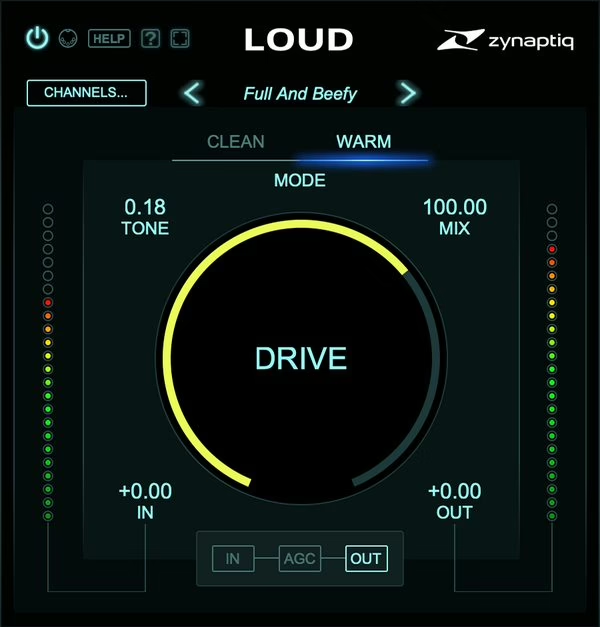
The interface centers on a large DRIVE knob, flanked by a TONE control that adaptively reshapes the frequency response and a MIX control for parallel processing. Two modes, CLEAN and WARM, change the color of the built-in saturation and limiting. A level-compensated monitoring switch (AGC) lets you A/B without being fooled by the volume jump — the classic trap when you’re chasing “louder.” LOUD also handles up to 16 channels, so it works on immersive formats.
WIDE: widening without breaking mono compatibility
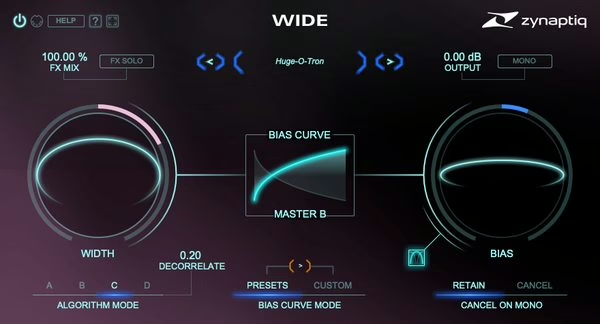
WIDE tackles a problem every mastering engineer knows: widening the stereo image almost always costs you phase trouble the moment you collapse to mono. The plugin offers four algorithms — three stereo-to-stereo, one mono-to-stereo — based on zynaptiq’s sample-accurate spectral processing and resynthesis rather than the usual Mid/Side or time-shift tricks. The claim: widening that is “virtually free” of artifacts, and 100% mono-compatible if you want it.
The main controls are a WIDTH knob, a DECORRELATE parameter and a BIAS section tied to a curve that makes the effect frequency-dependent — widening the top end without touching the low end, for instance. A Cancel on Mono option manages the mono fold-down, broadband or per frequency band. That discipline on compatibility is what sets WIDE apart from a plain widener: it’s built for mastering, where a widening trick that falls apart in mono is a deal-breaker.

Price, availability and formats
Both plugins are available now in VST3, AU and AAX on macOS and Windows. LOUD is priced at $99 / €99 (intro $49 / €49), WIDE at $149 / €149 (intro $99 / €99). The introductory offers run through October 10, 2026 — enough time to demo both before deciding. If you already ride perceived loudness by hand, our guide to mastering chain order shows where a tool like LOUD fits. On the density side, LOUD overlaps with the logic of parallel compression; on the stereo side, WIDE is a natural extension of Mid/Side processing.
My take
LOUD gets the brief right: one big knob, two flavors, and you get density in seconds where a classic chain wants three modules and ten minutes of tweaking. zynaptiq’s bet is to hide the complexity behind a single move — and when the algorithm holds up, it works. WIDE is more specialized, but its well-managed mono compatibility makes it genuinely useful for mastering, where widening usually costs you in phase. At $49 and $99 during launch, both are worth a demo before the prices climb back up.