A presenter opens their mouth, the voice lands a fraction of a second too early, and the whole newscast feels wrong. Lip-sync, the way sound sticks to the lips, is one of the faults the eye catches fastest. Yet it does not come down to a single setting but to a race between two signals, picture and sound, that do not cross the chain at the same speed. Understanding that race is already most of the way to winning it.
A fault the eye rarely forgives
Our perception is not symmetrical. In nature, light arrives before sound: you see the lightning, then you hear the thunder. The brain therefore accepts sound that follows the picture fairly well, but copes badly with sound that comes before it. A presenter whose voice runs ahead of the lips looks dubbed, almost fake, long before you can name the problem. That asymmetry drives everything else: a slight audio delay always beats a slight audio lead.
Why the picture falls behind
Processing the picture costs time. A production switcher, scaling, de-interlacing, encoding, a set-top box at the end of the chain, a television set with its own image processing, each stage adds its latency. Sound, by contrast, follows a lighter path and comes out sooner. Without correction, the audio therefore arrives ahead of the video, which is exactly the case the ear hates. The job is to delay the sound by just enough to catch the picture, stage after stage.
The thresholds to know
Standards put numbers on this tolerance. ITU-R BT.1359 sets a detectability threshold: the drift starts to show when sound leads the picture by more than about 45 milliseconds, or trails it by more than 125 milliseconds. Past a second threshold, the acceptability limit, around 90 milliseconds ahead and 185 milliseconds behind, the fault becomes clearly disturbing. The asymmetry returns: the margin allowed behind is nearly three times wider than ahead. On the European side, EBU R37 aims for a tighter end-to-end figure, on the order of 40 milliseconds ahead and 60 milliseconds behind, splitting a small budget across each stage so the build-up stays under control.
Where the drift creeps in
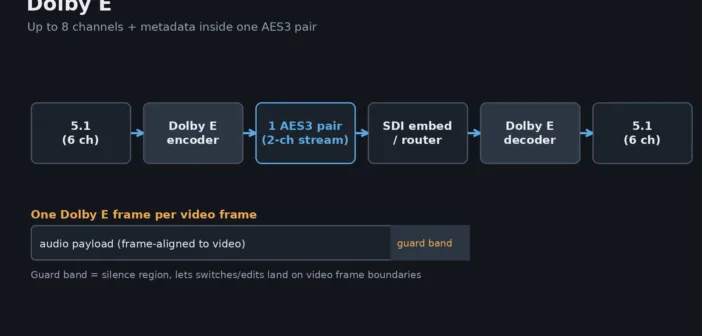
The strength of the classic TV signal is that the audio travels inside the video. As long as the sound stays embedded in the SDI, picture and sound stay locked, as our article on embedded audio in SDI explains. The drift appears when you de-embed the audio to process it, on a console or a processor, then re-embed it: during that detour, the video has kept moving, often by one frame or more. Dolby E, for instance, forces its own one-frame delay that has to be built into the budget.
Measuring the drift
You only correct well what you measure. The oldest method is still the film clapperboard: a gesture that marks a picture and a sound at the same instant, whose gap you read in the edit. In operation, you use test generators that emit a visual flash paired with a beep, then analysers that compare the arrival of the two and show the offset in milliseconds. Measuring at the end of the chain, as close as possible to the television, gives the figure that really counts, because that is where all the latencies have added up.
Fixing and preventing
The fix runs through audio delay lines, set to match the picture, and frame synchronisers that realign the video. The best prevention is to keep the sound embedded as long as possible and to limit the round trips. On a SMPTE ST 2110 network the approach changes in nature: video and audio travel as separate streams, but every packet carries a timestamp locked to a shared PTP clock. Alignment no longer depends on cable length but on those timestamps, which simplifies end-to-end sync. At the viewer’s end, finally, the “audio delay” setting on a TV or a soundbar trims the last milliseconds added by the set’s own image processing.
My take
Lip-sync is a good read on the health of a chain: when it slips, it usually means an audio detour was left out of the latency budget. The useful habit is not to correct blindly at the end, but to know, at each stage, who adds what. Keeping the sound in the SDI as long as you can solves half the problems before they happen. And when it all lines up, nobody mentions it, which is the fair reward for a job noticed only when it fails.