A great main PA doesn’t make great coverage. The moment a room gets longer, wider or fuller, the main system leaves areas under-served: the front rows looking up beneath the boxes, the sides a straight-hung line array never reaches, the back where the level has collapsed. Fill loudspeakers — front-fills, out-fills, delays — exist to close those gaps. The trick is knowing which to deploy, where to place them, and how to blend them in without causing more problems than they solve.
Why the main PA never covers the whole room
A main system, line array or point source, is optimized to throw far and cover a wide slice of the audience. But physics sets limits. A line array hung high and angled to reach the back mechanically passes over the front rows: people against the stage mostly hear room reverb and stage sound, not the system. On the sides, a column’s horizontal coverage stays narrow until you complement it. And in depth, every doubling of distance costs decibels: at the back of a long room, pushing the mains to “catch up” only crushes the middle rows.
The answer isn’t more volume, it’s adding sources where they’re missing, at the right level. That’s the whole art of fills: several small, well-placed boxes beat one big PA pushed to its limit. Before you even get there, a properly hung and angled line array already solves part of the vertical coverage problem.
Front-fills: giving sound back to the first rows
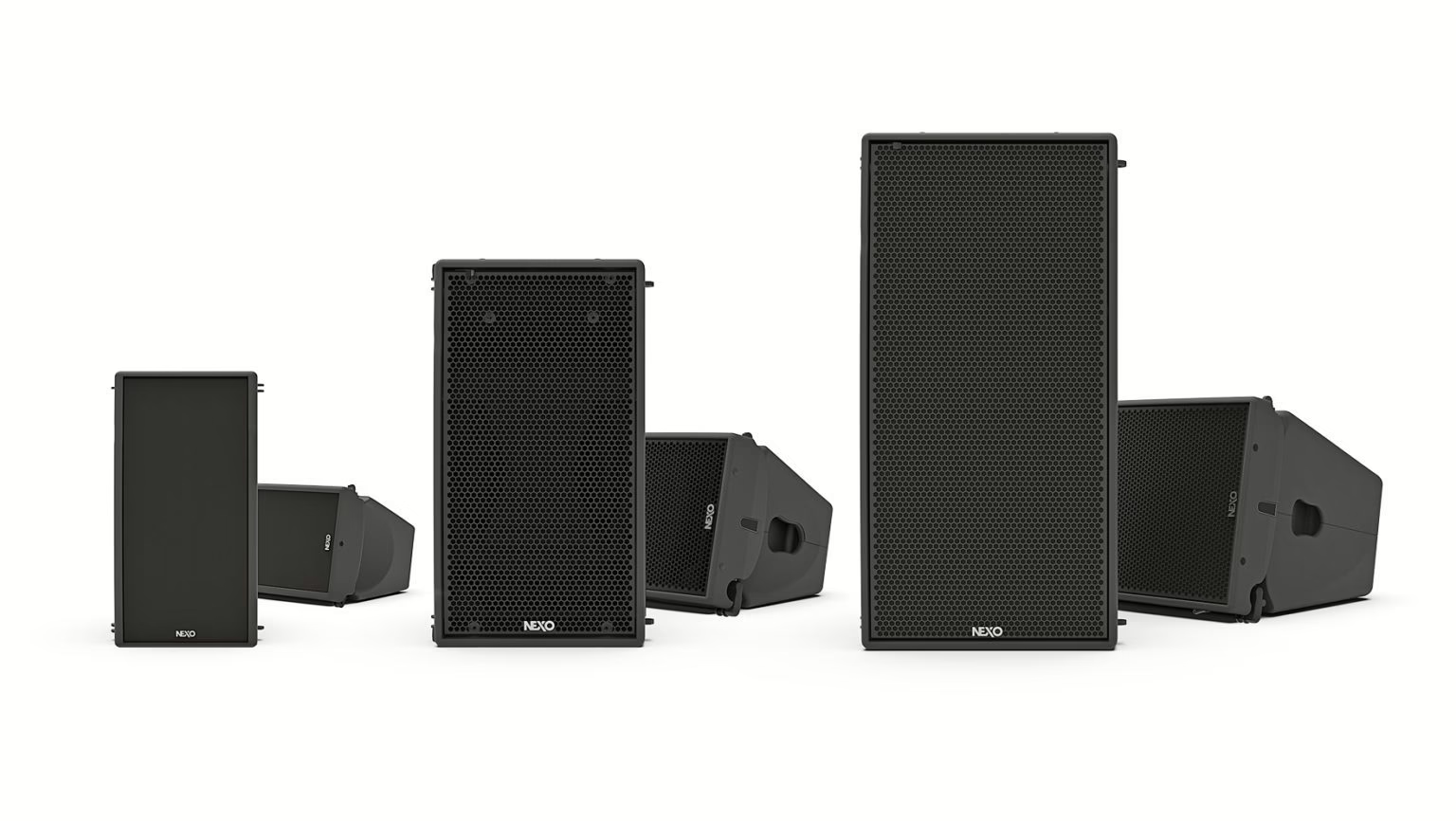
Front-fills are the most cost-effective fills. Placed at the stage lip, aimed at the first rows, they’re usually small full-range boxes, discreet, spread across the stage width. Their job isn’t to “make level” but to restore presence and intelligibility to an audience the mains fly over. You set them a few decibels below the main system: they should disappear, adding just enough proximity without pulling the ear toward the floor.
Two pitfalls recur. First, the count: three or four evenly spaced front-fills cover better than a pair at the ends, which leaves a hole in the center. Second, time alignment: a front-fill is much closer to the listener than the mains, so its sound arrives early. Without a compensating delay, the sound image drops to the floor and the result turns muddy. So you add a delay to re-align the front-fill with the arrival of the mains — the same principle as the rest of the system, covered in our guide to system tuning.
Out-fills, side-fills and lip-fills: widening and plugging gaps
When the room is wider than the main system’s coverage, out-fills take over on the sides. These are often point-source boxes, flown or stacked, angled into the areas the mains don’t see. Same logic as front-fills: fill a specific zone, at a coherent level, re-aligned in time. Lip-fills and in-fills handle the special cases — a very wide stage where the center lacks presence, a thrust, an awkward floor. The idea stays the same: identify the under-served zone, pick a box whose dispersion matches, and blend it in cleanly.
Delays: carrying sound to the back without pushing everything
In a long room, a festival field or a nave, you deploy delay speakers: boxes placed deep in the room that “relaunch” the level for distant zones. This is where time alignment becomes critical. Sound from the mains takes time to cover the distance; if the delay plays at the same instant as the electrical signal, it arrives well ahead of the mains for the listener beneath it, and the ear localizes the source in the wrong place. So you delay it by the time sound takes to travel from the mains to it, sometimes with a few extra milliseconds to exploit the precedence effect (Haas effect): the listener still localizes the stage while benefiting from the delay’s level. A well-set delay is inaudible as such — you simply hear the stage, louder and clearer.
Zoning the room and balancing levels
Thinking in zones changes everything. Mains, front-fills, out-fills, delays: each group covers a slice of the audience and is balanced independently. The goal is a level curve as flat as possible from one end of the room to the other, with no “hot spot” in front of the system and no dead zone at the back. That means separate sends on the console — subgroups or dedicated matrix outputs — to adjust each zone without touching the others. The low end deserves the same care: a cardioid subwoofer setup keeps the bass off the stage and out of the front-fill zone.
Too much fill level is the most common fault. A front-fill or delay you “hear” as a distinct source is mis-set: it should support, not double. When in doubt, turn it down. Manufacturer prediction tools, like ArrayCalc from d&b audiotechnik, help visualize coverage and decide where a fill is truly needed before you hang anything.
Aligning in time: the common thread
Everything above rests on one principle: every fill source is closer to or farther from the mains for a given listener, so its arrival must be re-aligned. Microphone measurement, distance calculation, critical listening: the three complement each other. A perfectly chosen fill system that isn’t aligned will sound blurry, with comb filtering in the overlap zones. Conversely, modest but well-aligned fills turn a difficult room into even coverage. And as always in live sound, the cleaner the coverage, the less you push — which also helps preserve gain before feedback and the system’s overall stability.
My take
Fills are the thing you skimp on when time runs short, and the thing that separates “it works” from “it’s good everywhere.” Three discreet, properly delayed front-fills change the front-row experience more than an hour spent fine-tuning the mains EQ. The right reflex fits in a sentence: cover first, raise the level second. A room where every zone gets its own source, aligned in time and balanced just right, mixes itself — and the audience hears only one thing: the show, the same everywhere.