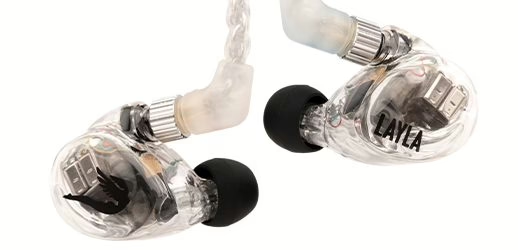
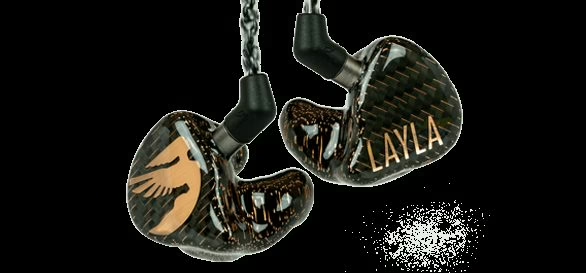
Jerry Harvey invented the custom in-ear monitor in the late 1990s; three decades on, his company is running the process in reverse. JH Audio is opening its flagship line, until now reserved for custom-moulded shells, to a universal fit that drops into any ear with no impressions required. The Layla, the catalog’s reference since 2015, is the headline act.
Twelve drivers per ear, no less
Each shell packs twelve balanced-armature drivers split into three banks of four: four for the lows, four for the mids, four for the highs. A fourth-order passive crossover splits them, for a stated 10 Hz–23 kHz response. On paper and in the ear, the goal is surgical precision: deep, controlled bass, detailed mids, extended highs with no harshness. A 20-ohm impedance, roughly 117 dB sensitivity and up to -26 dB of passive isolation mean you can hold a loud stage without pushing levels.
Bass at your fingertips
The Layla’s signature trick is the variable bass attenuator built into the detachable four-pin cable: a dial that adds up to 10 dB at the bottom without touching the rest of the response. In practice, the same IEM moves from a neutral, analytical control mix to a bass-rich stage monitor depending on the song or instrument. FreqPhase technology, with its triple-bore waveguides, time-aligns lows, mids and highs so they reach the ear in phase — that’s what gives the brand its famously stable, coherent image.
Universal doesn’t mean cut-price
Going universal removes the ear impressions and the custom build time, but keeps the architecture and tuning of the custom versions. You still get the silver-plated Litz cable, a shell in clear or black, and the same voicing philosophy. Budget around €1,900: this is unapologetic high end, built for stage monitoring, studio production and critical listening. To place the Layla in today’s field, our round-up of the best in-ear monitors for the stage in 2026 maps it all out, from budget to custom. And if you’re weighing the switch, see our piece on when ear monitors improve stage monitoring. The range lives on the JH Audio site.
My take
Making the Layla available without moulds removes the main barrier to the very top of the IEM market: no trip to an audiologist before you can even try it. The bass attenuator is still the brand’s smartest idea, because it settles the endless neutral-versus-hyped debate with a single dial. The price, of course, keeps the Layla out of reach for a lot of players. But for a singer or instrumentalist who lives on stage and wants one IEM that can double for mixing, universal fit removes the last excuse not to make the jump.
Frequently asked questions
How does it differ from the custom Layla?
The electronics, the twelve drivers and the tuning are identical. The universal version uses interchangeable tips instead of a shell moulded to your ear: no impressions, immediate availability, in exchange for slightly less personalized isolation and fit.
What does the bass dial do?
It adds up to 10 dB at the low end without changing the mids or highs. You move from a neutral response, ideal for judging a mix, to a fuller stage monitor as the moment demands.
What cable and connector does it use?
A detachable silver-plated Litz cable with a four-pin connector, which is where the bass attenuator lives. Because the cable is removable, it can be replaced when it wears — the usual weak point of stage IEMs.
Who is it for?
Demanding stage monitoring, studio production and critical listening. The twelve drivers and up to -26 dB of isolation clearly target professionals who spend long hours with IEMs in.