In-ear monitors have been presented for twenty years as the natural evolution of stage monitoring. They solve real problems — stage volume, gain before feedback, consistency from one night to the next — and they create others that no brochure mentions. So the question is not whether they beat a wedge, but for whom, on which stage, and under what conditions.
- The decision is taken position by position, never for the whole band at once.
- In-ears win when stage volume is the main problem, or when consistency is critical.
- Wedges stay ahead when a musician needs to feel the room, and for line-ups that change constantly.
- A successful switch costs two extra console inputs: the ambience microphones.
- Transition happens gradually, one position at a time, never overnight across a whole stage.
The problem each system solves, and its price
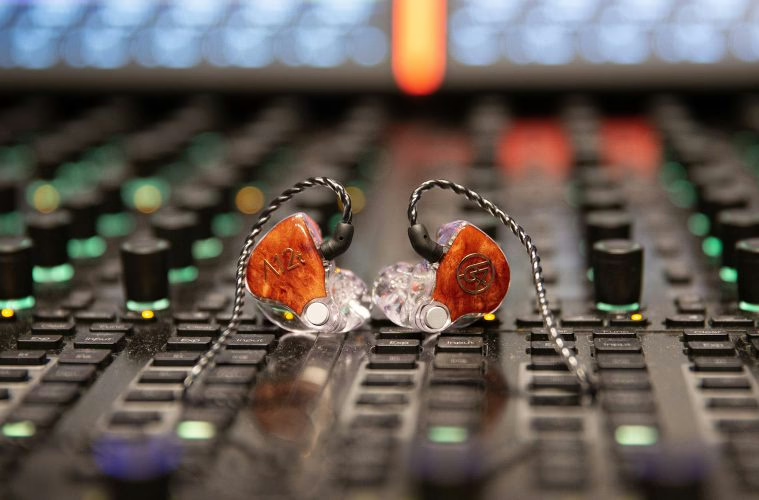
The two do not compete on quality but on the nature of the problem they address. A wedge projects sound into a shared space: simple, immediate, but it adds level to the stage and it rings. An in-ear delivers sound straight to the ear canal: it removes the feedback loop and the shared volume, but it isolates.
| Topic | Wedge | In-ears |
|---|---|---|
| Stage volume | Increases it | Almost eliminates it |
| Feedback | Permanent limiting factor | Non-existent |
| Consistency between venues | Poor, venue-dependent | Excellent |
| Contact with the room | Natural | Lost, has to be rebuilt |
| Setup time | Immediate | Frequency plan required |
| Cost per musician | Moderate | High, especially wireless |
| Hearing risk | Diffuse, tied to stage level | Direct, hence the mandatory limiter |
| Comfort for a musician who moves | Limited to the wedge’s coverage | Total, wireless |
Where in-ears clearly win
The first case is the crowded stage. When six wedges are running at once, each one throws sound into everybody else’s microphones and headroom collapses for the whole band. Moving the hungriest positions to in-ears immediately hands headroom back to those still on wedges — a collective gain, not just an individual one.
The second is the singer who needs consistency. A voice is steered by ear, and a singer who hears themselves differently every night sings differently, usually too hard. In-ears give them exactly the same environment in a village hall and in a theatre — probably the single most solid benefit of the whole technology.
The third is synchronisation. The moment a click, a sequence or backing tracks enter the show, the question is settled: they cannot come out of a wedge. The fourth is mobility: a singer who works the whole stage leaves their wedge’s coverage by the third step.
Where the wedge stays ahead
This is the part you rarely read. A drummer and a bass player play with their body as much as with their ears: the physical pressure of a wedge or a drum fill gives them information that in-ears do not reproduce, however good. Plenty of rhythm sections keep a wedge or a stage sub alongside their in-ears, and that is not a step backwards.
Line-ups that change constantly — shared bills, band competitions, multiple support acts — sit badly with in-ears: changeover time allows neither mix setting nor tip distribution, and hygiene becomes a genuine issue. A wedge stage reconfigures in three minutes.
Finally, the musician who refuses to lose the room has a legitimate argument, not a whim. Contact with the audience is part of the performance, and an in-ear system without ambience microphones removes it outright. Which brings us to the decisive point.
The two inputs that decide whether it works
A move to in-ears almost always fails for the same reason, and it is not technical: the musician ends up shut in. Cut off from the room, from the audience, from the breathing of the show. They pull one earpiece out, lose their balance, and conclude the system does not work.
The fix costs two console inputs: a pair of ambience microphones pointed at the room, blended discreetly into every mix. It sounds trivial and it changes everything — it restores the applause, the room’s reverberation, the sense of being somewhere. Add a genuine stereo image rather than duplicated mono and you have turned an adequate system into one musicians agree to keep.
The transition that succeeds is the one made gradually and from the top: equip the singer first, since they gain the most, and keep the rest of the stage on wedges. The band sees the benefit without going through a total upheaval, and the remaining positions convert of their own accord over subsequent shows. Equipping an entire stage the day before a gig produces the same result every time: a disoriented band, a difficult night, and a system that goes back in its case.
The costs to plan for
Three items are consistently underestimated. Stereo mixes consume two buses per musician where a wedge takes one: a console with eight auxiliaries that used to cover a whole stage now equips four people. Ear tips decide the final result — a badly sealed in-ear loses all the bass, and the wearer turns the volume up to compensate, which is exactly the risk you were trying to avoid. And the frequency plan, on wireless systems, adds a preparation step to every date.
One note on budget: equipping fixed positions with wired packs costs three times less and removes half the failure modes. A drummer, a keyboard player, a backing vocalist at a mic stand have no need for mobility. Reserve the wireless side for those who genuinely move — which, on most stages, is one or two people.
For those staying on wedges, winning headroom is a matter of correction and geometry, and building the blends themselves is covered in our guide to mixing stage monitors for a band. On the wiring side, our guide to connecting a stage monitor to a mixing console covers the signal path, which is identical for an in-ear transmitter.
Frequently asked questions
Should the whole band be equipped, or only some positions?
Position by position, and gradually. The singer first — they get the clearest benefit. Mixed configurations, with the singer on in-ears and the rhythm section on wedges, are the norm rather than an awkward compromise.
Do in-ears really eliminate feedback?
For the positions concerned, yes, completely: there is no longer an acoustic loop between the microphone and a loudspeaker. As long as one wedge remains on stage, feedback remains possible for whoever uses it.
Is a drummer better off on in-ears?
It depends on how they play. If they play to a click, yes, without hesitation. Otherwise many drummers prefer to keep physical pressure — a drum fill or a stage sub — alongside their in-ears, because they play with their body as much as their ears.
Can consumer earphones be used to start with?
For a trial, yes. In service, no: passive isolation is insufficient, which drives the volume up, and the non-detachable cable breaks at the first snag. A detachable connector is the real dividing line for stage gear.
How many buses does the console need?
Two per musician in stereo, one in mono. That constraint limits a move to in-ears far more often than the equipment budget does — and it is the first number to check before buying anything. Our guide to choosing your mixing console covers how to count them properly.