One wireless mic, two wireless mics: you plug in the supplied antennas and all is well. But the moment a production lines up six, twelve or twenty wireless links, stacking antennas on the back of every receiver turns into a headache — clutter, a forest of antennas interfering with each other, unreadable cabling. Antenna distribution is the clean answer, and it’s a field skill every sound engineer handling wireless needs to own.
Why distribute instead of multiplying antennas
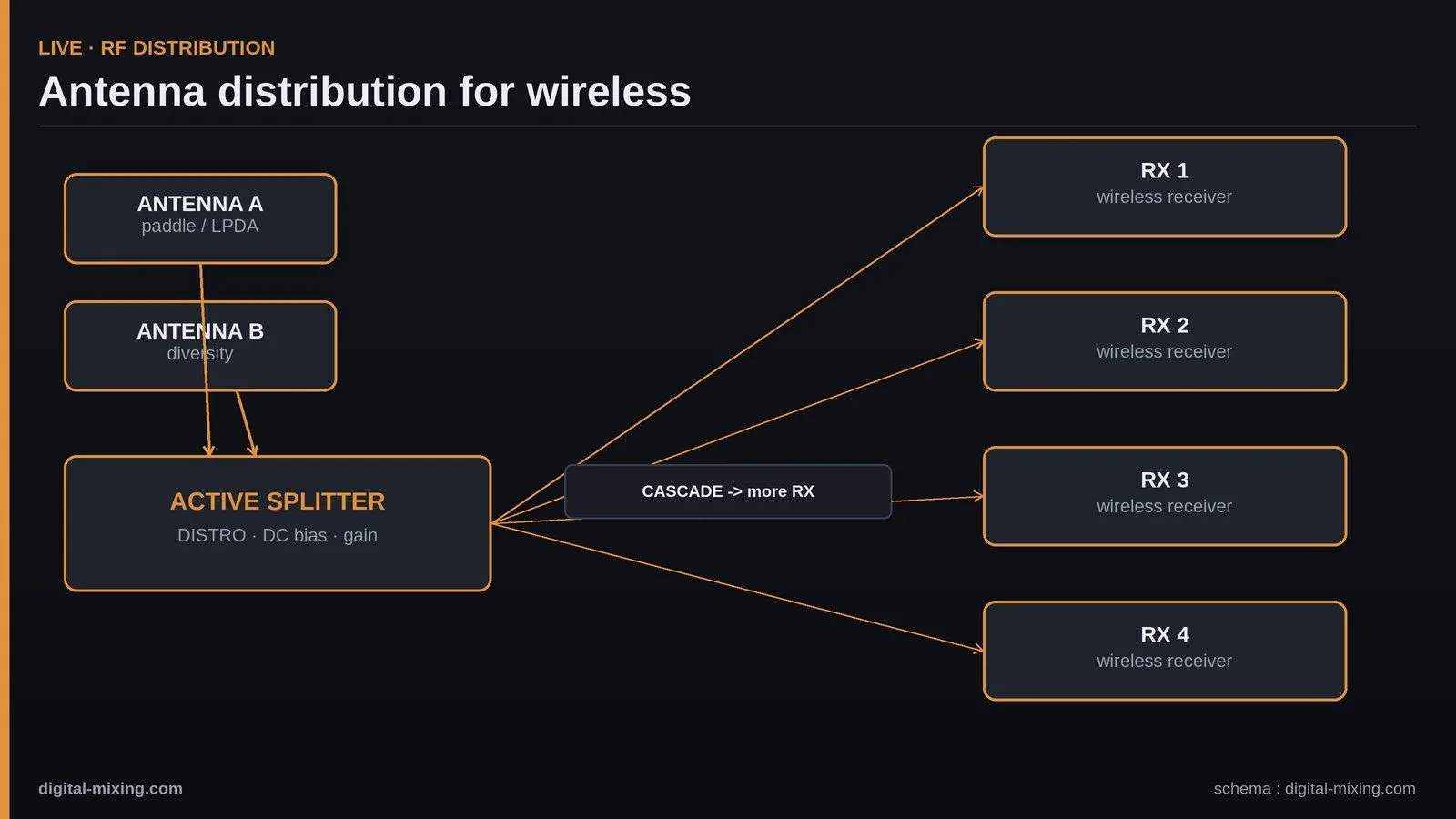
The basic idea is simple: instead of a pair of antennas per receiver, you install a single pair for the whole rack and split the captured signal out to every receiver. You win on all fronts: fewer antennas to place, controlled radiation, and above all you avoid the interaction between antennas crammed together, which degrades reception and complicates RF frequency coordination.
The antenna pair itself serves another purpose: diversity. Two spaced antennas receive the same transmitter from slightly different angles; the receiver constantly picks the better of the two, which limits dropouts as the performer moves.
The active splitter, heart of the system
The key piece is an active splitter (or antenna distributor). It’s not a plain passive splitter: it contains an amplification stage that offsets the insertion losses you get whenever you split a signal to four, eight receivers or more. A good distributor offers unity gain — it gives back exactly what it took — across a wide frequency range.
A second, often decisive function: most distributors power the receivers over the coax with DC (the familiar DC bias), doing away with individual wall-warts. And when the number of links exceeds a single unit’s capacity, you cascade several distributors off the same antenna pair.
Choosing your antennas
Three main families cover most needs:
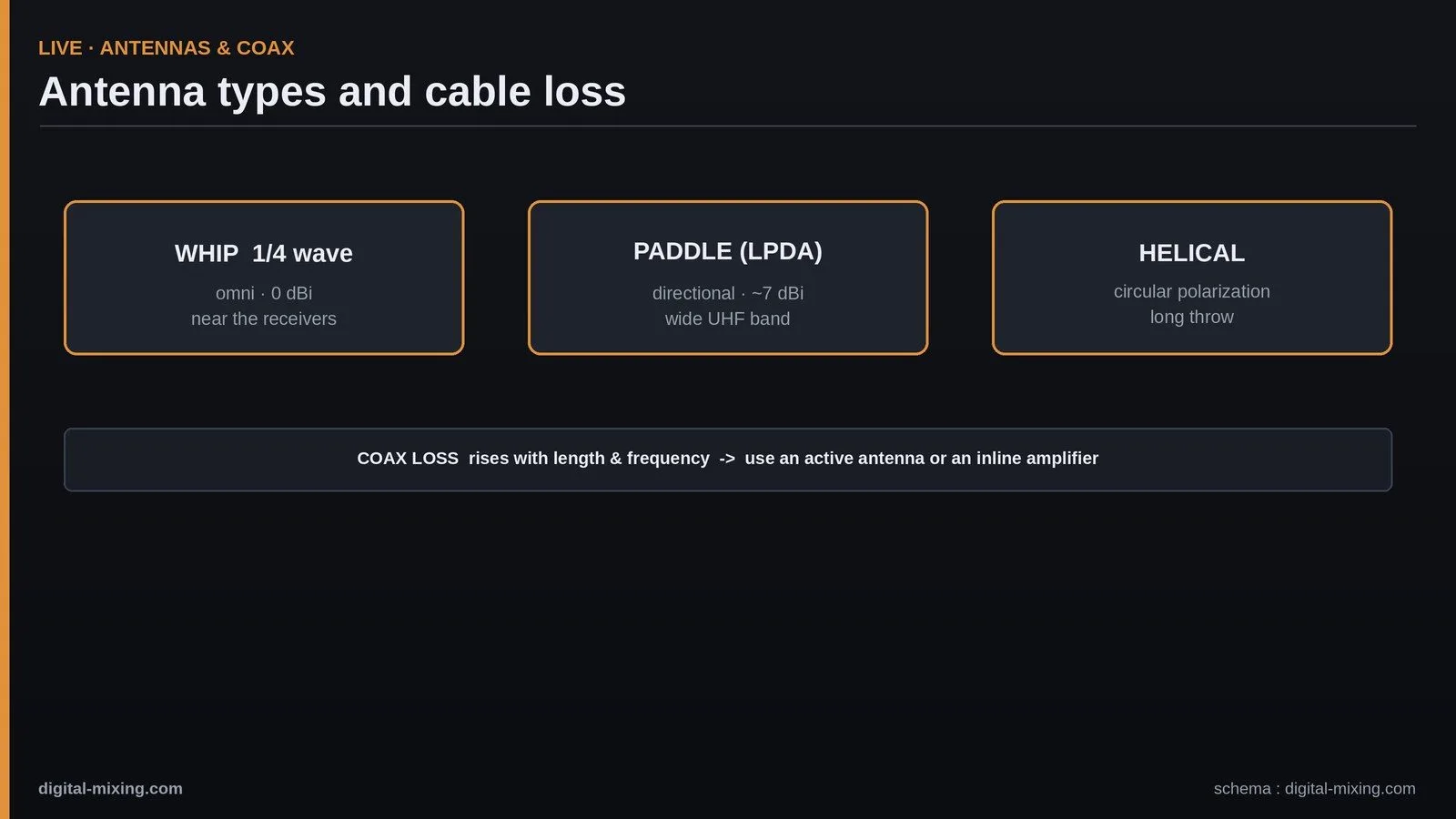
- The quarter-wave whip: omnidirectional, no gain, fine right on the receiver for a small setup, but to be avoided for remote distribution.
- The directional paddle (LPDA): it picks up within a cone, with useful gain, and rejects what comes from behind. The default choice as soon as you move antennas out toward the stage.
- The helical antenna: circular polarization and long throw, valuable on big stages or when transmitter orientation varies a lot.
Placement matters as much as the model: keep antennas in the clear, mount them high, in direct line of sight to the stage, and well away from LED walls, screens and switch-mode supplies that pollute the spectrum.
Coax, the link people underestimate
Between antenna and distributor, coax introduces a loss that grows with length and with frequency. Thin RG58-type cable is acceptable over a few metres; beyond that you need low-loss coax (LMR type or equivalent) or you’ll watch range collapse at the top of the UHF band.
Two fixes: the active antenna, which amplifies right at the cable head, or the inline amplifier placed ahead of the distributor. Be careful not to over-amplify, though: too much gain raises the noise floor and overloads the input stage. Good practice is to offset losses, not over-compensate them.
In-ears: combine rather than split
The logic flips for wireless monitoring. There, several IEM transmitters must feed a single antenna: you use not a splitter but a combiner, which sums the transmissions while limiting intermodulation between transmitters. Golden rule on a mixed stage: physically separate the receive (mic) and transmit (ear) antennas, so IEM transmitters don’t swamp the mic receivers. You then pick your systems with that coexistence in mind — something we detail in our roundup of the best wireless mic systems for the stage.
It all fits into a wider rack prep, alongside patch and stageboxes and choosing the right live vocal mic.
Prepping the RF rack: pitfalls to avoid
A few habits head off most of the trouble. First, check that the distributor’s frequency range actually covers the receivers’: a distributor built for one band won’t pass another cleanly. Keep the coax runs between antennas and rack identical in length and as short as possible, so diversity works under good conditions. Avoid running antenna cables alongside multicores and power feeds, a source of interference. Finally, scan the spectrum on site once the system is up: a venue’s RF environment when empty is nothing like it is once it’s full of phones and lighting in use.
On sizing, a four-way distributor covers a small band; beyond that, you cascade or move to a larger chassis. Better to leave headroom than to max out a unit at the last minute, the night before a run of dates.
My take
Antenna distribution is the job you improvise once and never let go of afterwards. The day you swap a forest of whips for a clean pair of paddles and an active distributor, the dropouts vanish and the rack breathes. The real trap isn’t the hardware, it’s the cable: a good distributor behind thirty metres of cheap coax will save nothing. Sort the coax and the placement before you think about gain, and a twenty-link rack becomes a quiet evening.