On stage, a vocal mic isn’t judged by its spec sheet but by what it forgives. In the studio you chase detail and transparency in a treated, quiet room. Out front and on the monitors you’re after something else entirely: a mic that rejects what you don’t want, shrugs off a moving hand and a singer cupping the grille, and holds up against drum bleed three feet away and a PA pushing hard. The finest studio mic in the world can be unusable on stage. Here’s how to make the call.
Why a stage mic is nothing like a studio mic
A live vocal mic works in the middle of the noise. It picks up a voice a few millimetres away, but also everything around it: the monitors, the drums, the amps, the PA bouncing off the walls. Three constraints dominate and rank everything else.
- Gain before feedback. The headroom you have before the system starts to ring. A mic that rejects sources other than the mouth hands you more usable level.
- Bleed rejection. The less the mic hears the kit and nearby instruments, the cleaner the vocal and the easier the mix.
- Mechanical toughness. Drops, handling, humidity, transport: a stage mic has to survive a whole tour without flinching.
Until those three are sorted, the mic’s “colour” is a living-room debate. A gorgeous tone that feeds back at half volume is worthless.
Dynamic vs condenser: the real match-up
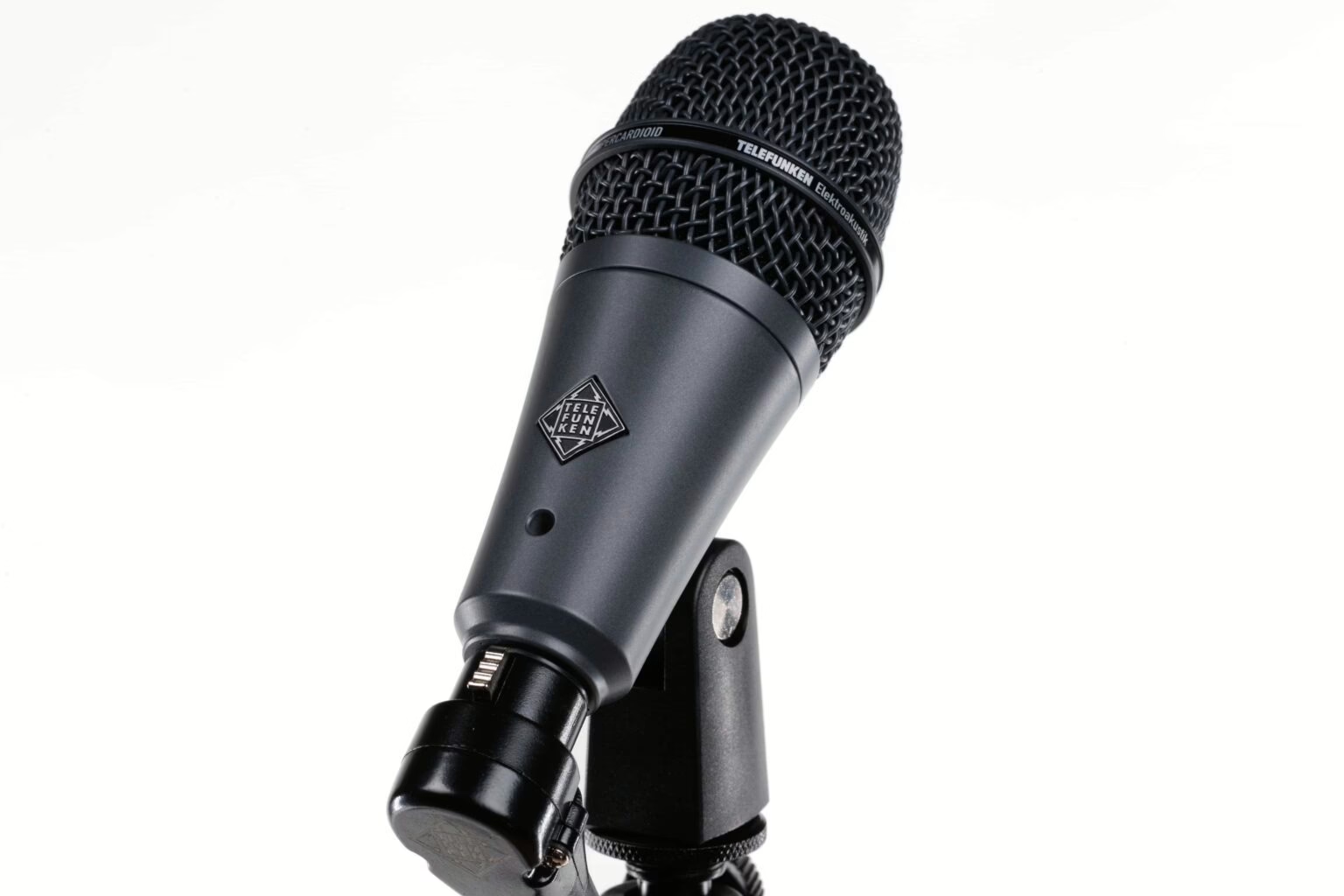
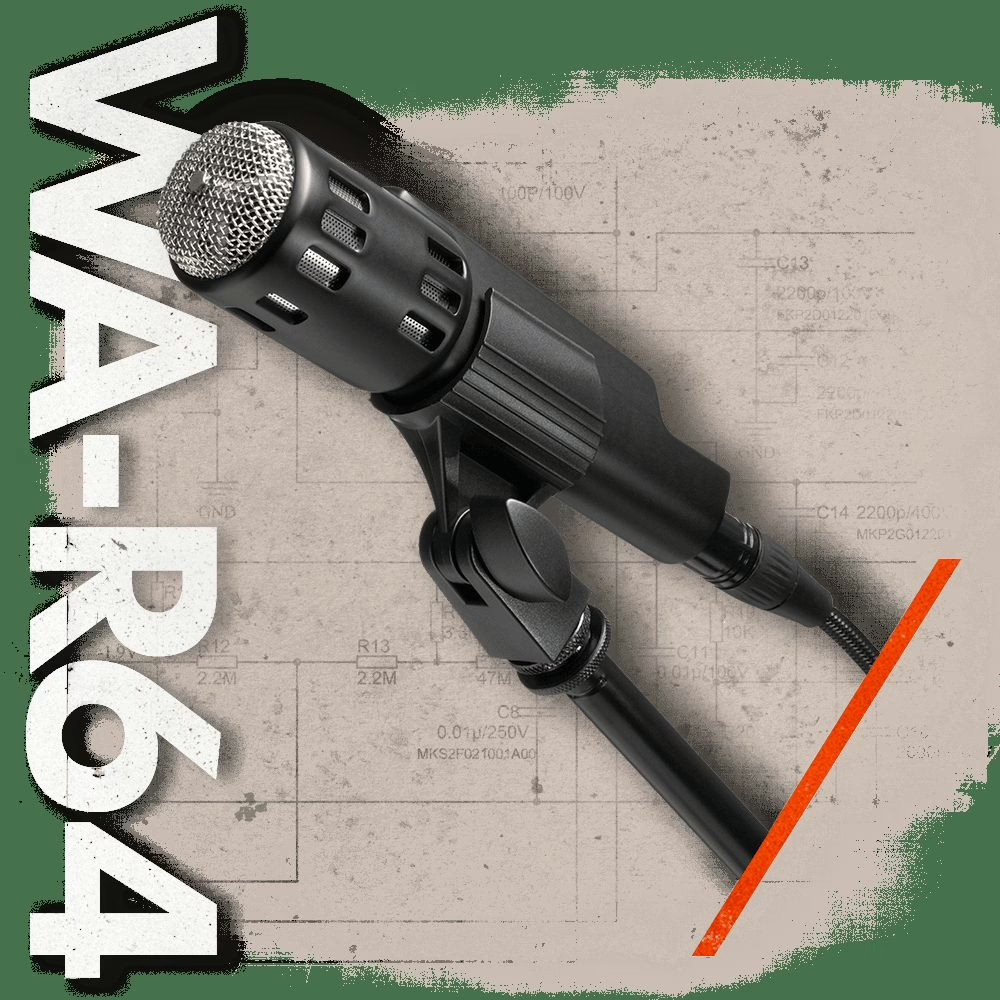
The dynamic mic is still the stage-vocal standard, and for good reasons. Its heavier diaphragm is less sensitive: it mostly captures what’s loud and close — the singer’s mouth — and far less of the room. It handles very high sound-pressure levels without distorting, survives knocks, doesn’t mind stage humidity and needs no power. It’s the tool that forgives. Recent stage releases make the point: both the TELEFUNKEN M81-SH and the Warm Audio Retro 64 build on a dynamic capsule engineered for ruggedness and control first.
The condenser plays a different game. Its very light diaphragm reacts to the slightest detail: the top end is more open, the dynamics finer, the voice more “present.” The flip side is immediate — it also hears everything else far better. On a loud, busy stage that sensitivity works against you: more bleed, less gain before feedback, more care needed on monitor placement. A stage condenser shines when the environment is controlled: quiet stages, in-ear monitoring rather than wedges, singers who own their mic distance.
The ribbon mic remains a stage curiosity: superb tone, but mechanical fragility and low output make it a niche pick for tightly controlled setups. For the vast majority of live vocals, the match-up is dynamic versus condenser.
| Criterion | Dynamic | Stage condenser |
|---|---|---|
| Gain before feedback | High | More limited |
| Bleed rejection | Good | Average |
| Detail and top end | Fair to good | Excellent |
| Mechanical toughness | Excellent | Handle with care |
| Power | None | 48 V phantom required |
| Home turf | Any stage, loud and busy included | Controlled stages, in-ear |
Polar pattern: the setting that changes everything
Before the dynamic-versus-condenser question, the polar pattern decides half of your stage sound. It describes where the mic accepts sound from and, crucially, where it refuses it.
- Cardioid. Picks up the front, rejects the rear. The versatile classic. Its point of maximum rejection sits directly behind the mic, so the wedge belongs on that rear axis.
- Supercardioid and hypercardioid. Tighter at the sides, they reject more of the stage and raise gain before feedback. But watch out: they reopen a small pickup lobe at the rear. The wedge no longer sits dead-centre behind the mic but slightly off, in the true rejection angle (often around 120 to 150°).
That detail explains half of all “unexplained” feedback: you swap a cardioid for a supercardioid, leave the wedge where it was, and drop straight into the rear lobe. Pattern choice and monitor placement are inseparable — which is why setting monitor level and EQ is planned alongside the mic, and why moving to in-ear monitoring rewrites the whole equation by taking the wedge out of it.
Feedback, bleed and proximity effect: the real-world traps
Three phenomena show up at every soundcheck. Knowing them buys you time and level.
Proximity effect. Every directional mic boosts the low end as the source moves closer. A singer cupping the grille gets a bigger, boomier voice than at five centimetres. It’s neither a fault nor a feature — it’s a tool. Use it to thicken a thin voice; tame it with a high-pass filter or EQ when the voice turns muddy. The mistake is fixing it in the mix without realising the mic distance was moving through the song.
Mic technique. The best capsule won’t save a hand wrapped around the grille — a move that, on a cardioid, destroys the pattern and turns the mic into a feedback magnet. Part of a stage mic’s “good sound” is simply how the artist holds it.
The whole-system trade-off. Gain before feedback depends on the mic, but also on the pattern, monitor placement, system tuning and room acoustics. Swapping the mic without touching the rest fixes one variable only. It’s a system, not an isolated component.
Toughness, reliability and touring details
A stage mic spends its life being grabbed, dropped onto stands and packed away damp. A few things make the difference over time: a rugged grille that’s easy to remove for cleaning (hygiene matters when several artists share one mic), an internal capsule shockmount that curbs handling noise, and a body that won’t roll off a table or slip from the hand. On connectivity, no need to overthink it: a solid XLR and a serious cable (Mogami, Canare, Klotz) are more than enough — the real issue is the solder joints and flex points, not some overpriced “audiophile” cable.
Then there’s wired versus wireless. Wired removes a variable (no frequency coordination, no batteries), and for a fixed vocal on a stand it’s unbeatable for simplicity. Wireless earns its place the moment the artist moves, but it adds a chain — transmitter, receiver, frequency coordination — whose reliability has to be flawless. Many stage series come as both a wired capsule and an interchangeable wireless head, so you keep the same voicing on either side.
My front-of-house take
After years of stages, gigs and festivals, my instinct stays simple: on a stage I don’t fully control — which is nearly all of them — I reach for a solid cardioid or supercardioid dynamic, full stop. It forgives the surprises, takes everything and lets me focus on the mix instead of hunting feedback. I keep the condenser for setups where I own the environment: quiet stage, in-ear monitors, an artist with reliable mic distance. That’s where it delivers what it promises.
And I’m wary of the opposite reflex, the common one: believing a pricier or more “detailed” mic will rescue a voice. On stage, 80% of the result comes down to placement, a pattern chosen in step with the monitors, and clean gain structure. The mic matters — but it comes after the method, not before it. Pick it for what it refuses to hear as much as for what it captures, and you’ve already solved the hard part.