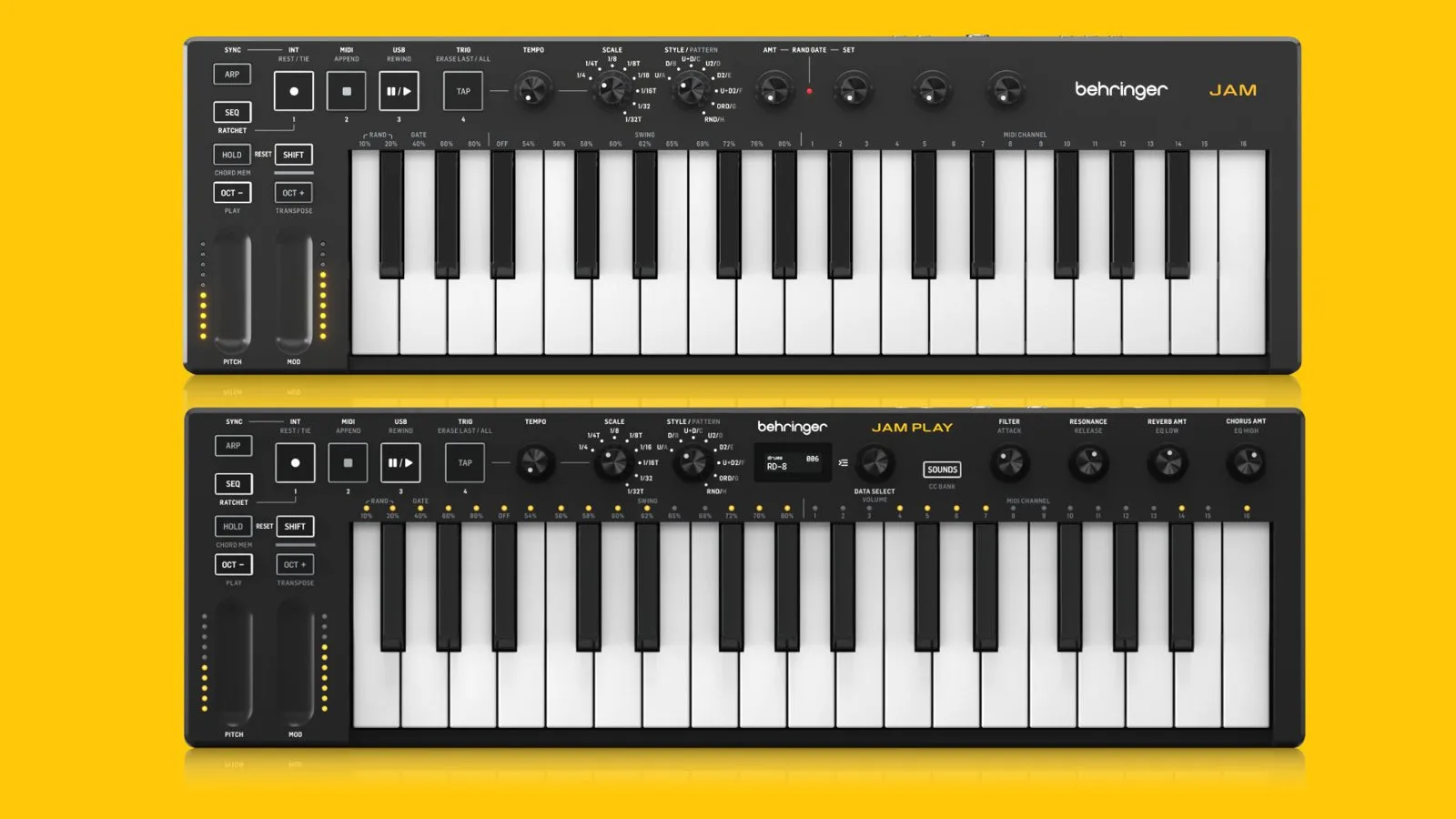
Behringer keeps mapping every corner of the compact keyboard market. After the first-generation Swing and Jam, the brand has announced two new keyboard sequencers clearly inspired by Arturia’s Keystep range: the Jam and the Jam Play. The difference comes down to one word: the Jam Play has sounds on board, the Jam doesn’t.
A well-stocked common core
Both models share the same chassis and the same logic. You get 32 mini keys with velocity and aftertouch, a 64-step sequencer handling up to 8-note polyphony, with rests, ties and legato. An 8-mode arpeggiator and a chord mode of up to 16 notes round out the creative toolkit.
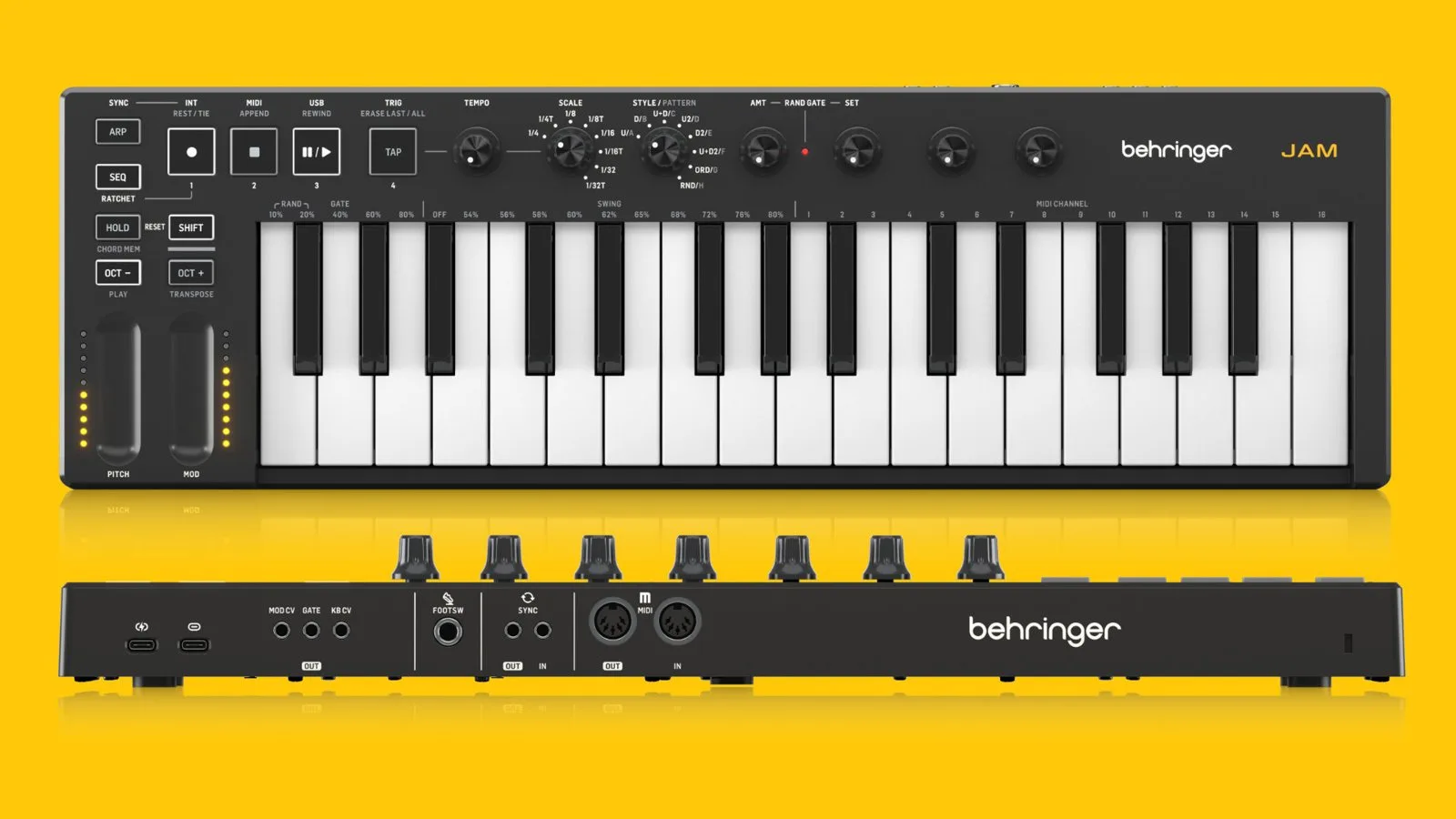
For control, four assignable endless rotary MIDI encoders and touch strips for pitch and modulation replace the usual wheels. The connectivity is generous for the category: 5-pin DIN MIDI In/Out, sync in/out, a footswitch input, CV keyboard / gate / modulation outputs to drive an analogue synth or a modular, and two USB-C ports. Enough to put these keyboards at the centre of a small hybrid setup.
Jam or Jam Play: the question of sounds
The Jam is a pure controller-sequencer: no sound engine, it drives your hardware and software instruments. The Jam Play adds a sound source: 128 instruments (piano, organ…) and drum sounds, shaped through eight parameters — low-cut filter, resonance, reverb amount, chorus amount, an attack-release envelope and low and high EQ settings. It logically adds a 3.5mm stereo audio output and a display.
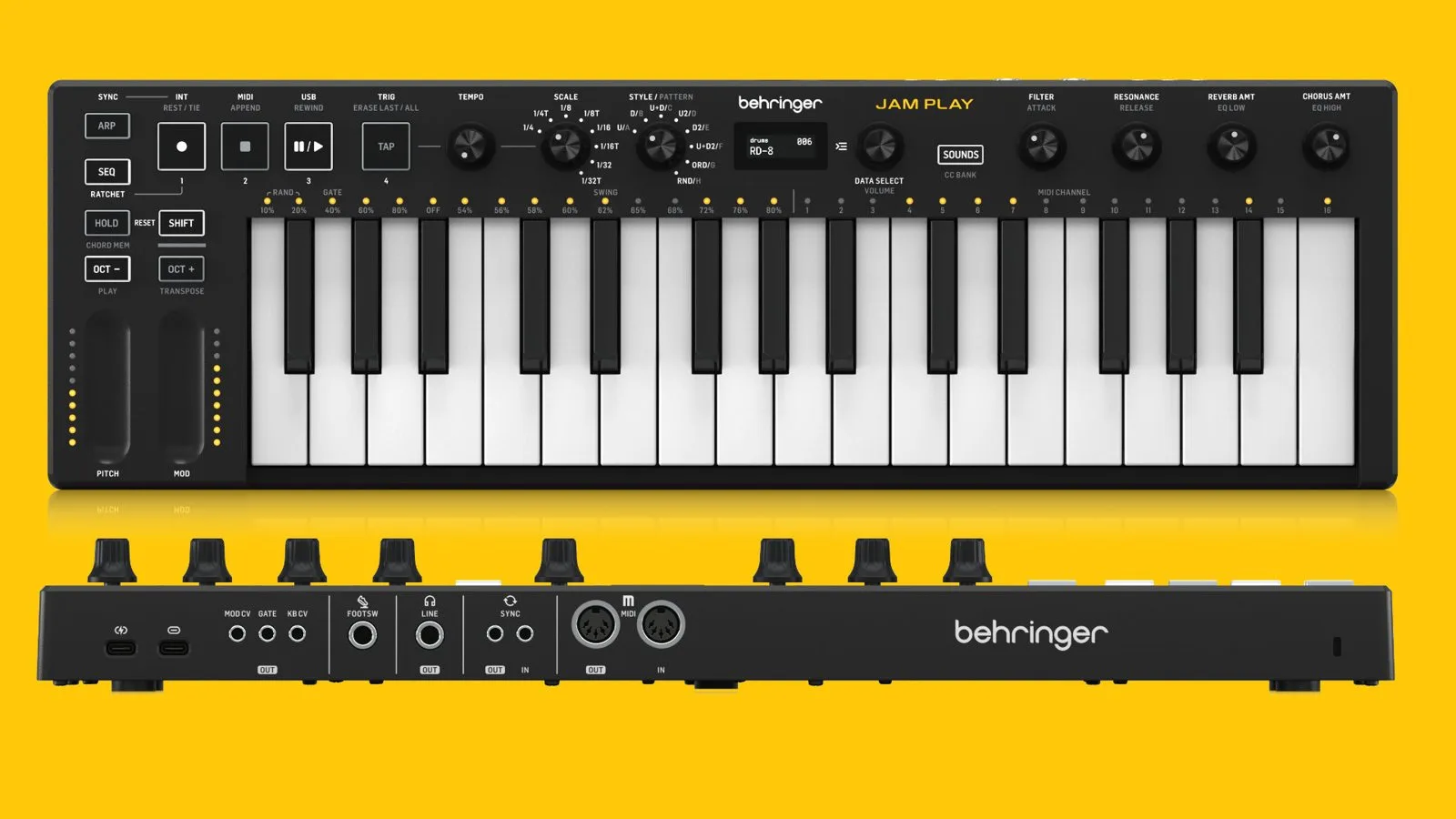
So the Jam Play is a small standalone keyboard that can make sound without a computer — handy for sketching an idea on the train or without patching everything in. The leaner Jam is aimed at those who already have their sources and mainly want a good sequencer with CV outputs. To understand what those outputs really allow, our MIDI and CV/Gate guide lays it out, and our look at the Novation FLpad shows another take on hands-on control.
Unapologetic hybrids
It’s hard not to see these Jams as “Frankensteps”: they borrow features from both the Keystep 32 and the Keystep 37 to make their own proposition rather than a straight clone. That’s the Behringer method, already seen with the BCR32: take a market reference, enrich it and break the price.
Speaking of which, price and availability haven’t been announced yet. That’s the great unknown of these Behringer reveals, where pricing often makes all the difference against established competition.
My take
There’s real logic in offering the same base in two versions: the pure controller for some, the standalone keyboard with sounds for others. The spec sheet is dense — 64 steps, 8 voices, chords up to 16 notes, CV/Gate, dual USB-C — and on paper the Jam ticks a lot of Keystep boxes. The Jam Play and its 128 built-in sounds clearly target the mobile musician who wants to capture an idea without a computer. It all hinges on two things missing from the announcement: the price and the quality of the mini keys, often the weak link in this format. If Behringer nails both, these are serious contenders.