A digital synth, a Eurorack module and a computer do not naturally speak the same language. To make them play together you need a translator, and two protocols have shared that job for decades: MIDI on one side, CV/Gate on the other. Understanding what sets them apart, and above all how to make them talk, is what turns a pile of gear that ignores each other into a coherent hybrid studio. Here is how it works.
Two worlds, two ways to say “play this note”
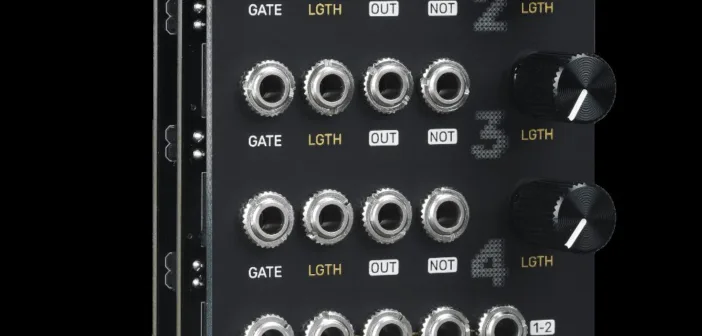
CV/Gate is the older of the two. It is an entirely analogue system, born with the first modular synthesizers. The idea is direct: an electrical voltage carries the information. A control voltage, the CV, sets the pitch; a second voltage, the gate, says when the note starts and how long it lasts. No data, no numbers: just volts rising and falling in real time, at the speed of electricity.
MIDI, which arrived in 1983, works the opposite way. It is a digital protocol: it transmits not voltage but messages. “Note 60 pressed with a velocity of 100,” “note 60 released,” “mod wheel at half travel.” A single MIDI cable carries sixteen independent channels and a wealth of information CV/Gate cannot encode: velocity, continuous controllers, program changes, the sync clock. It is a rich language, but it is a language: it has to be decoded at the far end.
CV/Gate in detail: volt per octave and gate
On almost all current gear, pitch follows the so-called volt-per-octave standard: each extra octave adds exactly one volt to the control voltage. Go up an octave, add a volt; go up a semitone, add a twelfth of a volt. It is linear, easy to reason about, and it is what lets an analogue sequencer play an oscillator in tune.
Beware, though: a few older instruments, notably of Japanese design, use another convention, hertz-per-volt, where doubling the voltage makes the octave. The two worlds are not directly compatible, and patching one into the other without conversion sounds wrong. That is the first trap of the modular world.
The gate itself comes in two variants you must not confuse. The gate proper stays high for as long as the note lasts: it opens the envelope and holds it. The trigger, by contrast, is a very short pulse that only says “start now,” carrying no duration. A drum machine sends triggers; a keyboard sends gates. Confuse the two and your envelopes will not behave as expected.
MIDI in detail: notes, controllers and clock
On the MIDI side, a note message carries three things: the channel, the note number and the velocity. Add to that continuous controller messages, the famous CCs, which drive everything else: volume, pan, mod wheel, but also any parameter a synth agrees to receive. Velocity and aftertouch open up an expressiveness CV/Gate does not encode natively.
Finally, MIDI carries a clock, the MIDI clock, which keeps several machines locked to the same tempo. It is what makes your sequencers start, stop and advance in unison. On the analogue side, synchronisation happens differently, through dedicated clock pulses or, on vintage machines, through DIN sync. Reconciling these two ways of counting time is often the real challenge of a hybrid studio.
Making the two talk: the conversion interface
The centrepiece of a hybrid studio is the MIDI-to-CV interface (and often the reverse). Its job: take the MIDI messages from your computer or keyboard and turn them into voltages your modular understands. A MIDI note becomes a volt-per-octave CV; the key press becomes a gate; the MIDI clock becomes an analogue clock pulse. Many of these interfaces also offer several assignable CV outputs, to drive parameters from MIDI CCs.
In practice, a typical chain looks like this:
- your DAW or sequencer sends MIDI (notes, clock, controllers);
- a MIDI-CV interface translates those messages into CV, gate and clock;
- the CV drives oscillator pitch, the gate fires the envelopes, the clock paces the modular sequencer;
- in return, the modular’s audio output goes back into your audio interface for recording.
The other way round, a CV-to-MIDI interface lets an analogue sequencer drive a digital instrument or record itself as MIDI into the DAW. The bridge works both ways, as long as you carefully decide who owns the clock.
The tempo question: who keeps time?
In any synced system, one machine alone must be the clock master; everything else follows. That is the golden rule, and forgetting it is the number-one cause of drift. In practice you often pick the DAW as master, because it handles tempo, meter changes and recording cleanly. The DAW then sends its MIDI clock to the interface, which redistributes it as analogue clock to the rest of the rig. If you prefer a groovebox or a hardware sequencer to lead, that works too: the point is that there is only one conductor.
The traps to know
The first, as we saw, is the volt-per-octave / hertz-per-volt confusion: always check your instruments’ convention before linking them. The second is calibration: an analogue oscillator drifts with temperature and needs tuning, and a conversion interface is calibrated to stay in tune across the whole keyboard range. A poorly calibrated modular plays out of tune in the extreme octaves, even driven by a perfect CV.
The third trap is latency: converting, routing and re-routing introduces tiny delays that, stacked up, shift one machine against the others. You compensate for them in the DAW or by adjusting the starts. Finally, remember that modern MIDI is no longer confined to five-pin DIN sockets: USB carries MIDI, and a good share of your keyboards and controllers now talk directly over it.
Why it is worth the trouble
You might think, in an all-digital age, that CV/Gate is a relic. It is not, and the Eurorack revival proves it. I lived the shift from analogue to computer-based music from the inside, and my conviction is simple: digital won on production and editing, but analogue keeps its place whenever it brings something audible. A well-planned hybrid studio takes the best of both: the precision, recall and editing of digital, the texture and immediacy of the modular. MIDI and CV/Gate are not rivals; they are the two languages of one workshop, and the conversion interface is the interpreter.
In short
MIDI carries rich digital messages; CV/Gate carries analogue voltages in real time. A conversion interface bridges the two, provided you respect the volt-per-octave convention, tell gate from trigger, calibrate your oscillators and appoint a single clock master. That is the foundation on which a hybrid studio is assembled, where a module like u-he’s first all-analogue Eurorack module or a stage controller like the Doepfer A-198-2 ribbon sits naturally alongside the computer. Once you master that bridge, everything connects, and the principles of subtractive synthesis apply on both sides of the cable.